Small-worktop roasters
You want to roast sweet potatoes without giving over most of the counter to an appliance. Check its width, depth and height alongside the ventilation clearance required by its own instructions.


Choose a mini oven only after checking that its external dimensions and required ventilation space fit your usable worktop; litre capacity alone will not tell you whether your potatoes or roasting tray will fit. For regular sweet-potato roasting, look for temperature and timer controls suited to your recipes, then weigh extra functions against the space they take and the cleaning they may require.
You want to roast sweet potatoes without giving over most of the counter to an appliance. Check its width, depth and height alongside the ventilation clearance required by its own instructions.
You mainly want straightforward temperature and timer controls, rather than several cooking modes. Good Food’s whole sweet-potato recipe uses 180°C in a conventional oven or 160°C with a fan for 45 minutes to an hour, depending on size.
You also want to cook wedges, vegetables or other small batches. A tray that accommodates an even layer and cooking functions you will actually use may matter more to you than choosing the smallest appliance.
Start with the space the oven needs in use, then check whether its controls and tray suit whole sweet potatoes or wedges. Consider extra functions only after those essentials fit your kitchen.
| Concern | What to check | Who this matters to |
|---|---|---|
| Worktop fit and placement | Measure the usable width, depth and height, then allow for the exact model’s ventilation and surface requirements. Check internal tray dimensions separately. | If counter space is tight, I need room for the oven and its required clearance without losing the space I cook on. Roughly 46% of consumers would make worktop fit their primary concern. |
| Roasting controls | Check that the adjustable range covers your recipe’s conventional or fan temperature, and that the timer suits the cooking time you expect. | When I switch between whole potatoes and wedges, I want controls that let me follow the relevant recipe and check the food as it cooks. Around 36% of consumers would put roasting control first. |
| Functions and batch space | Consider convection, air-fry or hotplate functions only for tasks you regularly do; check that the tray accommodates the batch you intend to roast. | If I also cook wedges, vegetables or other small meals, I want those uses to justify the appliance’s space and cleaning demands. Approximately 18% of consumers would prioritise versatility. |
A 20L or 23L label does not show whether your tray, whole potatoes or an uncrowded layer of wedges will fit. Nor does it account for ventilation space around the appliance.
Compare the internal tray or rack dimensions with your intended batch, and check the oven’s external measurements and placement instructions against your worktop.
Good Food’s recipes use different temperatures and times for whole sweet potatoes and wedges. Potato size and the way the food is cut also affect when it is ready.
Choose adjustable controls, follow the recipe’s preheating directions and check tenderness and browning rather than relying on the timer alone.
Hotplates and multifunction cooking modes may broaden what an appliance can do, but they do not remove its placement requirements. Good Housekeeping also found the interior of its tested Ninja Foodi 10-in-1 Multifunction Oven tricky to clean.
Decide whether you need hob capacity or will use convection and air-fry modes regularly; compare the exact model’s size, accessories and cleaning design before choosing.
A multifunction countertop-oven option if sweet potatoes are only one of several things you plan to cook.
The SDA1608 is a 23L mini oven with dial controls for buyers considering a conventional countertop format.
The 22L 89220 offers several cooking functions for buyers who also value an interior light and removable crumb tray.
The 20L 35389 combines roasting, grilling, baking and toasting options in one mini oven.
A 20L oven-and-grill option for buyers who want basic roasting controls.
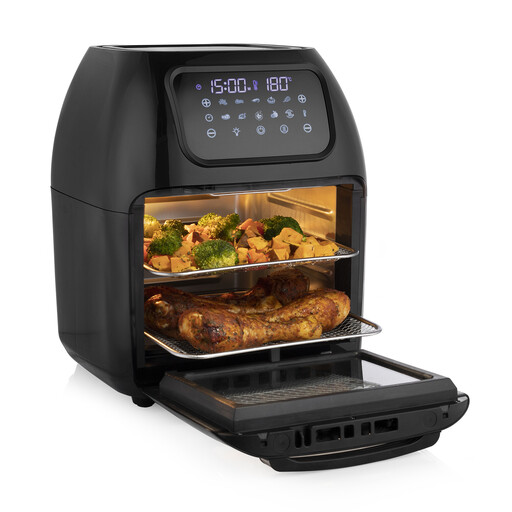
This air-fryer oven offers another countertop approach to sweet-potato roasting and other small-batch cooking. It is not a conventional mini oven, so check its worktop clearance and usable tray space against the same priorities.
 No image available
Consider this air-fryer oven if you want to roast sweet potatoes alongside other small batches and its placement requirements suit your kitchen.
It may suit a small batch, but the 20L figure alone cannot confirm that your potatoes or tray will fit. Compare the internal rack and tray dimensions with what you plan to cook, then check external size and required clearance.
Look for controls that cover the recipes you use. Good Food’s whole sweet-potato recipe uses 180°C conventional or 160°C fan for 45 minutes to an hour, depending on size; its wedge recipe uses 200°C conventional or 180°C fan for 30–40 minutes. Check tenderness rather than treating either time as a fixed result.
Follow the placement instructions for the exact model rather than applying one clearance figure to every oven. For example, the Tower T14045 instructions call for a flat, stable, heat-resistant surface and at least 20cm clearance on all sides.
Choose a tray that lets the cut pieces sit in one layer rather than piled together. Good Food’s roasted-vegetable recipe calls for an even layer and tossing halfway through; check the directions of the sweet-potato recipe you are following as well.