Occasional celebration baker
If this tart is your main reason for buying, start with the tin and rack measurements. Temperature control and a suitable rack arrangement matter more to this decision than cooking modes you may never use.


Choose a mini oven for your birthday chocolate tart only after checking that your tin, including its rim or handles, will fit level on the usable rack and pass through the door; litre capacity alone cannot establish that. Then check the recipe temperature and baking arrangement. Hotplates and extra cooking functions are worth considering if you will use them for the rest of the party meal.
If this tart is your main reason for buying, start with the tin and rack measurements. Temperature control and a suitable rack arrangement matter more to this decision than cooking modes you may never use.
If the oven will stay on your worktop for future bakes, consider its usable space, baking controls and required ventilation clearance together. A compact exterior is helpful only if the appliance fits safely where you plan to use it.
If you are preparing dishes alongside the tart, hotplates or additional oven functions may serve that wider menu. Check the tart-baking requirements separately: those extras do not establish tin fit.
Make tin fit your first pass-or-fail check, then compare baking controls, safe placement and any functions you will use beyond the tart.
| Concern | What to check | Who this matters to |
|---|---|---|
| Tart-tin fit | Measure the tin across its widest outside points, including its rim or handles. Compare that measurement with the exact model’s usable rack width, depth and door opening. | If my chosen tin cannot sit level or pass through the door, the oven cannot handle the birthday tart; around 36% of consumers put tin fit first. |
| Baking control | Check that the thermostat covers your recipe temperature and that the rack position and baking setting suit the tart. Follow the model instructions if using fan assistance. | When I am following a pastry recipe, I want a suitable temperature setting and room to position the tin away from the elements; roughly 29% of consumers prioritise baking control. |
| Worktop and electrical setup | Allow for the model’s specified clearance as well as its exterior size. Check its plug and power requirements, and do not overload an extension device. | With limited worktop space, I need a heat-resistant position and an electrical setup that can accommodate the oven; about 21% of consumers make safe placement their primary concern. |
| Wider party cooking | Decide which other dishes you will prepare and whether you would use hotplates or additional functions. Check the instructions before planning simultaneous use. | If I am cooking more than the tart, I may want the appliance to help with other dishes too; around 14% of consumers put that versatility first. |
A stated capacity does not give you the usable rack width, depth or clearance needed to insert a tart tin level.
Measure your actual tin and check the exact oven’s manual or internal-dimension drawing before ordering.
Hotplates and additional programmes may be useful for other party food, but they do not establish tart-tin fit or a suitable temperature setting.
Check fit and recipe requirements independently, then choose extra functions only if they serve your wider cooking plans.
A countertop oven also needs a stable, heat-resistant position and the surrounding space specified by its manufacturer. Electrical Safety First warns that plug-in ovens can overload an extension lead when used with other large appliances.
Read the model’s placement and electrical instructions before choosing a worktop position; do not overload or daisy-chain extension devices.
The Russell Hobbs 22780 manual calls for an initial element-curing procedure that may produce a smell or smoke, with ventilation during the process.
Read your chosen model’s first-use instructions in advance. Use oven gloves around hot surfaces and let the appliance cool before cleaning.
These examples show different countertop-oven formats; compare the exact model and your tart tin rather than relying on the brand name.
Its 22780 Mini Kitchen combines an oven and double hotplates for buyers who expect to cook more than the tart.
Tower lists dial-controlled mini ovens at different stated capacities, including the 23-litre T14043 and 32-litre T14044.
The DT200UK is a multifunction countertop-oven option for buyers planning several kinds of cooking after the birthday event.
The Sfornatutto Chef EO34302 is another stated larger-capacity countertop-oven option to investigate.
These countertop ovens cover two ways to plan beyond the tart: an oven with hotplates for other party food, and a multifunction oven for varied cooking. For either one, check your tin and recipe against the exact model instructions before buying.
 No image available
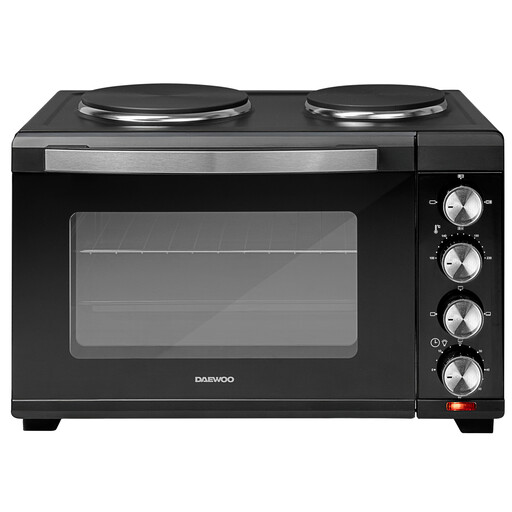
Consider this oven-and-hotplate format if you plan to prepare other party food alongside the tart.
The product name states a 32L capacity and 3000W power. Measure your tin against the exact model’s usable rack and door dimensions, and check its placement and electrical instructions before use.
 No image available
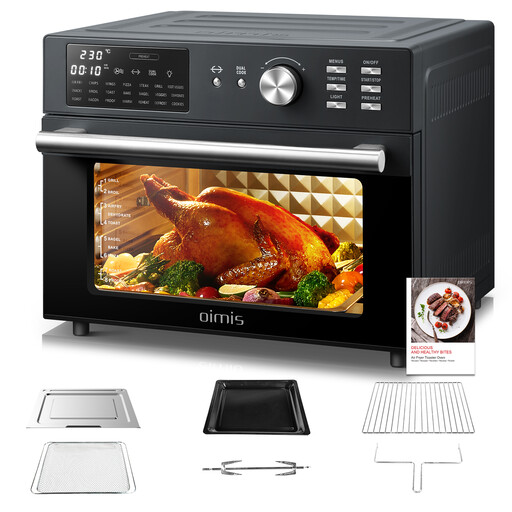
Consider this multifunction format if you expect to use the appliance for other cooking tasks as well as the tart.
The product name states 1800W power, rotisserie and dehydrator functions, and a claim that it fits a 13-inch pizza. That pizza claim does not confirm tart-tin fit: check usable rack and door dimensions, the baking temperature and the placement instructions for this model.
Measure the tin’s widest outside points, including any rim or handles, and compare them with the exact oven’s usable rack width, depth and door clearance. A stated litre capacity cannot tell you whether the tin can be inserted and supported level.
No particular heating format follows from the tart alone: start with tin fit and a temperature setting suitable for your recipe. Russell Hobbs says the fan in its 22780 distributes heat and may call for different cooking times or temperatures; follow the recipe and that model’s instructions rather than applying one adjustment to every oven.
Place it only where you can follow the exact model’s instructions for a stable, heat-resistant surface and surrounding clearance. For example, the Russell Hobbs 22780 manual specifies at least 50 mm of space around that appliance; another model may have different requirements.
Do not assume an extension lead is suitable. Electrical Safety First warns that plug-in ovens can overload one when combined with other large appliances; check the oven instructions and the extension device’s rating, and do not daisy-chain extensions.