Small-batch picnic bakers
You usually make one tray of tartlets or similar savoury bakes and want a countertop appliance for baking them before you leave.


For one small tray of tomato tartlets, choose a mini oven with baking controls suited to your recipe and a rack or tray that safely accommodates your tin; capacity in litres alone cannot establish fit. Consider a compact air-fryer mini oven for small batches, a conventional 28–30-litre format for more tray flexibility, or a larger multifunction oven if you will use its other cooking modes regularly.
You usually make one tray of tartlets or similar savoury bakes and want a countertop appliance for baking them before you leave.
You want to bake tartlets but may also use the oven for grilling, toast or larger meals, so tray space and cooking modes matter alongside its worktop footprint.
You expect to use the oven occasionally and then store it, making safe positioning, cooling and cleaning instructions especially relevant.
Choose the oven format around the batches you expect to bake, then check your tartlet tin against the usable shelf space and the controls against your recipe.
Consider it when: You normally bake one small tray and want an appliance that also offers air-frying functions. The Russell Hobbs 26680 has a 20-litre cavity and a Bake setting.
Trade-off: A 20-litre capacity does not tell you whether your tartlet tin will fit; air-frying speed claims do not establish pastry-baking results.
Consider it when: You want more nominal cavity space or a conventional oven layout. Russell Hobbs lists a 30-litre Mini Kitchen with an adjustable thermostat and baking tray; Salter documents a 28-litre oven-with-hobs format.
Trade-off: Extra litres do not establish usable tin space or even baking, and the appliance still needs room on your worktop.
Consider it when: Tartlets are one of several regular cooking tasks and you would also use modes such as roasting or pizza cooking. Ninja lists Bake among the DT200UK’s functions.
Trade-off: Additional modes are unnecessary for tartlets alone; check the appliance footprint, accessories and tin fit before choosing them.
| Concern | What to check | Who this matters to |
|---|---|---|
| Baking control and tin fit | Check for a Bake setting or adjustable thermostat that covers your recipe temperature, and confirm that the tin sits safely on the supplied rack or tray. | If I want the pastry to bake as intended, I need suitable controls and a level place for my tin. Around 50% of consumers put baking control and tin fit first. |
| Capacity and worktop space | Compare the tin’s width, depth and height with usable shelf dimensions; measure the worktop with the model’s required clearances in mind. | For one small tray, I may favour a compact footprint; for repeated batches, I need to know how much usable room I have. Around 33% of consumers prioritise space and batch flexibility. |
| Placement and cleaning | Read the exact model’s instructions for heat-resistant placement, clearance, cooling and cleaning its tray or accessories. | When I bake only occasionally, I want to position the oven safely and clean it before putting it away. Around 17% of consumers place safety and upkeep first. |
A 20-, 28- or 30-litre label cannot show whether your tartlet tin will sit level or clear the door and heating elements.
Measure the tin, including its handles, and compare it with the oven’s usable shelf dimensions before treating capacity as a deciding factor.
Manufacturer comparisons about preheating or energy use do not establish how a particular recipe will bake. Which? assesses oven performance separately from other features in its mini-oven testing.
Check for suitable baking controls and tin fit, and consult independent oven-performance results where available.
The Russell Hobbs 26680 manual calls for a stable, level, heat-resistant surface and 150 mm of space around that model.
Check the clearance specified for the oven you choose, as well as the space available on your worktop.
Salter’s guidance prohibits outdoor use of its documented oven-with-hobs model. An extension arrangement also needs to respect the appliance instructions and its electrical rating.
Plan to bake indoors unless the exact model permits your intended setting. Electrical Safety First advises against loading extension devices beyond their marked rating.
Its UK range includes both a conventional 30-litre Mini Kitchen and a compact 20-litre air-fryer mini oven.
Its documented 28-litre oven-with-hobs format is relevant if you want a conventional layout with hobs.
Its DT200UK is a larger multifunction countertop-oven option for cooks who would use modes beyond baking.
This multifunction countertop oven is a choice to consider if picnic tartlets are one of several cooking tasks. Check its baking controls and usable shelf space against your recipe and tin before deciding.
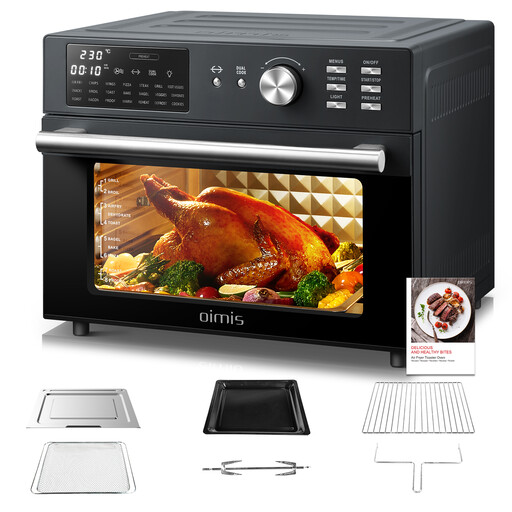 Image unavailable
Consider this multifunction oven if you also want to use its other cooking options; confirm that its controls cover your tartlet recipe and that your tin fits safely on the usable shelf.
Yes, if the model has a Bake setting, offers a temperature suitable for your recipe and holds your tin safely on its tray or rack. Check the tartlets as they cook rather than assuming the timing will match a full-size oven.
Capacity alone cannot answer that. Compare your tin’s width, depth and height, including handles, with the usable shelf space and the clearance needed to close the door safely.
Check the exact model’s instructions before planning outdoor use. Salter’s guidance prohibits outdoor use of its documented oven-with-hobs model, so baking at home before the picnic is the appropriate plan for that appliance.
Follow the exact appliance manual and check the electrical ratings before using an extension lead. Salter does not recommend one for its documented model, while Electrical Safety First advises against exceeding an extension device’s maximum current rating with the combined load.