Small bake-sale batch organisers
If several trays of wedges must come out of a limited kitchen, compare baking-pan dimensions, rack positions and worktop fit before relying on the oven’s litre capacity.


Choose a mini oven for beetroot wedges by the supplied tray’s usable dimensions and whether its temperature controls cover your recipe, rather than by cavity litres alone. Check the appliance’s footprint and required clearances if worktop space is tight; hobs are useful if you also need to prepare other food, but they do not increase roasting-tray space.
If several trays of wedges must come out of a limited kitchen, compare baking-pan dimensions, rack positions and worktop fit before relying on the oven’s litre capacity.
Integrated hobs may be useful for sauces or other food, provided the appliance still leaves enough worktop space for preparing and handling roasting trays.
Alongside the oven, plan how the food will be prepared, packed and described. The Food Standards Agency and GOV.UK say food supplied at charity or community events must be safe to eat; check the rules applicable to your event and location.
For repeated beetroot-wedge batches, establish how much fits on the supplied tray, then check kitchen fit and recipe controls before deciding whether extra hob functions earn their worktop space.
| Concern | What to check | Who this matters to |
|---|---|---|
| Usable roasting space | Compare the supplied tray’s width and depth with the amount of wedges you intend to spread in one layer. Check rack positions and whether another compatible tray is available. | If I need repeated batches for the sale, I want to know how many wedges fit on a tray without piling them up. Around 42% of consumers put usable roasting space first. |
| Worktop fit and controls | Measure the appliance space, allowing for the door and clearances specified in its manual. Check that the temperature range covers your recipe setting. | With little worktop room, I need an oven I can position safely and operate between other preparations. Worktop fit and straightforward controls come first for roughly 33% of consumers. |
| Other cooking functions | Check whether the planned menu needs hobs or other modes, and whether the appliance can be used in the sequence you require. | When I also have sauce or other food to prepare, separate hotplates could matter more to me than roasting alone. Extra cooking functions are the primary concern for about 25% of consumers. |
Cavity volume does not tell you how much tray area is available for a single layer of wedges. A tray that is too small for your planned batch means more roasting rounds.
Find the supplied tray dimensions and compare them with the amount you plan to cook; a paper template can help you picture the usable area.
Hotplates support other food preparation, but they do not enlarge the oven’s baking tray.
Choose an oven with hobs when your menu calls for them. If wedges are the main task, compare tray dimensions and the cooking controls first.
The Food Standards Agency and GOV.UK say food supplied at charity or community events must be safe to eat. How registration and allergen-information requirements apply depends on the activity and how food is supplied.
Check the official guidance for the event’s country and ask the relevant local authority about your arrangements, particularly if you will package food before sale.
A stated temperature range or cooking mode does not establish the roasting time or batch yield for your wedge thickness and tray loading.
Test the intended recipe and tray before the sale, recording how many portions each batch produces and how long your process takes.
For a compact roasting-focused option, The product information lists a 30L HOMCOM 800-167V70SR with a 34 × 28.9 cm baking pan, four rack positions and 60–230°C temperature control.
For menus that need hob cooking as well as roasting, The product information describes a Morphy Richards 28L mini oven with a fan-assisted oven and two hobs.
For a larger countertop format, De'Longhi lists the EO34302 with a 34L cavity, convection mode, a baking pan and a wire rack.
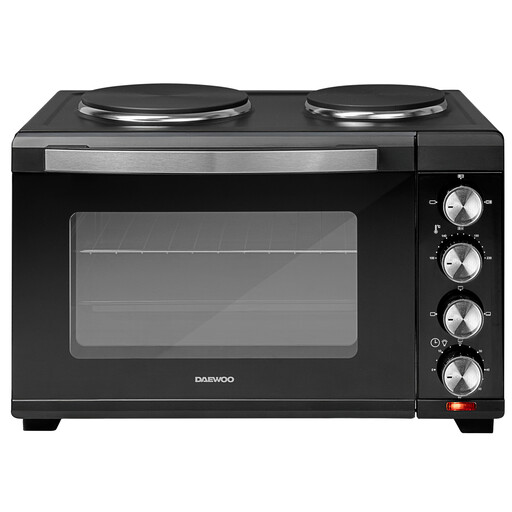
This countertop oven is relevant if your bake-sale preparation calls for hotplates as well as space to roast wedges. Check its supplied tray dimensions against the batch size you need.
 No image available
Consider this model if you need hotplates for other bake-sale food alongside an oven for the wedges.
The product name lists a 32L capacity and a 3000W rating. Confirm the supplied tray dimensions for your planned batch and follow the appliance instructions for placement and electrical setup.
No: 30L describes cavity volume, not the tray area available for wedges in one layer. The product information lists a 34 × 28.9 cm baking pan for the HOMCOM 800-167V70SR; compare the supplied pan for any oven with your planned batch, then test the recipe.
Whether registration applies depends on the event’s activities and location, so ask the relevant local authority about your arrangements. The Food Standards Agency and GOV.UK say food supplied at charity or community events must still be safe to eat.
Check the ingredients you use and how the wedges will be packed and sold before deciding what information must accompany them. Requirements depend on the activity and location; Food Standards Scotland says that when any of the 14 specified allergens are ingredients in prepacked food, their presence must be emphasised in the ingredients list.
Test your beetroot-wedge recipe using the intended tray, wedge thickness and loading level before the sale. Record the time and yield for a complete batch rather than assuming a listed thermostat range or cooking mode predicts the result.