Buffet batch cooks
If you need several trays of wedges, focus on usable tray area, rack positions and timer length. Hotplates are worth considering if sauces or sides are also part of your preparation plan.


For buffet beetroot wedges, compare the supplied tray and rack arrangement before choosing by oven capacity: a stated 42-litre cavity does not tell you how many wedges will fit in one layer. Consider a 23–25-litre oven if worktop space is the tighter constraint and you can cook in batches; choose hotplates only if you also plan to prepare sides or sauces.
If you need several trays of wedges, focus on usable tray area, rack positions and timer length. Hotplates are worth considering if sauces or sides are also part of your preparation plan.
If worktop or storage space is tight and the wedges are one part of a smaller buffet, a 23–25-litre oven is a route to consider, provided you can accommodate the batches your tray size requires.
If you will cook successive batches, compare temperature settings, timer length and any stated fan or programmable functions. Those features help you plan a cooking sequence but do not, by themselves, establish even browning.
Start with the amount you need to fit on a tray, then decide how much control and worktop space your preparation plan calls for. Integrated hotplates matter only if you will use them alongside the oven.
| Concern | What to check | Who this matters to |
|---|---|---|
| Tray fit and batch size | Compare supplied tray dimensions and rack positions with the wedges you need to spread in one layer. | If I have many wedges to prepare, I need to know what fits on each tray before planning batches; around 36% of consumers put practical batch capacity first. |
| Roasting controls | Compare the exact model’s temperature range and timer duration, plus any stated fan or oven-light function. | Cooking successive trays means I need a timing routine I can manage while preparing the rest of the buffet; repeatable control comes first for around 29% of consumers. |
| Worktop and storage space | Measure the intended location against the appliance dimensions and its model-specific ventilation clearances. | When the oven has to fit on a crowded worktop and be stored afterwards, I can accept smaller batches; space is the primary concern for around 21% of consumers. |
| Cooking sides alongside wedges | Consider hotplates only if you need them, and confirm whether the exact model permits simultaneous use. | If I also need to heat a sauce or side, coordinating those dishes is more important to me than an oven-only setup; around 14% of consumers prioritise this multi-dish need. |
Cavity volume does not establish how much tray space is available for a single layer of wedges. Tray shape and shelf positions also affect the batches you can plan.
Check the supplied tray dimensions against the quantity you intend to cook per batch.
Hotplates offer another way to prepare sides or sauces, but also give you more hot surfaces to accommodate while cooking.
Choose a hotplate model if simultaneous preparation is part of your buffet plan, not simply because the feature is available.
Cooking wedges and keeping them hot for service are different tasks. Food Standards Agency caterer guidance calls for suitable hot-holding equipment for food held hot on a buffet.
Plan when the wedges will be served and, for a food-business buffet that requires hot holding, arrange appropriate equipment rather than relying on the mini oven alone.
The space an oven occupies is not necessarily all the space it needs in use. For example, The product information lists a 100 mm minimum side clearance for the Sage Smart Oven Pro BOV820BSS; other models may differ.
Measure the intended location and follow the placement instructions for the exact model you choose.
Tower Housewares lists both a 23-litre mini oven and the 42-litre T14045, giving buyers compact and larger-capacity models to compare.
Daewoo Electricals lists a 25-litre countertop oven and the 42-litre SDA1610GE, which also has dual hotplates.
The Sage Smart Oven Air Fryer SOV860BSS is a 22-litre option for buyers interested in the listed fan-assisted and programmable functions.
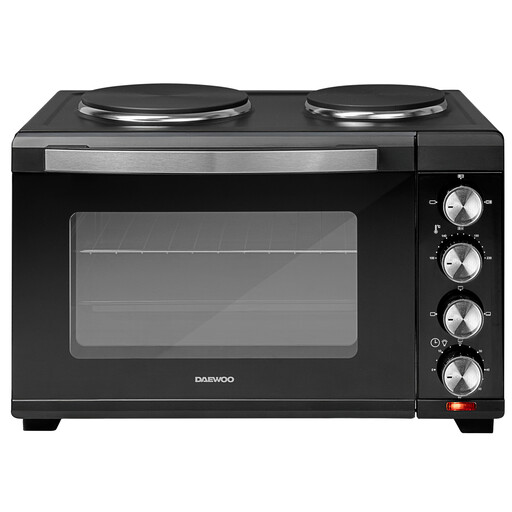
This countertop oven is relevant if you want to roast beetroot wedges and would also use integrated hotplates for buffet sides. Check tray fit and placement before deciding whether it suits your batch plan.
 No image available
A countertop option to consider if your buffet plan includes wedges and hotplate-cooked sides.
The product name states 32L capacity and 3000W power. Compare the supplied tray’s dimensions with your intended batch, and check the model’s placement instructions before buying.
A 42-litre capacity alone cannot tell you that: it describes cavity volume, not the tray area available for wedges in one layer. Check the supplied tray dimensions and shelf layout against the quantity you need per batch.
Do not assume a cooking mini oven is suitable hot-holding equipment. For food-business buffets, Food Standards Agency caterer guidance calls for suitable equipment and says hot food should generally be kept at 63°C or above, subject to its stated exceptions; plan cooking and service around the applicable guidance.
A fan is not established as a requirement for this buffet task. Compare usable tray space, adjustable temperature and timer settings first; if fan assistance or presets matter to your batch routine, check those features on the exact model without assuming they guarantee even browning.
Measure both the intended worktop space and the space needed around the exact oven for ventilation. Check its installation instructions and electrical requirements rather than applying another model’s clearances to it.