Single-tenderloin cooks short on space
If you usually roast one small tenderloin, a compact oven may meet your needs, provided your dish fits inside and the appliance has room for ventilation.


A 12-litre model is worth considering for one small tenderloin if your roasting dish fits; a 20-litre air-fry mini oven adds cooking modes, while a 30-litre fan-assisted model offers more stated cavity space for sides. Check the actual tray dimensions and required ventilation clearance before buying, and use the pork’s centre temperature rather than a programme time to judge whether it is cooked.
If you usually roast one small tenderloin, a compact oven may meet your needs, provided your dish fits inside and the appliance has room for ventilation.
If you also want to grill, bake or toast, an air-fry mini oven offers several functions in one appliance. Check that its tray suits your usual meal rather than choosing by programme names alone.
If vegetables or potatoes need to cook alongside the pork, usable tray space and the arrangement of racks matter more than finding the smallest oven.
Start with the meal and roasting dish you normally use, then check where the oven can safely sit. Extra cooking modes matter most if you will use them beyond an occasional roast.
| Concern | What to check | Who this matters to |
|---|---|---|
| Usable roasting space | Compare the internal shelf and supplied tray dimensions with your dish; allow room around the food. | I want to roast pork and vegetables together without crowding the tray. Around 42% of consumers put meal capacity first. |
| Worktop fit and placement | Measure the intended space, including door access, and follow the model’s ventilation instructions; the Russell Hobbs 26680 manual calls for 150 mm around the unit. | In a small kitchen, I need an oven I can position safely without taking over the counter. Worktop fit comes first for around 33% of consumers. |
| Versatility and clean-up | Check the available cooking modes and the instructions for cleaning the tray and removable parts. | I would use the oven for grilling or baking between roasts, so those functions matter more to me than extra cavity space. Roughly 25% of consumers make multi-use cooking their first priority. |
Cavity volume does not tell you whether your dish will pass through the door or sit on the rack with room around the food.
Measure the dish and check the oven’s internal shelf, tray and door-clearance dimensions, particularly if you plan to add vegetables.
A programme or recipe time cannot establish the centre temperature of an individual tenderloin.
Use a clean food probe in the thickest part. UK Government and Food Standards Agency business cooking guidance gives 70°C for two minutes as standard cooking advice.
A hot countertop oven also needs the clearance specified in its manual. Electrical Safety First warns that an extension lead shared with other large appliances may be overloaded.
Choose a stable, heat-resistant location and check the exact model’s instructions. The Russell Hobbs 26680 manual specifies 150 mm of space around the unit.
A larger multifunction oven occupies worktop space even when you only need to roast one small tenderloin.
Choose the cavity and functions around your usual meals, and check dish fit before paying attention to the number of programmes.
Its 22780 Mini Kitchen and 26680 Express Air Fryer Mini Oven illustrate two different approaches to roasting on a worktop.
The EO12012 is a compact option to consider when one tenderloin, rather than a tray of sides, is the usual meal.
Ninja presents the DT200UK as a multifunction countertop oven for cooks who expect to make varied meals.
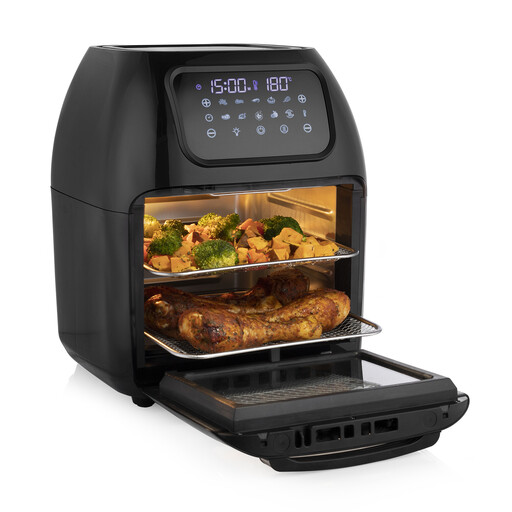
This 10-litre air-fryer oven is an option to consider for a single tenderloin, provided your roasting dish fits and you have a suitable place for the appliance.
 No image available
Consider this model for a smaller roasting setup if your dish and tenderloin fit inside. Its listed features include 1800 W, a touch screen, ten programmes, a non-stick coating and dishwasher-safe parts; check the relevant cleaning instructions before use.
Choose by the fit of your roasting dish, not the litre figure alone. A compact cavity may suit one small tenderloin, but you need to check the internal tray dimensions and allow room around the food; cooking sides at the same time calls for more usable space.
Check the centre or thickest part with a clean food probe rather than relying on the timer. UK Government and Food Standards Agency business cooking guidance gives 70°C for two minutes as standard advice and lists alternative safe time-and-temperature combinations; follow any applicable pack instructions too.
No: use a stable, heat-resistant location with the clearance required by the exact model’s manual. For example, the Russell Hobbs 26680 instructions specify 150 mm around the unit for heat flow.
Do not assume an extension lead is suitable. Electrical Safety First warns that ovens may overload one when it is shared with other large appliances; check the oven’s power requirements and your socket arrangement, and ask a qualified electrician if you are unsure.
Let the oven cool and clean its removable parts as the model’s instructions direct. Russell Hobbs instructs owners of the 26680 to empty and clean its crumb tray regularly and not to operate the oven without that tray fitted.