Squash roasters with compact kitchens
If worktop space is tight or a full-size oven is inconvenient, check the appliance footprint together with its required clearance. The supplied tray still needs enough usable area for your usual wedges.


Choose a mini oven with a tray or rack that lets your usual batch of squash wedges sit in one spaced layer, and check that its temperature controls suit your recipe. A compact air-fryer oven is worth considering for small batches, while a larger fan-assisted oven gives you more scope for other oven meals; in either case, check usable tray space, worktop clearance and electrical requirements before buying.
If worktop space is tight or a full-size oven is inconvenient, check the appliance footprint together with its required clearance. The supplied tray still needs enough usable area for your usual wedges.
For one or two portions, a compact hot-air oven may suit the batch you cook most often. A rack or basket that exposes the wedges to circulating air is more relevant than a large stated cavity capacity, provided the wedges are not crowded.
If squash wedges often accompany another dish, a larger tray-style oven and conventional cooking functions may be useful beyond this one recipe. Check the tray layout and any restrictions on using functions together.
Start with the number of wedges you normally roast, then check the cooking controls and whether the oven can be positioned and powered as its instructions require.
| Concern | What to check | Who this matters to |
|---|---|---|
| Single-layer tray space | Compare usable tray or rack dimensions with your usual batch, not just the oven’s litre capacity. Check whether the wedges can sit with gaps between them. | If I roast several portions at once, I need enough flat space to spread the wedges out rather than stack them. Around 42% of consumers put batch space first. |
| Airflow and temperature | Check for a fan-assisted, convection or air-fry mode and a temperature range that reaches your recipe’s setting. Consider how the supplied rack or basket holds the wedges. | When I usually cook a small batch, I care most about exposing the wedges to circulating heat for browning without crowding them. For around 33% of consumers, that cooking layout is the primary concern. |
| Worktop fit and everyday use | Check external dimensions, the model’s required ventilation clearance and its electrical instructions. If you want other cooking functions, check whether they can be used together. | In a constrained kitchen, I need an oven I can position safely and use for meals besides squash. That practical fit comes first for around 25% of consumers. |
A stated cavity capacity does not tell you the tray’s flat area. If wedges have to be piled up, they have less exposed space for roasting.
Measure or request the usable tray dimensions and compare them with the batch and wedge thickness you normally cook.
Hotplates, rotisserie and dehydration settings can serve other meals, but they do not establish how much squash fits on a tray. Some functions also have simultaneous-use restrictions.
Check temperature control, fan or convection mode and usable tray space first. Choose additional functions for meals you actually intend to make.
Countertop ovens have hot surfaces and need to be positioned as their manuals direct. Electrical Safety First warns that ovens used with other high-power appliances may overload an extension lead.
Follow the chosen model’s placement instructions, keep combustible items away and avoid overloading extension leads or chaining adaptors. The Russell Hobbs 22780 manual, for example, specifies at least 50 mm of space all around the appliance.
A comparison based on cooking frozen pizza does not tell you how long your squash wedges will take or how they will brown.
Follow a squash recipe as a starting point, then check tenderness and adjust for wedge thickness, spacing and your appliance.
These brands illustrate different countertop-oven formats. Check the particular model rather than assuming a feature applies across a brand’s range.
A tray-style Mini Kitchen sits alongside more compact mini-oven models.
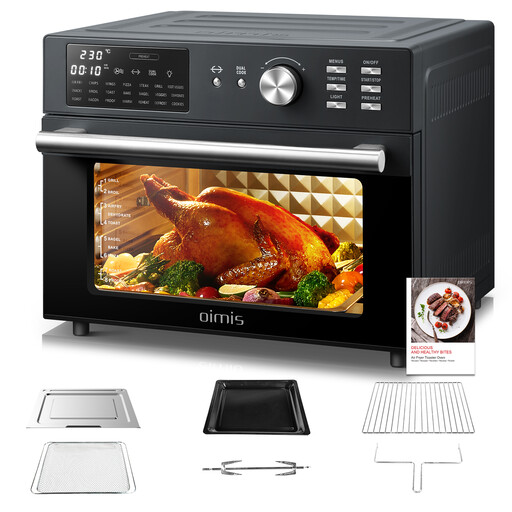
A 28 L mini-oven format with cooking functions beyond tray roasting.
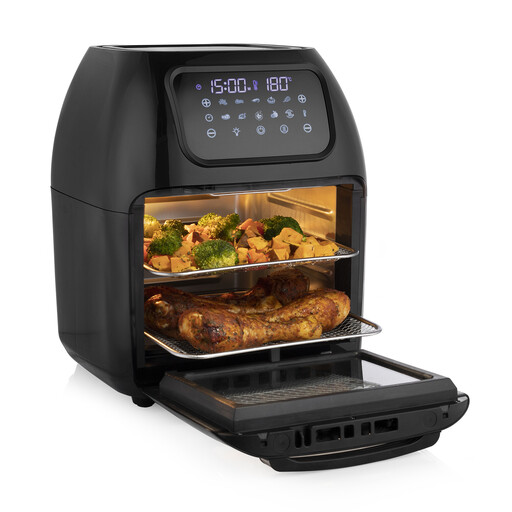
An air-fryer-oven format to consider for smaller batches using airflow accessories.
A compact tabletop oven with convection and grill functions.
These two countertop choices cover different batch needs: a 10 L air-fryer oven to consider for smaller portions and a 30 L multi-function oven to consider when you also want space for other cooking. For either one, confirm that the usable cooking surface fits your squash wedges in a spaced layer.
 No image available
Consider this compact format if you normally roast a small batch of wedges. Its product title lists 1800 W, a touchscreen, 10 programmes, a non-stick coating and dishwasher-safe parts. Check the usable rack or tray area against your batch and follow the model’s positioning instructions.
 No image available
Consider this larger format if you want a countertop oven for squash and other meals. Its product title lists 21 presets, 1800 W and space for a 13-inch pizza. Before choosing it for wedges, confirm the temperature range, usable tray dimensions, included accessories and required ventilation clearance; 30 L alone does not establish the size of a single-layer batch.
Choose a mini oven that reaches the setting in the squash recipe you intend to use. Good Food gives 200°C, or 180°C fan, as guidance for small squash cubes; wedges take longer, and thickness, spacing and the appliance affect cooking time. Check tenderness rather than relying on the timer alone.
No: a fan-assisted or convection mini oven is also an option, particularly if you need more tray area or conventional oven functions. An air-fryer oven may suit smaller batches using airflow racks or a basket, but avoid crowding the wedges in either format.
Follow the clearance instructions for the exact model you buy. The Russell Hobbs 22780 manual specifies at least 50 mm all around the appliance, a stable, level, heat-resistant surface and care around hot surfaces; do not assume its clearance figure applies to another oven.
Use your recipe’s timing as a guide and check whether the wedges are tender with a knife. Good Food gives around 35–45 minutes for wedges, but thickness, spacing and the oven can change the time needed. Follow the recipe or packet cooking instructions for any other food you prepare alongside them.