
24/7 Customer Support

Free returns

Same-day & Next-day Delivery

Quality Guaranteed

Unlock Your Welcome Offers: FREE Delivery | Up to 80% OFF | Free 30-day JoyPlus trial
Download the APP
A mini trampoline can make home cardio more convenient, particularly when outdoor weather, limited space or busy routines make a full gym session impractical. However, compact does not mean every model will suit every household. The wrong rebounder trampoline may be too small, too noisy, difficult to store or unsuitable for the user’s weight.
Before buying an indoor fitness trampoline, look beyond phrases such as “professional”, “silent” or “low impact”. The useful details are usually in the technical specifications, safety instructions and dimensions.
A listed diameter of 40 or 48 inches refers to the overall frame, not necessarily the clear jumping mat. Spring covers, frame rails and padding reduce the active area. Measure the available floor space and allow room around the trampoline, rather than placing it directly beside a sofa, wall or table.
A folding mini trampoline may be easier to store, but check its folded dimensions and weight. A product that technically folds is not necessarily convenient to move between a living room and a cupboard.
Noise depends on the rebound system, floor surface, footwear and the user’s movement. Steel springs can produce a different sound from elastic resistance bands. Non-slip or rubber-covered feet may help reduce vibration and protect flooring, but they cannot remove every sound.
If you live in a flat or maisonette, consider a springless rebounder trampoline with elastic bands and use it on a firm, level floor. Avoid thick, unstable rugs that could affect balance.
An exercise trampoline with handle can provide a point of contact during controlled movements, but it is not a substitute for correct positioning or supervision. The handle must be firmly secured and adjusted to a suitable height. A loose or poorly positioned bar may create an additional impact hazard.
Also check whether the maximum user weight includes the person only or the person plus any equipment. Never choose a model solely because its advertised size appears suitable.
The stated maximum load is a non-negotiable specification. Choose a model with a suitable margin rather than buying close to the limit. The products below range from 25kg for children to 120kg for adult users.
Children’s models should not be used by adults, even if the frame looks sturdy. Likewise, a kids mini trampoline is intended for supervised play and simple bouncing, not advanced manoeuvres.
Steel springs can offer a responsive bounce, while elastic bands may provide a quieter feel. Neither system removes the need for inspection. Look for:
Some products list EN ISO 20957-1, GB 17498.1-2008 and ASTM F2276-10(2015) among their standards information. Treat these details as product documentation to review, not as a reason to ignore the supplied warnings or local usage requirements.
A trampoline with adjustable handle is useful for households where users vary in height. Compare the maximum assembled height with your ceiling clearance, including the user’s head and any movement above the mat.
Pre-assembled models can reduce set-up time, but they still need to be unfolded correctly and checked before first use. Inspect the frame, mat, springs, bands, foam pad and handle regularly. Store an indoor trampoline away from damp conditions and extreme temperature changes.
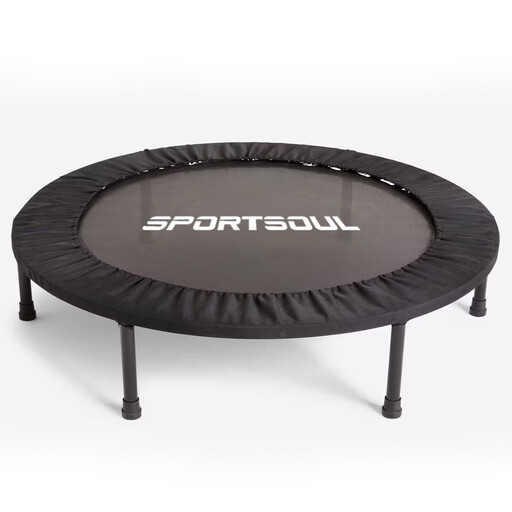
Why This Fits Their Persona: A compact option for adults creating a simple home workout area in a UK flat, spare room or bedroom.
It has a stated 100kg maximum user weight and silent, non-slip foot covers. It arrives ready to use, helping avoid complicated assembly claims.
40-inch footprint, 6.6kg net weight, 36 steel springs and no assembly required.
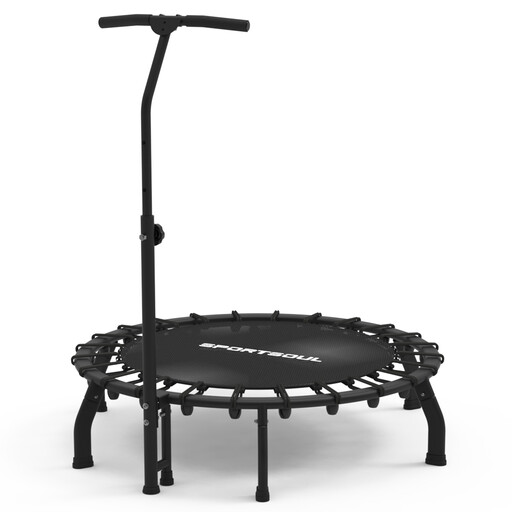
Why This Fits Their Persona: Suitable for adults who prioritise a higher stated capacity and a pre-assembled resistance system for regular indoor cardio.
Its listed 120kg maximum user weight is clearly stated, while the elastic ropes and mat arrive pre-assembled. Users should still inspect all connections before use.
42-inch diameter, 120kg stated capacity and a 48.6-inch assembled height.
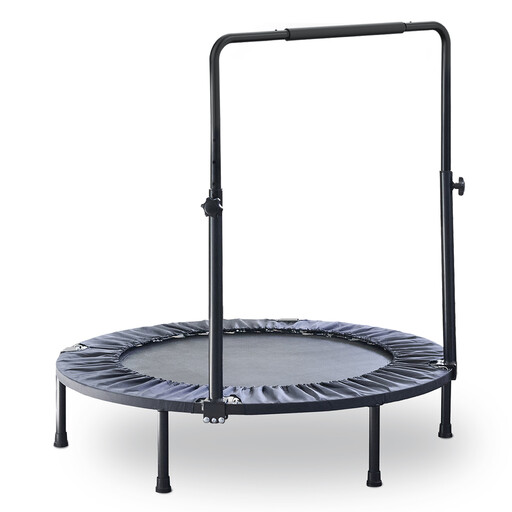
Why This Fits Their Persona: Designed for adults who want a wider jumping area, adjustable support and a folding format for home storage.
The product lists an 80kg maximum user weight, adjustable handle height and pre-assembled springs, mat and foam pad. Confirm the capacity suits you before purchase.
48-inch overall size, adjustable handle and a foldable 12.8kg steel-frame design.
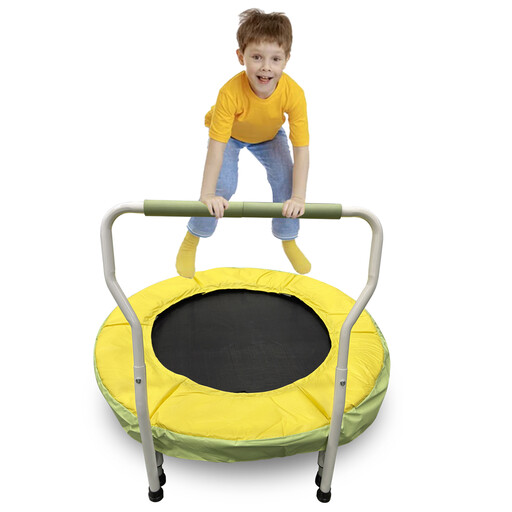
Why This Fits Their Persona: A 36-inch indoor option for children aged 3–6, provided an adult supervises every use and the capacity is respected.
It lists a full-coverage spring pad, adjustable foam handle and a 25kg maximum user weight. It is not suitable for older or heavier users.
24 steel springs, full spring coverage and a compact 36-inch footprint.
A rebounder can support controlled bouncing and other low-impact cardio movements, but the actual impact and intensity vary by user, technique and rebound system. Start slowly, keep movements controlled and stop if you feel pain or unsteadiness.
Measure the trampoline’s full diameter or width, then add clear space around it. You also need sufficient ceiling height for the user and handle. A 40-inch model has a smaller footprint, while a 48-inch model needs a wider clear area.
Lifespan depends on frequency of use, user weight, storage and maintenance. Regularly inspect springs, elastic bands, mat and padding, keep the equipment indoors and replace damaged parts rather than continuing to use it.