What to check before choosing
Start with the allergen you need to avoid, then check the exact product and pack size; a suitable format alone says nothing about its other ingredients or warnings.
| Priority |
What to check |
Your needs |
| Declared allergens |
Read the current ingredients list and allergen emphasis. The Food Standards Agency says the 14 regulated allergens must be emphasised in the ingredients list of prepacked food. |
I need to identify every declared ingredient relevant to my allergy before choosing a pack. |
| Milk-free claims |
Check that the claim applies to the exact product. ASDA and Sainsbury’s list 25g white-chocolate-style buttons as milk-free; Cadbury’s listed white button recipe includes milk-derived ingredients. |
If I avoid milk, I need an explicit product-specific claim rather than assuming pale chocolate buttons are milk-free. |
| Other allergens |
Compare each free-from claim with the full ingredient list and suitability warnings. ASDA’s milk-, egg- and gluten-free buttons declare soya; M&S marks its dairy-free giant buttons unsuitable for nut and peanut allergy. |
A claim about one allergen does not answer my questions about soya, peanuts or tree nuts. |
| ‘May contain’ wording |
Read precautionary allergen labelling as well as recipe ingredients. Food Standards Agency research explains that this wording communicates possible unintended presence through cross-contact. |
I need to consider a relevant warning even when that allergen is not listed as an ingredient. |
| Pack format |
Confirm the size and whether the format meets your serving needs. ASDA and Sainsbury’s list 25g button packs; Cadbury’s white button bag is listed as 100g. |
For a small treat, I would check the pack size without treating a smaller portion as evidence of allergy suitability. |
Product-line references
These examples show why brand familiarity and chocolate format cannot replace a check of the exact product.
Cadbury
Cadbury White Chocolate Buttons are listed as a 100g bag of bite-sized white chocolate.
- A conventional white-chocolate button format.
- The listed recipe includes milk-derived ingredients and soya lecithins, so it does not fit milk or soya avoidance.
Lindt
Lindor White Chocolate Truffles are a filled truffle option rather than a small button pack.
- An alternative format for shoppers choosing white chocolate truffles.
- Lindt lists milk, lactose and soya ingredients for the white truffles, with a ‘may contain’ warning for hazelnuts and other nuts. Lindt also says it cannot guarantee its products are nut-allergen safe.
M&S Made Without
The Made Without Dairy Giant Chocolate Buttons Treat Bag is a 150g dairy-free button product, not white chocolate.
- An option to examine if dairy avoidance matters more than choosing white chocolate specifically.
- Its listed ingredients include cocoa mass, and M&S marks it unsuitable for people with nut or peanut allergy.
Joybuy product options
This conventional white-chocolate button option is relevant if you do not need to avoid its declared milk or soya ingredients; it is not a substitute for the milk-free 25g products discussed above.
 No image available
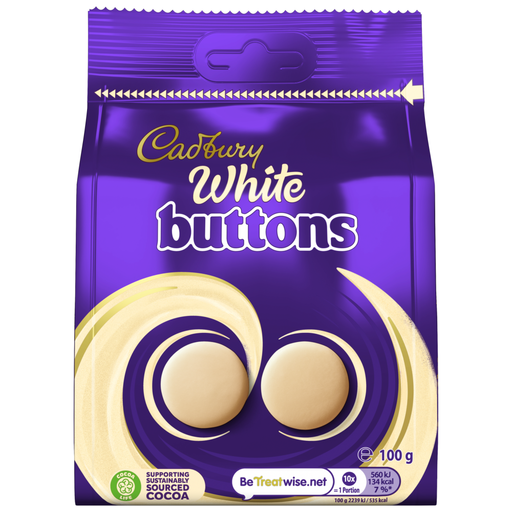
Cadbury White Giant Buttons 100g
This 100g pack of giant white-chocolate buttons is an option to consider only if you do not need to avoid milk or soya. Its listed ingredients contain both, and the product description says it may contain nuts and wheat; check the current pack for the warnings relevant to you.
View on Joybuy
Questions about allergens and mini chocolate
How do I check a prepacked mini chocolate product for allergens?
Read the current physical pack’s full ingredients list and any precautionary warning before buying. In the UK, the Food Standards Agency says the 14 regulated allergens must be emphasised in the ingredients list of prepacked food; check the exact product for every allergen relevant to you.
Does ‘may contain’ mean the allergen is an ingredient?
No. The Food Standards Agency explains that precautionary allergen labelling communicates possible unintended presence through cross-contact rather than an intentional ingredient. Consider a relevant warning as part of your allergy decision.
Are ordinary white-chocolate buttons suitable if I avoid milk?
Not if their current ingredients declare milk. Cadbury’s listed white button recipe includes skimmed milk powder, whey powder from milk and milk fat; ASDA and Sainsbury’s list separate 25g milk-free white-chocolate-style button products. Check the full current pack for your other relevant allergens too.
Does dairy-free mean a button product is suitable for nut allergy?
No. Dairy-free describes a different concern from nut or peanut suitability. M&S marks its Made Without Dairy Giant Chocolate Buttons unsuitable for people with nut or peanut allergy, so check each product’s own warnings.
Are free-from white-chocolate-style buttons conventional white chocolate?
Not necessarily. ASDA describes its 25g buttons as white-chocolate-flavour and free from milk, egg and cereals containing gluten; Sainsbury’s describes its 25g milk- and gluten-free buttons as a white-chocolate alternative. Compare the exact recipe and allergen declarations rather than assuming the products have the same ingredients.


