Shoppers who want a clear stopping point
A stated weight and nutrition value for one bite can help you decide on a quantity before eating. A bag of small pieces does not, by itself, define a single portion.


For a defined late-night portion, choose a product that states an amount per bite rather than relying on the word “mini”: Tesco Finest Caramelised Biscuit Bites lists one bite as 13g and 68 kcal, but it is a sweet snack containing fudge, not plain fudge. If you prefer fudge-centred coated pieces or traditional fudge, choose by ingredients and texture, then decide how much to take from the pack and check its current label.
A stated weight and nutrition value for one bite can help you decide on a quantity before eating. A bag of small pieces does not, by itself, define a single portion.
If you want the texture of traditional fudge, check whether a “fudge bite” also contains chocolate, biscuit, cereal or pretzels. Those ingredients make it a different kind of sweet snack.
Check the exact pack before buying or serving. The fudge-style bites discussed here have ingredient lists or warnings involving milk, wheat or gluten, soya, nuts, peanuts or egg, depending on the product.
Start with whether you want one quantified bite, a pack to portion yourself, or traditional fudge; then compare the ingredients and label values for the exact product.
| Priority | What to check | Your needs |
|---|---|---|
| Portion clarity | Look for grams and nutrition per piece, not just the pack weight. Tesco Groceries lists one Tesco Finest Caramelised Biscuit Bite as 13g; the M&S examples are 128g and 225g multi-piece packs. | I want to decide on one bite in advance, rather than estimate a serving from an open bag. |
| Type of sweet | Read the description and ingredients for coatings, biscuit, cereal or pretzels. M&S Blond Fudge Bites contain a fudge core and biscuit crumb; its pretzel mini bites combine fudge with cornflakes and pretzels. | If I am craving traditional fudge, a coated or crunchy bite may not be what I want. |
| Nutrition values | Compare values on the same basis, such as per bite or per 100g, and account for how many pieces you plan to eat. Tesco Groceries lists 5.8g sugars per 13g Caramelised Biscuit Bite; Marks & Spencer lists 54.1g sugars per 100g for Blond Fudge Bites. | Small pieces help me count what I take, but I do not want to assume that “mini” describes the sugar content. |
| Allergens and storage | Read the current pack’s ingredients, allergen declaration and storage instructions. Check warnings for the exact variety rather than applying another fudge product’s label. | I may be buying for someone with an allergy, or keeping part of a multi-piece pack for another time. |
“Mini” describes the pieces, not necessarily a suggested amount to eat. A sharing pack can contain many of them.
If a defined portion matters to you, look for a stated per-piece amount or put the quantity you want in a bowl before eating.
Coatings, biscuit, cereal and pretzels change the ingredients and texture. A product containing fudge pieces may feel quite different from conventional fudge.
Read the product description and choose traditional packaged fudge if that is the texture you are after.
Recipes and label information can change, which matters particularly when checking allergens.
Before eating or serving, read the physical pack’s ingredients, allergen declaration, best-before date and storage instructions.
Department for Education guidance addresses food and drink provided in state-funded schools in England. It does not establish an HFSS classification for every fudge product or answer a household portion-choice question.
For a school-food decision, check the rules for the exact setting and product. For a snack at home, focus on the product’s ingredients, label and the amount you intend to eat.
These examples illustrate different fudge formats; their inclusion does not indicate which products are available on Joybuy.
Marks & Spencer lists a 128g bag of Blond Fudge Bites and a 225g pack of Sweet and Salty Pretzel Fudge Mini Bites.
Caramelised Biscuit Bites are a confection-style option containing fudge pieces, rather than plain fudge.
Waitrose & Partners lists conventional packaged fudge, including 150g Clotted Cream Fudge and 130g Dark Chocolate & Caramel Fudge.
For a late-night snack, this Joybuy option is a bag of fudge minis to portion yourself, rather than a stated single-bite serving.
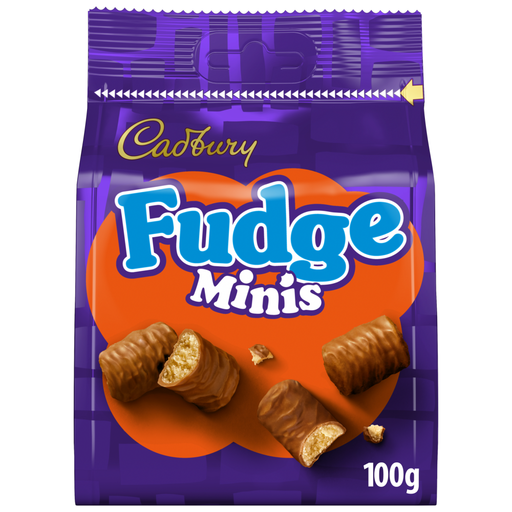 Image unavailable
The 100g bag offers fudge minis for a late-night snack. If you want a stopping point, choose how many pieces to take rather than treating the whole bag as one serving; check the current pack’s allergen information before eating.
No. It can describe the size of each piece in a multi-piece pack. If you want a defined quantity, look for a stated per-piece weight and nutrition; Tesco Groceries gives values for one 13g Caramelised Biscuit Bite, while the M&S examples are sold as 128g and 225g packs.
No conclusion about sugar content follows from the size of a piece. Check how the label states its values and how many pieces you intend to eat: Tesco Groceries lists 5.8g sugars per Caramelised Biscuit Bite, while Marks & Spencer lists 54.1g sugars per 100g for Blond Fudge Bites.
Check the exact current pack for ingredients and allergy advice. The Tesco and M&S fudge-style examples include or warn about allergens such as milk, wheat or gluten, soya, nuts, peanuts and egg, with the details differing by product.
The Department for Education’s school-food guidance concerns food and drink provided in state-funded schools in England, not a household midnight snack. It does not classify every fudge product as HFSS; a decision about food supplied in a school requires the rules for that setting and the exact product to be checked.
Follow the instructions on the exact pack. Tesco’s Caramelised Biscuit Bites specify cool, dry storage and keeping the original packaging closed after opening; the M&S products checked also specify cool, dry storage.