Small-kitchen oat-bar bakers
A countertop oven may suit you if you bake one tray at a time. Check that your tin fits the usable rack area and that the appliance has enough surrounding space for the clearance specified in its manual.


For one small tray of oat bars, choose a countertop oven if your tin fits its usable rack area and you have room for the required clearance. A mini kitchen adds hotplates for other cooking tasks; a full-size oven makes more sense if you are replacing a main oven or need substantially more capacity. A capacity figure in litres cannot confirm whether your tin will fit.
A countertop oven may suit you if you bake one tray at a time. Check that your tin fits the usable rack area and that the appliance has enough surrounding space for the clearance specified in its manual.
If oat bars are only part of what you cook, a mini kitchen with hotplates may make more use of your worktop space than a basic oven. The Russell Hobbs 22780 is one example with two hotplates.
If you also need room for larger dishes or several trays, consider a full-size oven. Check its kitchen fit and electrical installation requirements rather than choosing a countertop model solely for the oat-bar batch.
Choose the oven format around the cooking you need beyond one tray of oat bars, then check tin fit, placement and electrical requirements for the exact model.
Choose it when: You mainly want to bake one small tray without installing an oven.
Trade-off: A compact oven still needs worktop clearance, and its capacity in litres will not tell you whether your tin fits.
Choose it when: You will use the hob functions as well as the oven.
Trade-off: Those extra cooking surfaces take up space and need cleaning even if you usually bake only oat bars.
Choose it when: You are replacing a main oven or need room for larger batches and other dishes.
Trade-off: Check the housing and electrical installation requirements; this is a different commitment from placing a mini oven on a worktop.
| Concern | What to check | Who this matters to |
|---|---|---|
| Tin fit and space | Compare your tin with the usable rack dimensions. Allow for the exact model’s required clearance, not just its footprint. | If my tin cannot sit level inside the oven, its stated capacity is little help. Around 34% of consumers put tin fit and worktop space first. |
| Temperature control | Check that the adjustable range covers your recipe and which heating functions the model provides. | When baking a small tray, I want to judge browning before relying on a recipe’s usual timing. Around 33% of consumers put baking control first. |
| Electrical setup | Check the appliance’s power and plug requirements against the intended socket; avoid overloading extension leads. | I want a plug-in appliance without overlooking the electrical load it places on my kitchen setup. Plug-in practicality comes first for around 20% of consumers. |
| Other cooking needs | Decide whether you will use hotplates or need the capacity of a full-size oven, then check the space and installation each choice requires. | If oat bars are only one of the things I cook, extra functions or room for larger batches may matter more than a small footprint. Around 13% of consumers prioritise those needs. |
Cavity volume does not describe the usable rack width, depth or height. A tin may not sit level or leave enough room for the door to close.
Measure your tin and compare it with the model’s usable rack or tray dimensions before ordering.
A countertop oven needs the placement specified in its own manual. The Russell Hobbs 22780 manual calls for a stable, heat-resistant surface and at least 50 mm of space all round.
Measure the intended worktop position with the required clearance included, and keep combustible materials away from the oven.
Electrical Safety First warns that ovens can overload extension leads, particularly when other high-power appliances are connected.
Check the oven’s electrical requirements and use a suitable wall socket. Do not exceed an extension lead’s marked rating or daisy-chain extension devices.
Fan assistance does not establish how evenly a particular mini oven will bake your oat bars. Which? assesses oven performance when testing mini ovens, including temperature behaviour and preheating.
Watch the first batch and adjust the shelf position or recipe timing in response to the result.
The IG7131 is a dedicated 30-litre countertop mini oven to consider for one-tray baking.
The 22780 Mini Kitchen combines a 30-litre oven with two hotplates for consumers who will use more than the baking function.
The Sfornatutto Chef EO34302 is a 34-litre electric oven for consumers considering a somewhat larger countertop format.
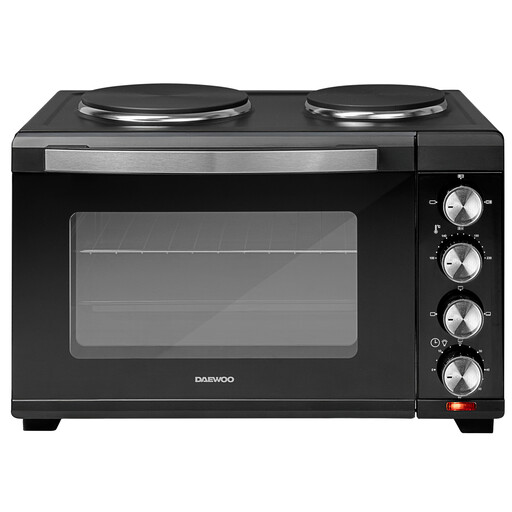
This countertop oven combines baking with hotplates for other cooking tasks. Check that your oat-bar tin fits before choosing it.
 No image available
Consider this countertop model for small-batch baking if you also want two hotplates.
The product name specifies a 32L capacity and 3000W power rating. Compare your tin with the usable rack dimensions and check the appliance’s electrical and placement requirements before use.
Yes, if the oven’s usable rack area fits your tin and its temperature range covers your recipe. A full-size oven is more relevant if you are also replacing a main oven or need room for larger batches.
Not necessarily: 30 litres describes cavity volume, not usable rack dimensions. Measure the tin’s outside width, depth and height, then compare them with the exact oven model’s rack or tray area and door clearance.
Do not assume an extension lead is suitable. Electrical Safety First warns that ovens may overload extension leads, especially alongside other high-power appliances. Check the oven’s power requirements and the lead’s marked rating, avoid daisy-chaining and seek qualified electrical advice if the intended socket or circuit is uncertain.
Follow the clearance in the exact model’s manual. For the Russell Hobbs 22780, the manual specifies at least 50 mm all round and a stable, heat-resistant surface; do not assume that measurement applies to another oven.