Choose a mini oven with adjustable heat, a timer and a tray that fits your pork tenderloin, but check the available worktop, ventilation clearance, socket arrangement and household rules before buying. A larger cavity or integrated hotplates makes more sense if you will regularly cook sides or shared meals and can accommodate the extra space and cleaning.
Who is a mini oven for?
Shared-kitchen tenderloin cooks
You want to roast one tenderloin with manageable controls and cleanup, while keeping ventilation clear and avoiding overloaded sockets. Electrical Safety First’s kitchen and socket guidance is particularly relevant when several people use the same space.
Small-space meal coordinators
You want to roast the main dish and prepare sides from one worktop position. Extra cooking functions may help, but the appliance and its hot surfaces still need room that housemates can safely share.
Flexible batch and leftovers cooks
You expect to bake, grill or reheat food as well as roast tenderloin, so cooking functions and supplied trays or racks matter alongside the space needed to keep them.
What matters when choosing?
Start with a safe place to operate the oven, then check whether its controls and usable tray space suit the roast you intend to cook.
| Concern |
What to check |
Who this matters to |
| Roasting control and pork safety |
Check the temperature control, timer and whether a suitable tray and rack leave room to check the meat with a thermometer. |
If I am roasting a lean tenderloin, I want to check doneness rather than trust a preset or elapsed time alone; around 36% of consumers put roasting control and pork safety first. |
| Electrical and fire safety |
Check the appliance rating, socket arrangement and placement instructions, as well as the household’s rules for personal cooking appliances. |
When other appliances may be running nearby, I need a clear, workable socket and a safe place to cook; electrical and fire safety comes first for roughly 29% of consumers. |
| Worktop fit and capacity |
Measure the available space including required clearance, then compare the usable cavity and tray dimensions with your meal. |
I need the tenderloin and its tray to fit without crowding a shared worktop; about 21% of consumers prioritise that balance of cooking space and footprint. |
| Cleaning and storage |
Check which accessories come with the oven, where they will be stored and who will clean the appliance after use. |
If the oven stays in a communal area, I want the trays and cooking surfaces to be practical to clean and put away; around 14% of consumers make that their primary concern. |
Mistakes to avoid
-
Assuming any extension lead will do
An oven and other kitchen appliances can exceed the rating of a shared extension lead. Electrical Safety First warns against overloaded sockets and daisy-chained extensions.
Check the oven’s rating against the lead’s marked limit, and do not use a damaged lead or connect one extension lead to another.
-
Choosing capacity without measuring the space
A cavity that fits the food does not establish that the appliance fits safely on the worktop. Tower’s instructions for the T14045 specify at least 20 cm clearance on all sides.
Measure width, depth and height with the exact model’s placement instructions in hand, then check the usable tray space separately.
-
Treating a timer as a doneness check
Tenderloin size and starting temperature affect cooking time; a timer does not measure the centre of the meat.
Use a food thermometer in the thickest part. Food Standards Agency material describes a core temperature of 70°C for two minutes as its standard advice for killing vegetative pathogens.
Keep a probe food thermometer available if the kitchen does not already have one.
-
Adding hotplates that no one needs
Integrated hotplates can help with sauces or sides, but they also add hot surfaces and cleaning tasks to a worktop shared with others.
Choose them if you will regularly use them alongside the oven; otherwise concentrate on tray fit, temperature control and a timer.
Relevant brands to consider
Ninja
SharkNinja UK presents the DT200UK as a large multifunction countertop oven for cooking tasks that include roasting.
- The DT200UK has Roast and Whole Roast functions, two-level cooking and supplied trays, an air-fry basket and wire racks.
- Its stated dimensions are H33.5 cm × W43.5 cm × D50.5 cm, with a 20.7 kg weight and 2400 W main-unit rating. Check that its position and socket arrangement work in the shared kitchen.
Russell Hobbs
The Russell Hobbs 22780 is a fan-assisted mini oven with integrated hotplates for households that would use both cooking areas.
- Russell Hobbs lists a 30 L capacity, a 60°C–230°C adjustable thermostat, a tray, a grill rack and double hotplates.
- Capacity alone will not tell you whether your roasting tray fits. The hotplates also need clear, manageable space when in use.
Tower
Tower’s T14045 offers a larger dial-controlled oven with hotplates and a rotisserie for cooking beyond a single small roast.
- Tower specifies a 42 L capacity, 90°C–230°C settings, a 90-minute timer, a tray, a rack and dual hotplates.
- The T14045 instructions call for at least 20 cm clearance on all sides. Its capacity and extra cooking surfaces may be unnecessary for one tenderloin.
Joybuy product choices
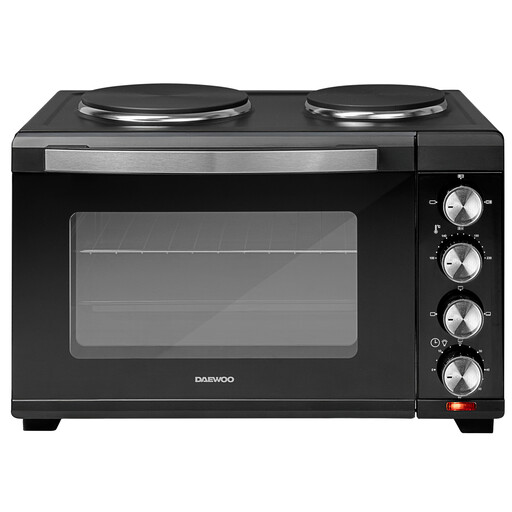
This countertop oven combines a stated 32 L capacity with dual hotplates, making it a choice to assess if you also plan to cook sides. Confirm that its controls, tray space and placement requirements suit your tenderloin and shared worktop.
 No image available
DAEWOO SDA1609GE electric oven with dual hotplates, 32 L
Consider this model if you want to roast tenderloin and would also use hotplates for sides, provided both fit your shared-kitchen routine.
The product name states a 32 L capacity and 3000 W rating. Before buying, confirm usable tray dimensions, ventilation clearance, temperature control and which accessories are included; check that the socket arrangement is suitable for the appliance.
View on Joybuy
Common questions
How do I check whether pork tenderloin is cooked safely?
Check the thickest part with a food thermometer rather than relying on the mini oven’s timer or a preset. Food Standards Agency material describes a core temperature of 70°C for two minutes as its standard advice for killing vegetative pathogens; cooking time can vary with the joint and oven.
Can I use an extension lead for a mini oven?
Only if the appliance load is within the lead’s marked rating and the arrangement follows the appliance and lead instructions. Electrical Safety First advises against daisy-chaining extension leads; check what else is connected to the shared socket, and fully unwind a cable reel when its instructions require it.
How much space should I leave around a mini oven?
Follow the placement instructions for the exact model, including clearance above and behind it. Tower’s T14045 instructions, for example, specify at least 20 cm on all sides; do not assume that measurement applies to every oven.
What should a shared household agree before buying?
Agree where the mini oven can stand, who may use it and who will clean and store its accessories. Check the accommodation’s appliance rules as well as the model’s placement instructions before committing shared worktop space.


