Single-tray bakers with limited space
If you bake modest portions, measure the tray, worktop and required clearance before choosing a compact oven. A small cavity figure alone cannot tell you whether the arrangement will fit.


For one small tray of apple slices, start with a countertop oven that has a bake setting, adjustable temperature and a timer, then check whether your tray fits rather than relying on cavity litres alone. A compact 12L model may suit a tighter worktop, while the cited 19–21L fan or convection models offer more shelf-position flexibility; a multifunction oven makes more sense if you will regularly use its other modes. Check the appliance’s clearance and electrical requirements before buying.
If you bake modest portions, measure the tray, worktop and required clearance before choosing a compact oven. A small cavity figure alone cannot tell you whether the arrangement will fit.
If you bake regularly, adjustable temperature, a timer and usable rack positions may matter more to you than the smallest possible cavity.
If apple slices are only one of several things you plan to cook, additional modes and cooking positions may be worth considering alongside the space the appliance occupies.
Choose the oven format according to how often you will use it beyond one tray of apple slices; then check the tray, controls and installation requirements of the particular model.
Consider it: For one modest tray when worktop space is a priority; De'Longhi lists a bake function on its 12L EO12012.
Trade-off: A small cavity limits your tray options, and the appliance’s outside dimensions and clearance still need checking.
Consider it: For more rack-position flexibility: The product information lists multiple cooking positions for the 19L Tefal Optimo OF445840 and three shelf positions for the 21L Sage Smart Oven Pro BOV820BSS.
Trade-off: Check the larger appliance’s worktop footprint; extra shelf positions do not guarantee a particular result for apple slices.
Consider it: If you will regularly use cooking modes beyond baking; Ninja and Breville list ovens with several functions.
Trade-off: Check the specific model’s bake controls, tray fit and space for its accessories rather than assuming its air-fry mode suits every recipe.
| Concern | What to check | Who this matters to |
|---|---|---|
| Tray fit and footprint | Usable tray dimensions and the space needed for the oven, open door and ventilation. | If I only bake one modest tray, I need an oven that fits both my dish and my worktop. Around 36% of consumers put this fit first. |
| Baking controls | A stated bake setting, adjustable temperature, timer and suitable rack positions. | When I bake often, I want to adjust heat and timing for the apple slices I am making. For around 29% of consumers, those controls are the primary concern. |
| Other uses and cleaning | Cooking modes you expect to use and the cleaning instructions for included accessories. | If this oven will handle other meals too, I care about useful modes without taking on awkward clean-up. Around 21% of consumers prioritise that broader use. |
| Electrical and placement needs | The model’s power and socket requirements, plus its specified clearances and suitable work surface. | Before making room for an oven, I need to know that its electrical supply and placement will meet the instructions. That is the first concern for around 14% of consumers. |
A capacity label does not establish whether your rectangular tray or dish will fit. De'Longhi separately states a maximum 26cm round plate for its 12L EO12012.
Measure your intended tray and compare it with the model’s usable dimensions; allow for the door to open on your worktop.
Electrical Safety First warns that ovens may overload an extension lead, while clearance requirements vary by model. The product information specifies 100mm of side clearance for the Sage Smart Oven Pro BOV820BSS.
Check the manual’s power, socket and clearance instructions. Place the oven on a stable, heat-resistant surface away from water and flammable items.
Additional modes are useful when you will use them, but they do not establish that a multifunction oven is necessary for occasional apple-slice baking.
Decide which other dishes you would cook regularly, then compare those modes with tray fit and the space needed to store accessories.
Ordinary private baking is different from operating a food business. GOV.UK states that food businesses in England, Wales and Northern Ireland must register with the local authority at least 28 days before trading.
If you plan to supply baked food to the public as a business in one of those nations, arrange registration before you start trading and check the applicable food-safety requirements.
These examples illustrate different oven formats; compare the dimensions and instructions of the model you intend to buy.
Its EO12012 is a compact, 12L countertop-oven example.
The Optimo OF445840 represents a 19L convection-oven format.
The Smart Oven Pro BOV820BSS is a 21L fan-oven option with programmable controls.
The Foodi DT200UK is a large multifunction countertop-oven example.
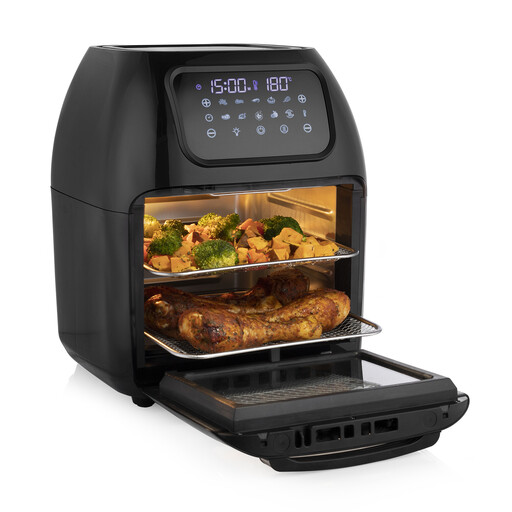
The Halo VDF127 is an air-fryer-oven example with a stated bake function.
This air-fryer-oven option is worth considering if you want one appliance for small-batch cooking and other uses. Confirm its bake settings, tray fit and placement requirements for your apple slices.
 No image available
Consider this multifunction format if you also want to cook beyond a small tray of apple slices; check that its bake settings and usable tray space suit your plans.
The product title states 10L capacity, 1800W power, touch-screen controls, 10 programmes, a non-stick coating and dishwasher-safe parts. Confirm the required ventilation space and that your intended socket meets the appliance instructions.
It can be, if your tray fits the particular oven. De'Longhi lists a maximum 26cm round plate for its 12L EO12012, but that does not confirm the fit of a rectangular tray; check its usable dimensions before buying.
Choose according to the bake controls and other cooking modes you will actually use. The cited Tefal and Sage models offer fan or convection cooking with multiple positions, while multifunction formats add other modes; neither format guarantees a particular texture for apple slices.
Do not assume an extension lead is suitable. Electrical Safety First warns that ovens can draw substantial power and may overload an extension lead; check the appliance instructions and use a suitable wall socket, seeking qualified electrical advice if your arrangement is uncertain.
Follow the clearance instructions for the exact model. The product information specifies at least 100mm to the sides of the Sage Smart Oven Pro BOV820BSS; Tefal’s Optimo instructions also call for a flat, stable, heat-resistant surface away from water splashes.
If you operate a food business in England, Wales or Northern Ireland, GOV.UK says you must register with the local authority at least 28 days before trading. That requirement concerns supplying food as a business, not ordinary private home baking.