Detail-led cake decorators
If piping, sugar flowers or fondant texture must fill the photograph, lens magnification, working distance and depth of field are central to your choice.


Choose the lens around the cake photographs you need before settling on a camera body: a standard zoom offers flexible framing for whole cakes and overhead scenes, while a compatible 1:1 macro lens is the route to frame-filling icing details. A movable screen helps with high or low camera positions; close-up work also calls for careful focus, lighting and camera support.
If piping, sugar flowers or fondant texture must fill the photograph, lens magnification, working distance and depth of field are central to your choice.
If you photograph complete cakes for listings or a portfolio, consider how easily you can frame overhead, side and low-angle views without moving the set.
If you make finished-cake stills alongside occasional process videos, consider screen access and video handling as well as the lens needed for your photographs.
Start with the size of the subject in the frame: whole-cake compositions and tiny decoration details place different demands on the lens. Then check whether the camera screen and shooting setup suit the angles you use.
| Concern | What to check | Who this matters to |
|---|---|---|
| Small decoration details | Check the exact lens’s maximum magnification and working distance. A standard kit zoom is not automatically a 1:1 macro lens. | If I want piping or sugar flowers to fill the frame, I need enough magnification without crowding the cake or my lights. Around 42% of consumers put decoration detail first. |
| Whole-cake framing | Check the supplied lens’s focal range against your shooting distance, and whether the screen is usable from above or below the camera. | For catalogue images, I need to fit the cake and its setting into the shot and compose from several angles. Whole-cake framing is the primary need for around 33% of consumers. |
| Stills and occasional video | Check screen movement and the video and audio connections you intend to use; if shooting handheld, check the exact stabilisation arrangement. | If I also record baking demonstrations, I need a setup that works when I move between photographs and video. Roughly 25% of consumers prioritise that mixed workflow. |
A zoom that frames a whole cake may not enlarge a small decoration enough for the close-up you have in mind.
List the whole-cake, overhead and detail photographs you need, then check the actual kit lens’s focal range and magnification. Plan for a compatible macro lens if 1:1 detail matters.
At close focusing distances, only a thin part of a raised decoration may appear sharp. Nikon’s food-macro guidance describes using smaller apertures for greater depth of field, while accounting for the reduced light.
Support the camera, test where focus falls across the decoration and adjust the aperture and lighting to suit the shot rather than relying on one setting.
Sony specifies a 2.4 cm working distance from the front of its E 30mm F3.5 Macro at maximum magnification. That close position can get in the way of lighting icing or tall decorations.
Check both magnification and working distance against the space your lights and reflectors need.
A body-only camera, a zoom kit and a macro-lens bundle lead to different starting setups, even when they share a camera name.
Check the full model code, supplied lens, accessories and warranty on the exact product page before ordering.
These camera systems offer different body-and-lens combinations for the shots discussed here. Check the exact body and compatible lens rather than treating a brand name as a complete setup.
An RF-mount option for full-cake stills with a separate close-focus lens choice.
A Z-mount option for a movable-screen body and a compatible life-size macro lens.
An E-mount option that pairs an α6400 body with a separate compact macro-lens route.
An X-mount option for photographers considering both fixed-position cake stills and handheld work.
These camera listings centre on zoom-equipped setups for whole cakes and flexible home-studio framing, with options to consider if you also make video. If small decorations must fill the frame, check a compatible close-focus lens separately.
 Image unavailable
Consider this zoom kit when whole-cake and overhead framing are your main tasks. Sony specifies a 180° tilting screen for the α6400; check a separate compatible macro lens if you need frame-filling icing details.
 Image unavailable
Consider this zoom kit if you photograph complete cakes and also plan occasional video. Check that the screen moves as your overhead setup requires, and confirm the lens’s close-focus capability before relying on it for decoration details.
 Image unavailable
This zoom kit is relevant if you want whole-cake photographs alongside baking videos. Check the supplied lens’s magnification and working distance, or plan a compatible macro lens if close decoration shots are essential.
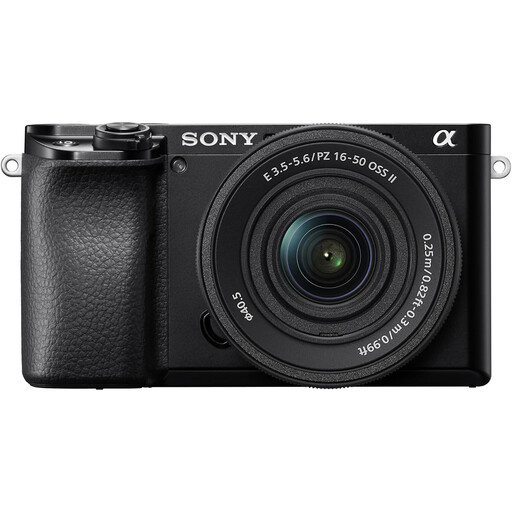 Image unavailable
A zoom kit could suit whole-cake framing, but confirm the lens included with this exact A6100 variant: its listing gives both 16–55 mm and 16–50 mm ranges. Check its close-focus capability separately if you photograph small decorations.
 Image unavailable
Consider the supplied zoom for whole-cake and table-scene compositions, rather than assuming full frame is necessary for those shots. Check a separate compatible close-focus lens if piping or sugar-work details are a priority.
No: an APS-C mirrorless camera can suit decorated-cake photography when its lens gives you the framing and close-focus capability you need. Check the available shooting distance and the lens’s field of view before choosing a sensor format.
Start with a standard zoom if complete cakes and overhead arrangements are your priority; choose a compatible macro lens when tiny decorations need to fill the frame. Nikon, Sony and Fujifilm specify 1:1 macro options for their respective systems, while Canon specifies 0.5x magnification for its RF 35mm F1.8 Macro IS STM.
Depth of field becomes shallow at close focusing distances, so a raised decoration may not all be in focus. Nikon’s food-macro guidance describes using smaller apertures for more depth of field, with enough light to compensate; support the camera and test both aperture and focus placement for your particular cake.
Check the warranty terms for the exact camera, seller and bundle before ordering. The Joybuy listing for the Sony α6400 ILCE-6400L with 16–50 mm lens states a one-year manufacturer’s warranty; do not assume the same terms apply to another variant or seller.