What to check before buying
For dried flowers on a shared bench, decide how much of the subject must be sharp, how small a detail you need to frame and whether the camera will also be used away from a fixed setup.
| Concern |
What to check |
Who this matters to |
| Sharpness through layered flowers |
Check the exact body’s focus-bracketing options, how the frames are combined and whether a rigid support will fit on the bench. |
If overlapping petals must be sharp from front to back, I need the flowers and camera to stay still throughout a focus sequence. Around 46% of consumers put this depth-of-field need first. |
| Magnification and room for lighting |
Compare the exact lens’s maximum magnification and working distance from its front to the subject; allow space for a light or reflector. |
For tiny textures on a crowded bench, I need close framing without putting the lens in the light’s path. Roughly 27% of consumers prioritise this balance. |
| Flexible workshop shooting |
Check whether stabilisation is in the body or lens, how the screen moves and whether the intended lens suits both close-ups and wider views. |
When I move between flower photographs and general workshop images, I want a setup I can use as the light and camera position change. Around 27% of consumers place that flexibility first. |
Brands to consider
These camera-and-lens combinations illustrate different ways to photograph dried flowers; the characteristics described here apply to the named models, not every product from each brand.
Canon
The EOS R10 and RF 35mm F1.8 Macro IS STM provide a close-focus route for stationary arrangements.
- Canon documents focus bracketing and in-camera depth compositing for the EOS R10.
- The RF 35mm lens reaches 0.5x magnification, not life-size 1:1; check whether that frames your smallest details closely enough.
Nikon
A Z50II paired with the NIKKOR Z MC 50mm f/2.8 is a route to 1:1 photographs of small floral details.
- Nikon specifies life-size 1:1 magnification for the named lens.
- At close focus, check whether the lens leaves enough room to position lighting. Confirm your preferred focus-stacking workflow separately.
Sony
The α6700 combines an APS-C body with in-body stabilisation; the E 30mm F3.5 Macro is a separate 1:1 lens option.
- Sony specifies five-axis in-body stabilisation for the α6700 and 1:1 magnification for the E 30mm lens.
- At maximum magnification, the E 30mm lens has about 2.4 cm working distance, which can restrict light placement around the flowers.
Joybuy cameras for workshop photography
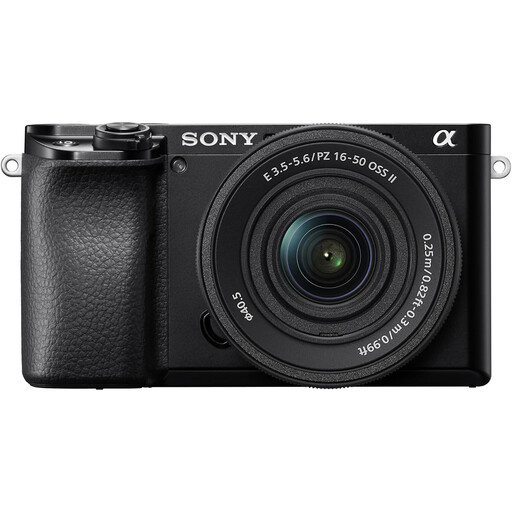
These Sony APS-C camera kits suit consideration for general workshop images and varied bench-level framing. Before choosing one for detailed dried-flower close-ups, check the bundled lens’s close-focus capability and whether you need a compatible macro lens or a separate focus-stacking workflow.
 No image available
Sony A6400 with 16–50mm Power Zoom lens
Consider this kit if you want a zoom for general workshop photographs as well as flower compositions. Check the included lens’s close-focus capability and the focus workflow you would use for layered detail.
View on Joybuy
 No image available
Sony A6700 with 16–50mm lens
Consider this kit if handheld general workshop photographs are part of the job: Sony specifies five-axis in-body stabilisation for the α6700. For close flower detail, check the bundled zoom’s magnification and whether a separate macro lens fits your intended lighting setup.
View on Joybuy
 No image available
Sony Alpha ZV-E10 II K with 16–50 mm f/3.5–5.6 Power Zoom
Consider this camera-and-zoom kit if you also make general workshop images or video. Check whether the included lens frames your smallest floral details closely enough, and plan a stable setup if sharpness across layered petals is the priority.
View on Joybuy
 No image available
Sony A6100 zoom-lens kit
Consider the A6100 for general workshop and flower photographs, but confirm the exact bundled lens before choosing this kit: its title says 16–55mm, while the detailed specification identifies an E 16–50mm lens. Check that lens’s close-focus capability and the camera workflow you intend to use for layered subjects.
View on Joybuy
Frequently asked questions
Do I need a 1:1 macro lens to photograph dried flowers?
Not necessarily: the magnification you need depends on how tightly you want to frame the subject. Canon’s RF 35mm F1.8 Macro reaches 0.5x, while Nikon’s NIKKOR Z MC 50mm f/2.8 and Sony’s E 30mm F3.5 Macro reach life-size 1:1 for smaller details; check the exact lens rather than the camera body alone.
Why use a support if the camera has stabilisation?
Stabilisation can reduce blur from camera movement, but it does not extend the depth of field through a layered flower. For a stationary close-up or a sequence of frames focused at different distances, keep the camera and arrangement steady; Canon recommends a tripod or other support for still-life macro work.
Will focus stacking work on a dried-flower arrangement?
Yes, if the flowers, camera and lighting stay still during the sequence. Canon documents focus bracketing and in-camera depth compositing for the EOS R10; moving petals, bench vibration or changing illumination can disrupt the combined image.
What should I check before setting up lights or charging in a shared workshop?
Ask the workshop operator which power points, charging locations and equipment positions are permitted, and keep shared routes clear. The Health and Safety Executive explains that workplace processes involving hazards such as flammables or combustible dust require appropriate fire precautions and risk assessment; the rules for your setup depend on the work taking place there.


