Choose the lens before the camera body if individual embroidery stitches need to fill the frame: a 1:1 macro lens offers greater reproduction scale than a 0.5x lens, which can suit broader motifs and finished pieces. Whichever route you take, a stable camera position, controlled lighting and a clean white background matter; close-up work also demands careful focusing.
Who is this setup for?
Stitch-detail documenters
If you need to show individual thread paths, stitch density or small construction details, lens magnification is a deciding factor. A 1:1 macro lens reproduces a subject at life size on the sensor, giving you a route to frame-filling close-ups.
Consistent catalogue-image makers
If you photograph finished embroidery or commissions repeatedly, you need a clean background and lighting you can control from one session to the next. Adobe’s product-photography guidance emphasises a controlled environment, good lighting and a clean background.
Beginner tabletop photographers
If you mainly photograph whole pieces and occasionally move in closer, a screen you can view from above or beside the table can make framing less awkward. Canon lists a vari-angle touchscreen for the EOS R50, as does Nikon for the Z50II.
What matters when choosing?
Decide how small an area must fill the photograph before choosing a body, then plan how you will hold the camera steady and light the embroidery against white.
| Concern |
What to check |
Who this matters to |
| Stitch-level magnification |
Check the exact lens’s maximum magnification. Sony specifies 1:1 for its E 30mm F3.5 Macro; Canon specifies up to 0.5x for its RF 35mm F1.8 Macro. |
If I need individual threads to occupy much of the image, I would choose the lens for that close-up scale rather than assume a supplied zoom will do it. Around 42% of consumers put stitch-level magnification first. |
| Repeatable white-background images |
Plan for a clean background, controlled lighting and a stable camera position. Check whether the screen is viewable from your shooting position. |
For a catalogue of finished pieces, I need the background and lighting to remain consistent across photographs. Around 33% of consumers chiefly prioritise that repeatable presentation. |
| Manageable tabletop setup |
Check screen movement, lens-mount compatibility and space for a tripod or other support. |
If I am starting with whole hoops or flat textiles, I want to frame from above without struggling to see the screen. Around 25% of consumers place a straightforward tabletop workflow first. |
What can complicate the setup?
-
Buying the body before deciding how close to shoot
The body alone does not determine reproduction scale. Sony specifies 1:1 magnification for its E 30mm F3.5 Macro, while Canon specifies up to 0.5x for its RF 35mm F1.8 Macro.
Decide whether you need frame-filling stitch detail, then check the maximum magnification and mount of the exact lens you plan to use.
A body-and-zoom kit may still require a separate macro lens for the close-up scale you want.
-
Expecting the background to photograph evenly by itself
A white surface does not remove shadows or uneven illumination. Adobe’s product-photography guidance calls for a controlled environment, good lighting and a clean background.
Leave room in your workspace for lighting and a stable camera position, and inspect the background as well as the embroidery in test frames.
Lights, diffusion or a camera support may add equipment and setup time.
-
Relying on resolution to keep every stitch sharp
Canon’s macro guidance notes that depth of field becomes very small at close range, making accurate focus demanding.
Keep static embroidery and the camera steady, inspect the area that matters at the intended output size, and consider multiple focus positions when a raised surface cannot be captured sharply in one frame.
-
Overlooking space between the lens and the embroidery
Sony specifies a 2.4 cm minimum working distance from the front of its E 30mm F3.5 Macro lens. That leaves little room to position lights around raised stitches.
Check a prospective lens’s working distance, not just its magnification, against your lighting arrangement.
Brands to consider for this setup
Canon
The EOS R50 and RF lens system offer a route for tabletop composition and broader embroidery close-ups.
- Canon UK lists a 24.2MP APS-C sensor, vari-angle touchscreen and Focus Bracketing Single Shot for the EOS R50.
- Canon specifies up to 0.5x magnification for the RF 35mm F1.8 Macro. Check whether that scale is sufficient if individual stitches need to fill the frame.
Nikon
The Z50II is a camera-body option for composing embroidery photographs from a tabletop or overhead position.
- Nikon UK lists a vari-angle touchscreen and an electronic viewfinder that previews settings on the Z50II.
- Choose a compatible close-up lens separately and check its specified magnification and working distance for the stitch scale you need.
Sony
Sony E-mount offers a documented 1:1 macro-lens route for close views of embroidery stitches.
- Sony UK specifies a 24.2MP APS-C sensor and E-mount compatibility for the α6400, and 1:1 magnification for the E 30mm F3.5 Macro lens.
- Sony specifies a 2.4 cm minimum working distance from the front of that macro lens, which can restrict light placement.
Joybuy camera choices for a tabletop setup
These Sony camera-and-zoom kits are choices for photographing whole embroidery pieces while considering a separate macro lens for stitch-level close-ups. Check the supplied lens’s close-focus specification before relying on either kit for individual-stitch images.
 No image available
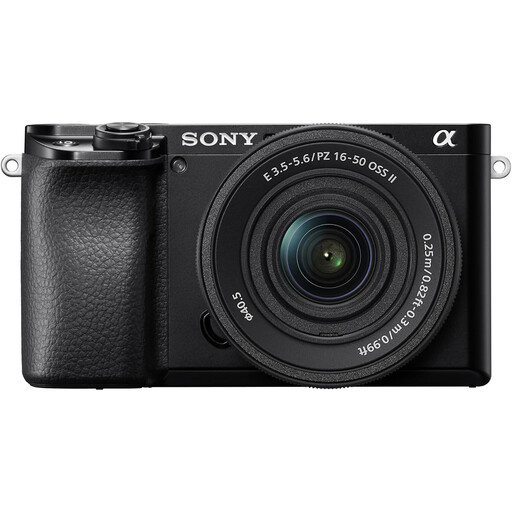
Sony A6400 with 16–50mm Power Zoom Lens
Consider this kit for photographing whole pieces now if you plan to choose a separate close-up lens for smaller stitch details.
The named kit includes a 16–50mm power zoom lens. For stitch-level work, check that lens’s maximum magnification or plan for a compatible macro lens; Sony UK specifies E-mount compatibility for the α6400.
View on Joybuy
 No image available
Sony A6100 with 16–55mm Zoom Lens
Consider this kit for whole-piece tabletop photographs, with the lens choice for tighter stitch views made separately.
The named kit includes a 16–55mm zoom lens. Check the exact supplied lens’s close-focus capability and compatibility with any macro lens you intend to add.
View on Joybuy
Common questions
Do I need a 1:1 macro lens to photograph embroidery?
Not for every photograph: a 0.5x lens can suit motifs, hoops and broader details. Choose a 1:1 lens when small stitch sections need to occupy much of the frame, and check the exact lens specification rather than assuming a supplied zoom offers that magnification.
Why are only some stitches sharp in a close-up?
Depth of field becomes very small at close range, so stitches at different distances from the camera may not all appear sharp in one frame. Canon’s macro guidance emphasises accurate focusing; use stable support and, for raised static embroidery, consider taking frames at different focus positions.
Will a mirrorless camera make a white background look even?
Not by itself: the background and lighting need to be controlled. Adobe’s product-photography guidance identifies good lighting, a clean background and a controlled environment as foundations for clear product images.
Is a vari-angle screen useful for overhead embroidery photos?
Yes, it can let you view the composition when the camera sits above a hoop or tabletop rather than at eye level. Canon lists a vari-angle touchscreen for the EOS R50 and Nikon lists one for the Z50II; either setup still needs a stable camera position and room for lighting.


