What matters when choosing?
Start with the largest folded item and the height available above the table. Check that framing and support arrangement before deciding how much close-up capability you need for supplementary images.
| Concern |
What to check |
Who this matters to |
| Repeatable overhead framing |
Check the support’s load rating for the complete kit and whether you can view the screen when the camera is mounted. |
If I photograph batches of folded items, I need to reset the camera without changing the composition each time; around 42% of consumers put repeatable framing first. |
| Space and portability |
Compare the complete kit with your storage space, table clearance and available mounting height. |
When I have to clear a shared table after each session, a kit I can move and store is my priority; roughly 33% of consumers chiefly need that flexibility. |
| Close textile detail |
Check the exact lens’s maximum magnification and working distance for the details you need to show. |
If customers need to see stitching, labels or weave separately from the whole-item shot, I prioritise close detail; about 25% of consumers place that need first. |
Relevant brands to consider
These camera-and-lens examples offer different ways to balance carrying weight, overhead framing and close detail; the figures describe the named products, not every model from each brand.
Fujifilm
An APS-C option built around the X-S20 body and XF30mmF2.8 R LM WR Macro lens.
- Fujifilm lists the X-S20 body at 491g and specifies 1:1 magnification for the XF30mmF2.8 macro lens.
- The body’s stated stabilisation rating does not establish sharpness or consistent framing in a particular overhead arrangement; check the complete kit against your support.
Nikon
A full-frame Z-mount option combining the Z5II with the NIKKOR Z MC 50mm f/2.8 for close details.
- Nikon specifies a 24.5MP sensor for the Z5II and 1:1 magnification for the Z MC 50mm f/2.8.
- Before using the 50mm lens for a whole folded item, check whether the workshop mount can place the camera high enough to frame it.
Sony
A full-frame option pairing the α7C II body with the FE 50mm F2.8 Macro for supplementary detail images.
- Sony specifies a 33.0MP sensor for the α7C II and 1:1 magnification for the FE 50mm F2.8 Macro.
- Check the available overhead height for whole-item framing with the 50mm lens. Sony’s stated stabilisation figure is not a substitute for a fixed mount.
Canon
A full-frame option pairing the EOS R8 with the close-focusing RF 35mm F1.8 Macro IS STM.
- Canon lists the EOS R8 body at approximately 414g and specifies a 17cm minimum focusing distance for the RF 35mm lens.
- The cited lens reaches up to 1:2 rather than 1:1 magnification. Canon’s EOS R8 manual describes lens-based image stabilisation, so check the lens and support you plan to use.
Joybuy camera kits
These interchangeable-lens camera kits include zoom lenses for planning whole-item shots. Before choosing one for an overhead workspace, check the complete kit’s mounting fit and whether its lens meets your close-detail needs.
 No image available
Sony A6700 APS-C with 16–50mm lens
Consider this zoom kit if you need to frame folded items at different sizes. Check that its screen remains usable on your overhead support and that the included lens can focus closely enough for weave or label shots.
View on Joybuy
 No image available
Sony A6400 APS-C with 16–50mm power zoom lens
The included zoom makes this a kit to assess for whole-item framing. Check the view from its tilting screen on your intended mount, and confirm the lens’s close-focus capability if detail images are essential.
View on Joybuy
 No image available
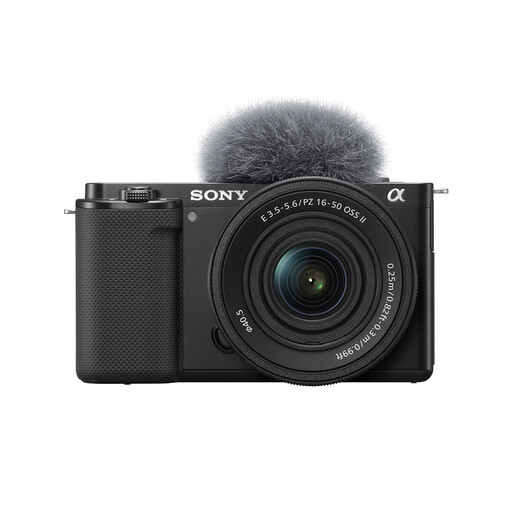
Sony Alpha ZV-E10 II K with 16–50 mm f/3.5–5.6 power zoom kit lens
This APS-C zoom kit is worth assessing where the camera must be positioned at an awkward angle above the table. Check screen access, the complete kit’s mounting fit and whether the lens meets your close-detail requirements.
View on Joybuy
 No image available
Sony Alpha 7 III full-frame with 28–70mm zoom lens
Assess this full-frame zoom kit against the height available for your whole-item shots. Its tilting screen needs a visibility check on the intended overhead mount; confirm close-focus suitability separately if you need small textile details.
View on Joybuy
 No image available
Sony ZV-E10K with 16–50mm power zoom lens
Consider this zoom kit if screen access is important when composing above a worktable. Check how its screen moves around your mount, along with the support’s load rating and the lens’s suitability for detail shots.
View on Joybuy
Common questions
Do I need a macro lens for folded-textile photographs?
Not necessarily for a whole-item image, but a macro or close-focusing lens may matter for separate views of weave, seams and labels. Check the detail size you need to show: Fujifilm, Nikon and Sony specify 1:1 magnification for the cited lenses, while Canon specifies up to 1:2 for the cited RF 35mm lens.
Do I need in-body stabilisation for overhead shots?
No: a secure overhead support addresses repeatable positioning more directly than in-body stabilisation. Stabilisation can still matter for handheld supplementary images; check whether the exact body-and-lens combination provides the method you want.
What should I check before mounting a camera above a shared worktable?
Check the support’s load rating against the complete camera-and-lens kit, then test screen visibility and whether the available height fits your largest folded item in the frame. Body weight alone will not establish whether the assembled setup fits.
What if other people appear in workshop product photos?
If people can be identified and a business or organisation handles the photographs, personal-data obligations may apply. Keep people out of product shots where practical, and follow the workshop’s arrangements for taking, storing and sharing images that identify anyone.


