For repeatable photographs of complete folded textiles, start with a mirrorless camera, a standard zoom that frames your usual items, stable support and controlled lighting. Check screen position and your colour-editing workflow before paying for features aimed at moving subjects. Add a dedicated macro lens when weave, stitching or small labels need to fill the frame; its working distance may make lighting harder to arrange.
Who needs which setup?
Repeatable catalogue-stills sellers
If most images show an entire folded item, concentrate on consistent framing and colour. A screen you can see from your camera position, a suitable standard zoom and an editable image workflow are more pertinent checks than rapid continuous shooting. Adobe UK identifies clarity and colour accuracy as important to product photographs.
Texture and workmanship detail sellers
If customers need to inspect weave, yarn, stitching or labels, check lens magnification as well as how much room remains for lighting at close range. A kit zoom that focuses close does not necessarily provide life-size macro images.
Photo-and-video catalogue creators
If you also make product demonstrations or review clips, consider the screen position, video features and connections you will use. Nikon, for example, specifies a Product Review Mode for the Z50II; video features need not drive a purchase intended mainly for still photographs.
What matters when choosing?
Decide what your usual photograph must show, then check whether the camera and lens fit your shooting position. Treat close-detail photography and video as separate requirements rather than assuming every textile listing needs them.
| Concern |
What to check |
Who this matters to |
| Consistent full-item images |
Check framing with your usual textile sizes, RAW capture if you intend to edit files, and exposure and white-balance controls. |
I need the colour and framing of successive catalogue images to stay consistent so customers can judge items without handling them; around 31% of consumers put this workflow first. |
| Overhead and tabletop handling |
Check screen movement, lens focal range and whether your support can safely hold the camera in the intended position. |
When the camera sits above a table, I need to compose each folded item without struggling to see the screen; roughly 31% of consumers prioritise this handling need. |
| Weave and stitching detail |
Compare lens magnification and working distance, particularly if small details must fill the frame. |
I need customers to inspect stitching or weave closely, but I still need room to position the light; around 23% of consumers make detail capture their primary concern. |
| Stills and product video |
Confirm the video modes, screen position and audio connections your planned clips require. |
If I make demonstrations alongside catalogue photographs, I need a camera that accommodates both tasks; about 15% of consumers put this mixed workflow first. |
Buying pitfalls
-
Assuming a close-focusing zoom is a macro lens
Canon specifies 0.25x magnification for the RF-S 18-45mm zoom, while Sony specifies 1:1 magnification for the E 30mm F3.5 Macro. That difference matters when a small stitch or section of weave must occupy much of the image.
Decide whether your listings need complete-item frames, moderate close-ups or frame-filling details before choosing a lens.
Frame-filling 1:1 details may call for a separate macro lens.
-
Prioritising action features over repeatable lighting
Adobe UK emphasises clarity and colour accuracy in ecommerce photography. For a stationary folded textile, inconsistent light and white balance can affect how the item is represented even when the camera has fast shooting features.
Plan a stable camera position, repeatable light placement and a consistent editing process before deciding which speed-related features matter to you.
-
Overlooking a macro lens’s working distance
Sony specifies a minimum working distance of 2.4 cm for the E 30mm F3.5 Macro at maximum magnification. With the lens that close to the fabric, positioning light without casting shadows takes more care.
Check whether your lighting arrangement works at the magnification you need, and use a suitable wider-framing lens for complete folded-item photographs.
Close-detail shots may require more deliberate light placement or additional small lighting accessories.
-
Assuming the charging accessories are in the box
Canon states that a USB-C charger is not included with the EOS R50 body.
Check the contents of the exact body or kit you plan to buy, then confirm that your charging arrangement is suitable.
An appropriate charger may be an additional accessory for that EOS R50 body package.
Brands to consider for these camera routes
Canon
The EOS R50 and RF-S 18-45mm zoom are a route to complete folded-item frames and moderate close-ups.
- Canon specifies a 24.2 MP APS-C sensor for the EOS R50 and 15 cm minimum focusing distance with 0.25x magnification for the RF-S 18-45mm lens.
- The zoom is not a 1:1 macro lens. Canon also states that a USB-C charger is not included with the EOS R50 body.
Nikon
The Z50II is worth considering when tabletop stills are joined by product-review video.
- Nikon specifies a 20.9 MP DX sensor for the Z50II, Product Review Mode and a 0.2 m minimum focusing distance for the NIKKOR Z DX 16-50mm f/3.5-6.3 VR.
- That standard zoom is not a dedicated macro lens; assess it against the size of the textile details you need to show.
Sony
The α6400 paired with the E 30mm F3.5 Macro addresses listings where close views of textile construction are a priority.
- Sony specifies a 24.2 MP APS-C sensor and RAW recording for the α6400, and 1:1 magnification for the E 30mm F3.5 Macro.
- At maximum magnification, the macro lens’s specified 2.4 cm working distance leaves little space for light placement.
Joybuy product choices
These camera-and-zoom combinations are relevant to framing folded textiles and, for some models, making product clips. Before relying on an included zoom for weave or stitching close-ups, check its magnification and working distance for the exact lens supplied.
 No image available
Sony Alpha ZV-E10 II K with 16–50 mm power zoom kit lens
Consider this combination if your textile listings will include both photographs and video clips. The product name specifies an APS-C mirrorless camera, a 26-megapixel sensor, a 16–50 mm f/3.5–5.6 power zoom and 4K60p video. Check the included lens’s close-up capability before planning frame-filling weave or stitch images.
View on Joybuy
 No image available
Sony Alpha 7 III with 28–70mm zoom lens
This full-frame camera-and-zoom combination is an option for complete folded-item photographs when the 28–70mm focal range suits your camera position. Confirm the supplied lens’s magnification and working distance if close views of textile construction are essential.
View on Joybuy
 No image available
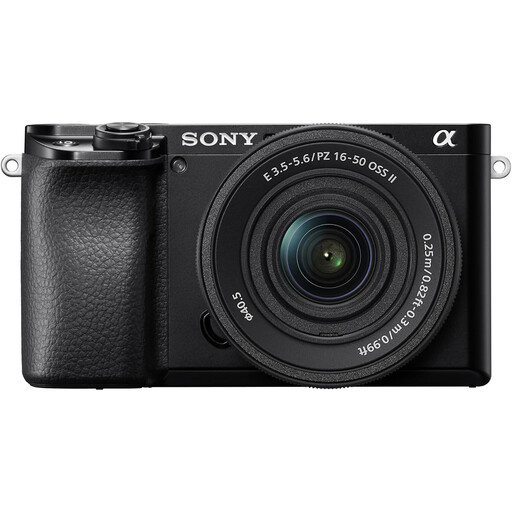
Sony A6400 with 16–50mm power zoom lens
The included zoom gives you a stated focal range to assess against your usual folded-item sizes. The product name identifies an APS-C camera and a 16–50mm power zoom; Sony specifies a 24.2 MP sensor and RAW recording for the α6400 body. This zoom is a different lens from Sony’s E 30mm F3.5 Macro, so check its own close-up specifications before choosing it for fine detail.
View on Joybuy
 No image available
Sony A6700 with 16–50mm lens
Consider the supplied zoom’s 16–50mm range against the space available for framing complete folded items. The product name identifies an APS-C mirrorless camera; check the exact included lens’s close-focus and magnification specifications if small textile details are part of your listings.
View on Joybuy
 No image available
Sony A6100 with 16–55mm zoom lens
For complete folded-item frames, assess whether the stated 16–55mm zoom range suits your table size and camera position. The product name identifies an APS-C mirrorless camera; confirm the exact included lens and its close-up specifications if you also need detailed weave or stitching photographs.
View on Joybuy
Frequently asked questions
Is a kit zoom enough for folded-textile photographs?
A standard zoom can suit complete folded-item frames and moderate close-ups when its framing and focus range work in your setup. Canon specifies 15 cm minimum focusing distance and 0.25x magnification for the RF-S 18-45mm, while Nikon specifies 0.2 m minimum focusing distance for the NIKKOR Z DX 16-50mm f/3.5-6.3 VR. If a small stitch or section of weave must fill the frame, check whether you need a dedicated macro lens.
Should megapixels decide which camera I buy?
Megapixels matter more if you routinely crop heavily, but they do not settle the choice on their own. Canon and Sony specify 24.2 MP for the EOS R50 and α6400 respectively, while Nikon specifies 20.9 MP for the Z50II; also assess your lens, lighting, focus and framing for the textile images you intend to make.
Why is a macro lens harder to light at close range?
A short working distance leaves less room between the lens and fabric for positioning light. Sony specifies a 2.4 cm minimum working distance for the E 30mm F3.5 Macro at maximum magnification, so check how you will avoid lens or camera shadows before relying on it for close-detail frames.


