Choose a camera system around the detail you need, the lens that can frame the paperweight closely enough and whether you will use multi-shot processing. For a stationary studio subject, Nikon says Z 8 firmware 3.00 can combine pixel shift with focus shift; higher-resolution single-frame routes are also available, but no camera body removes the need to control reflections and keep the setup stable.
Who these camera systems suit
Precision studio still-life photographers
If the paperweight stays still on a tripod and you need fine detail with more of the object in focus, Nikon's documented Z 8 pixel-shift and focus-shift combination is worth considering. It still requires a stable scene and controlled reflections.
Large-print and archival-detail buyers
If cropping or large output makes native capture resolution important, compare the resolution of the camera bodies alongside your file-handling capacity. Sony specifies 61.0 effective megapixels for the α7R V, while Fujifilm specifies 102 megapixels for the GFX100 II.
Close-up system builders
If small inclusions or signatures must fill the frame, assess the lens as carefully as the body. Nikon specifies 1:1 reproduction for the NIKKOR Z MC 105mm f/2.8 VR S; Canon specifies 1.4x maximum magnification for the RF 100mm F2.8L Macro IS USM.
What matters when choosing
Start with the framing and reflection control your paperweight needs, then decide whether native resolution or a multi-shot workflow would change the output you plan to make. Assess the body and compatible lens as one system.
| Concern |
What to check |
Who this matters to |
| Reflections against a dark background |
Allow space for a stable setup and deliberate control of the lighting and reflected surroundings; a higher-resolution body will not remove glare. |
Against a dark background, I need the glass edges to remain visible without distracting reflections; around 36% of consumers put reflection control first. |
| Close-up and output detail |
Check the lens magnification needed for small features and the body's native resolution for your intended crop or print. |
If I need to show a small inclusion or make a large print, I want enough detail at the framing I can actually achieve; roughly 29% of consumers prioritise close-up and output detail. |
| Front-to-back sharpness |
Confirm the exact model's focus-bracketing or focus-shift method, firmware requirements and whether a finished image needs processing. |
When a close-up leaves part of the paperweight out of focus, I need a repeatable way to capture its depth; about 21% of consumers make the deep-focus workflow their primary concern. |
| A complete, compatible system |
Check lens-mount compatibility and account for the macro lens, support and file storage alongside the body. |
Rather than choosing a body in isolation, I need a compatible close-up setup I can use together; around 14% of consumers put the complete system first. |
Buying pitfalls
-
Putting the whole budget into the camera body
The body alone does not provide the close-up framing needed for a small signature or inclusion. Nikon's 1:1 Z-mount macro lens and Canon's 1.4x RF macro lens are separate lenses.
Compare complete body-and-lens setups before choosing a camera.
A compatible macro lens, stable support and lighting accessories may be additional purchases.
-
Expecting pixel shift to fix reflections
Multi-shot capture needs the subject, camera and reflected environment to remain stable. Sony describes computer compositing for its α7R V Pixel Shift Multi Shooting, while Canon describes a nine-shot high-resolution mode for the EOS R5.
Control the lighting and reflections before deciding whether a multi-shot mode is useful for your output.
-
Assuming a focus feature produces a finished sharp image
Capturing frames at different focus positions is not the same as receiving a completed composite. Nikon's documented combination of pixel shift and focus shift is specific to the Z 8 with firmware 3.00.
Check the exact body, installed firmware and processing steps before relying on a focus-stacking workflow.
-
Overlooking high-resolution file handling
High native resolution and multi-shot capture can make storage and editing more demanding than a single-frame workflow.
Check that your memory cards, computer, editing process and backups suit the files you intend to create.
Relevant camera brands for reference
Nikon
The Z 8 offers a documented multi-shot route for stationary, intricate subjects.
- Nikon states that Z 8 firmware 3.00 can combine pixel shift with focus shift. Its NIKKOR Z MC 105mm f/2.8 VR S lens offers 1:1 reproduction.
- That combination depends on the specified body and firmware, a suitable lens and a stable setup; it does not control reflections.
Sony
The α7R V combines high native resolution with optional focus-bracketing and pixel-shift workflows.
- Sony specifies 61.0 effective megapixels and Pixel Shift Multi Shooting with up to 16 frames.
- Sony's pixel-shift frames require computer compositing and a scene that remains unchanged between captures.
Canon
The EOS R5 is an RF-system route with native capture and an optional multi-shot high-resolution mode.
- Canon specifies a 45-megapixel EOS R5 sensor and a nine-shot mode producing a 400-megapixel image. Its separate RF 100mm F2.8L Macro IS USM lens reaches 1.4x magnification.
- The multi-shot mode needs a controlled scene, and the cited macro capability depends on using the separate lens.
Fujifilm
The GFX100 II is a large-format route for buyers prioritising native capture resolution.
- Fujifilm specifies a 102-megapixel sensor for the GFX100 II.
- Sensor resolution alone does not establish close-up framing or front-to-back sharpness; check the G-mount lens and workflow needed for your subject.
Mirrorless camera kits on Joybuy
These interchangeable-lens kits offer starting points for a controlled still-life setup. Before choosing one for tiny paperweight details, check the supplied lens's close-focus ability and whether you will need a compatible macro lens.
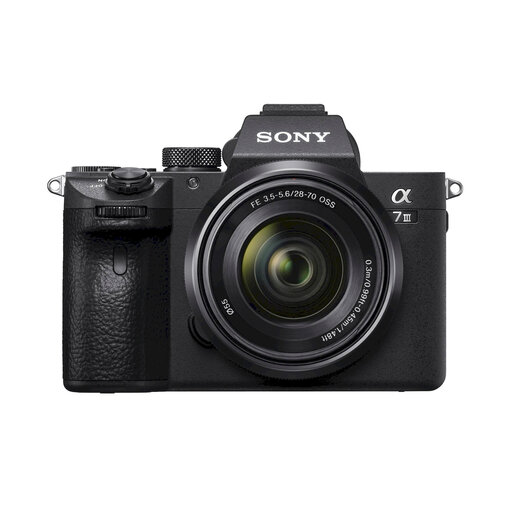 Image unavailable
Sony Alpha 7 III Full-Frame Camera with 28–70mm Zoom
Consider this kit if you want to start with the supplied zoom for a still-life setup. Check its close-focus distance and magnification before relying on it for small inclusions; also confirm any focus-bracketing and support requirements important to your workflow.
View on Joybuy
 Image unavailable
Sony A6700 APS-C Camera with 16–50mm Lens
This interchangeable-lens kit is an option for building an APS-C still-life setup. Check whether the supplied zoom frames your smallest details closely enough, and confirm the focus and support features you plan to use.
View on Joybuy
 Image unavailable
Sony Alpha ZV-E10 II K with 16–50 mm f/3.5-5.6 Power Zoom
Consider this APS-C kit for single-frame still-life photographs where its 26-megapixel capture meets your output needs. Check the supplied lens's close-focus ability for small paperweight features, and confirm the processing workflow if deep-focus composites matter.
View on Joybuy
 Image unavailable
Sony A6400 APS-C Camera with 16–50mm Power Zoom
This kit provides an interchangeable-lens starting point for a deliberate still-life setup. Before choosing it for close-up glass work, check how tightly the supplied zoom can frame small details and whether the body supports the focus workflow you need.
View on Joybuy
Frequently asked questions
Do I need pixel shift to photograph glass paperweights?
No: start with suitable close-up framing, stable support and controlled reflections, then consider pixel shift if your output calls for extra detail. Nikon says Z 8 firmware 3.00 can combine pixel shift with focus shift, but a multi-shot sequence needs the paperweight and reflected surroundings to remain still.
Should I choose a macro lens before a higher-resolution body?
If a small signature or inclusion needs to fill the frame, check lens magnification before paying for more camera resolution. Nikon specifies 1:1 reproduction for the NIKKOR Z MC 105mm f/2.8 VR S, and Canon specifies 1.4x maximum magnification for the RF 100mm F2.8L Macro IS USM; each must be paired with a compatible system.
What should I check before relying on focus stacking?
Confirm how the exact camera captures a focus sequence and how you will turn those frames into a finished image. Nikon ties the Z 8 pixel-shift-plus-focus-shift combination to firmware 3.00; whichever workflow you choose, keep the camera, paperweight, lighting and reflected surroundings stable throughout the sequence.


