Choose the lens and tabletop setup around the smallest costume-accessory detail you need to show: a true 1:1 macro lens makes sense for tiny clasps, stones and texture, while a 0.5x close-focus lens can suit complete-product shots and less demanding detail work. Neither route creates a clean white background by itself; stable support, a white sweep and diffused light remain important for sharp, repeatable images with controlled reflections.
Who is this setup for?
Small-detail catalogue sellers
If stones, clasps or fine ornament need to fill much of a product-detail image, start with the lens’s close-focus capability. Nikon UK and Sony UK document true 1:1 macro lenses that reproduce a subject life-size on the sensor.
White-background listing photographers
If you photograph glossy or faceted accessories repeatedly, plan the background and lighting alongside the camera. Shopify UK recommends a white backdrop, diffused light and tripod support for jewellery photography; reflections and front-to-back sharpness still need checking on your own items.
First-time interchangeable-lens buyers
If the camera must also handle general photographs, a body supplied with a zoom lens can cover broader framing. Check the exact supplied lens’s magnification before relying on it for very small accessory details.
What matters when choosing?
Decide how close the smallest detail must appear before choosing a body. Then plan enough room and stable support to light reflective accessories and repeat the same framing across listings.
True 1:1 macro system
Choose when: Tiny clasps, stones or textures need life-size reproduction on the sensor or substantial cropping.
Allow for: Narrow depth of field at close range and, depending on the lens, little space between its front and the accessory for lighting.
0.5x close-focus system
Choose when: Complete accessories and moderate detail shots matter more than life-size images of their smallest components.
Allow for: Smaller sensor-level reproduction than a 1:1 lens; check whether the resulting crop shows enough detail for your listings.
| Concern |
What to check |
Who this matters to |
| Close-up detail |
Compare the exact lens’s maximum magnification, minimum focus distance and compatibility with the camera mount. |
If small clasps or texture must remain clear after a tight crop, I need the lens to record them at a useful size. Around 36% of consumers put close-up detail first. |
| Reflections and sharpness |
Plan a white sweep, diffused light and rigid support; test focus bracketing or stacking for objects with visible depth. |
When shiny surfaces pick up glare and raised details fall out of focus, I need control over the lighting and the sharp area. Roughly 36% of consumers make reflection control and front-to-back sharpness their primary concern. |
| Repeatable workflow |
Check the lens mount, the file formats needed for editing, the support arrangement and the contents of the exact package. |
If I have many listings to photograph, I need a setup I can frame and use consistently without overlooking a required lens or accessory. For about 28% of consumers, that repeatable workflow is the main priority. |
Buying pitfalls
-
Choosing by megapixels without checking the lens
Body resolution does not tell you how large a tiny clasp or stone can be recorded on the sensor. The lens’s magnification and close-focus distance matter for that shot.
Identify the smallest feature you need to show, then check the specifications of the exact lens in the package. A supplied zoom should not be treated as a 1:1 macro lens without confirming its magnification.
A separate close-focus or macro lens may be needed for the detail shots you have in mind.
-
Expecting a camera setting to remove reflections
Metallic and faceted accessories can reflect lights, the camera and nearby objects even when the background appears white.
Test your most reflective item with a seamless white sweep and diffused light, adjusting the light and camera positions before settling on a repeatable arrangement.
The arrangement may also call for sweep material, diffusers or a light tent, stands and support.
-
Leaving no room to light a macro subject
A short distance from the front of the lens to the accessory can restrict where a diffuser or light fits. Sony UK specifies a 2.4 cm front working distance for the E 30mm F3.5 Macro; Nikon UK says the front of the NIKKOR Z MC 50mm f/2.8 can be about 5 cm from the subject at close focus.
Check front working distance as well as magnification, then test whether your lighting arrangement fits around the item.
-
Trying to fix shallow macro focus with a new body
At close range, parts of a dimensional accessory can fall outside the sharp area in a single exposure.
Use rigid support and test aperture choices. For deeper items, Canon UK describes focus stacking as combining frames focused at different distances to show more of the subject sharply.
Capturing and combining those frames can add editing time or require suitable software.
Relevant brands to consider
Nikon
The Z50II and NIKKOR Z MC 50mm f/2.8 form a DX-format Z-mount route to true 1:1 macro photographs.
- Nikon UK specifies 1:1 magnification and a 0.16 m minimum focus distance for the lens. On a DX body, it gives a 75 mm angle of view.
- Nikon UK says the lens front can be about 5 cm from the subject at close focus. Check whether that leaves room for the lighting you want around reflective pieces.
Sony
The α6400 with Sony’s E 30mm F3.5 Macro is an APS-C E-mount route to 1:1 close-up work.
- Sony UK documents 24.2 MP effective resolution and RAW recording for the α6400, and 1.0x magnification for the E 30mm F3.5 Macro.
- Sony UK specifies a 2.4 cm front working distance for that lens. Try the intended diffuser and light positions before relying on it for glossy accessories.
Canon
The EOS R50 with RF 35mm F1.8 Macro IS STM offers an APS-C route for complete-product photographs and less extreme close-ups.
- Canon UK specifies a 24.2 MP APS-C sensor for the EOS R50 and up to 0.5x magnification for the lens.
- The RF 35mm lens does not reach 1:1. If very small findings must fill the frame, compare the resulting crop with a true macro option.
Joybuy camera kits
These kits pair mirrorless bodies with zoom lenses for general accessory framing. If tiny details are central to your photographs, check the supplied lens’s magnification and close-focus distance before choosing a kit; the documented 1:1 and 0.5x lenses discussed above are separate lens choices, not the lenses named in these kits.
 Image unavailable
Sony Alpha ZV-E10 II K with 16–50 mm power zoom
Consider this APS-C kit for general accessory framing and a tabletop workflow. Its stated kit lens is a 16–50 mm f/3.5–5.6 power zoom, and the product title specifies 26 MP; check the lens’s magnification and minimum focus distance for your smallest details.
View on Joybuy
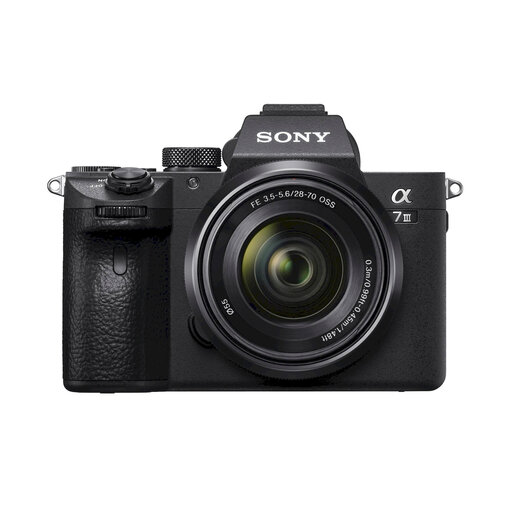 Image unavailable
Sony Alpha 7 III with 28–70 mm zoom lens
Consider this full-frame kit if you want a supplied zoom for complete-product framing. Before planning close crops of small findings, check the included 28–70 mm lens’s magnification and minimum focus distance.
View on Joybuy
 Image unavailable
Sony A6400 with 16–50 mm power zoom lens
Consider this APS-C kit for framing whole accessories with its supplied 16–50 mm zoom. Sony UK documents the α6400 as an E-mount body; check this kit lens’s magnification and minimum focus distance before deciding whether it covers your detail shots.
View on Joybuy
 Image unavailable
Sony A6700 APS-C with 16–50 mm lens
Consider this APS-C kit when a supplied 16–50 mm zoom suits your full-product framing. Check that lens’s close-focus distance and magnification against the smallest accessory feature you need to show.
View on Joybuy
Common questions
Do I need a true 1:1 macro lens for costume accessories?
Not for every shot: a 0.5x close-focus lens can suit complete accessories and moderate details. Choose a true 1:1 lens when tiny components need life-size reproduction on the sensor, and check the magnification of the exact lens rather than the camera body.
Why are parts of an accessory blurry in a macro photo?
The sharp area becomes narrow at close focus, so a raised clasp or stone may fall outside it. Use stable support, test the aperture and consider focus stacking for dimensional items; Canon UK describes stacking as combining frames focused at different distances.
Can a mirrorless camera create a clean white background on its own?
No: the background and reflections also depend on how you arrange and light the accessory. A continuous white sweep and diffused light give you control to test, especially with glossy or faceted pieces.
What should I check before buying a body-only camera?
Check that you have a compatible lens suited to both the whole accessory and its smallest required detail. A body-only package does not include a lens; also plan the stable support and lighting your white-background setup needs.


