Choose a mirrorless camera as part of a controlled lighting and colour workflow, rather than expecting the body alone to reproduce pottery glazes faithfully. For close surface detail, consider a body with focus bracketing alongside a suitable close-focus lens and stable support; for a studio setup that also serves handheld work, consider handling and stabilisation, while checking the conditions behind published ratings.
Who is this for?
Pottery sellers who need consistent colour
If photographs are used for listings, approvals or records, keeping the artificial light consistent and using a white-balance or colour reference matters. Calibrite describes reference targets for custom white balance and camera profiling.
Photographers of glaze texture and small details
Crystalline, speckled or raised surfaces can call for close framing and careful control of what stays in focus. Canon identifies focus bracketing and an appropriate macro kit as parts of a close-up workflow.
Creators moving between tabletop and handheld work
If the camera also records making-process shots away from the tabletop, handling and stabilisation become relevant. Fujifilm and Sony publish stabilisation specifications for the X-S20 and α6700, respectively, with conditions attached to their ratings.
What matters when choosing?
For pottery glazes under artificial light, decide whether repeatable colour, close-up depth or moving between setups is your primary need; then check the lens and lighting workflow alongside the body.
| Concern |
What to check |
Who this matters to |
| Consistent glaze colour |
Check RAW capture and custom white balance, and plan a reference target photographed under the same lighting as the pottery. |
If I rely on listing photographs to show a glaze, I need a colour process I can repeat, even when it takes more setup time. Around 46% of consumers put colour consistency first. |
| Close-up detail and depth |
Check focus-bracketing support and the intended lens’s magnification and working distance; plan stable support for sequences. |
When a textured rim or deep vessel needs more than one focus plane, I care about capturing the detail across the form. Roughly 36% of consumers make close-up detail their primary concern. |
| Flexible studio handling |
Compare the body and lens together for size and handling; read the test conditions behind stabilisation ratings. |
I move between tabletop photographs and handheld process shots, so carrying and positioning the camera matters to me. For around 18% of consumers, flexible handling takes priority. |
What should you avoid?
-
Expecting automatic white balance to settle glaze colour
Changing the light or relying on automatic white balance can make a repeatable colour workflow harder. Calibrite describes neutral and colour-reference targets for setting white balance and making colour corrections.
Photograph the pottery and reference target under the same lighting arrangement. Capture RAW if you intend to adjust colour during editing, rather than promising that photographs will match every viewing light.
Allow for a reference target and the time needed to maintain the capture and editing routine.
-
Treating a stabilisation rating as a close-up sharpness guarantee
Published stop ratings depend on stated test conditions. Fujifilm’s X-S20 rating, for example, is based on a CIPA test for pitch and yaw with the XF35mmF1.4 R lens; it does not establish results at every close-up distance.
Read the conditions for the body you choose and assess it at your intended framing and shutter speed. Use stable support for repeatable catalogue frames or focus-bracket sequences.
A tripod, copy stand or other stable support may be needed alongside the camera.
-
Using sensor resolution as a substitute for a close-focus lens
More pixels cannot bring an out-of-focus rim or inner wall into focus. Canon’s close-up guidance discusses focus stacking together with choosing an appropriate macro kit.
Check the lens’s maximum magnification, working distance and compatibility with the body before deciding whether a single frame or a focus-bracket sequence suits your pottery.
A suitable close-focus or macro lens may require a separate purchase.
Brands to consider for this work
Canon
The EOS R7 is a relevant EOS R-system body if focus bracketing is important for static pottery close-ups.
- Canon specifies a 32.5MP APS-C sensor and identifies in-built focus bracketing and stacking on the EOS R7.
- Canon’s up-to-7-stop stabilisation claim depends on collaborative body-and-lens operation. A suitable close-focus lens, stable support and controlled colour workflow remain separate decisions.
Fujifilm
The X-S20 is an X-mount example for a small-studio setup that also includes handheld work.
- Fujifilm specifies a 26.1MP APS-C sensor, 14-bit RAW and five-axis in-body stabilisation for the X-S20.
- Its up-to-7.0-stop rating is based on a CIPA pitch-and-yaw test with the XF35mmF1.4 R lens, not every lens or close-up arrangement.
Sony
The α6700 is an E-mount APS-C example for buyers considering an interchangeable-lens body for mixed tabletop and handheld work.
- Sony specifies approximately 26.0 effective megapixels, a 2500K–9900K colour-temperature setting range and five-axis in-body stabilisation for the α6700.
- Sony’s stated 5-step stabilisation figure is conditional on its test setup; it is not a promise of sharp handheld macro photographs.
Joybuy camera choices
These interchangeable-lens cameras are options for building a pottery-photography setup, from a supplied zoom for general framing to a body that leaves lens choice to you. Confirm close-focus capability and the exact bundle before relying on any option for glaze details.
 No image available
Sony Alpha ZV-E10 II K with 16–50mm f/3.5–5.6 Power Zoom
Consider this APS-C kit if you want a supplied zoom for general tabletop framing and expect to assess a different lens for closer glaze details.
The product title specifies 26 megapixels and a 16–50mm f/3.5–5.6 power zoom. Check that the lens reaches the magnification and working distance your pottery requires.
View on Joybuy
 No image available
Sony Alpha 7 III Full-Frame Camera, 28–70mm Zoom Listing
Consider this variant if you want a full-frame camera and are assessing the listed 28–70mm zoom for general pottery framing.
Confirm whether that lens is in the box before ordering. Check its close-focus magnification and working distance separately if small glaze details are the aim.
View on Joybuy
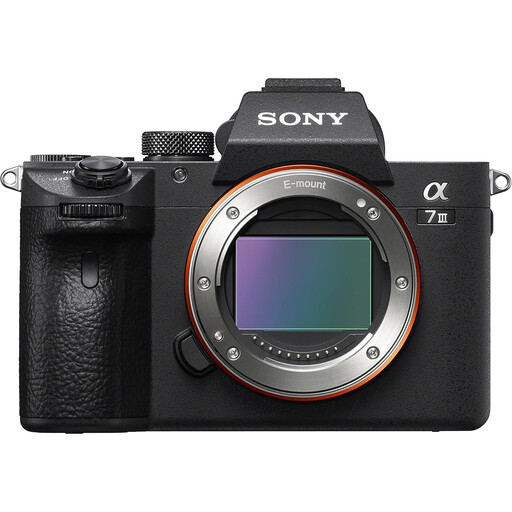 No image available
Sony Alpha 7 III Full-Frame Camera Body-Only Listing
Consider this listing if you want to choose a lens around your required pottery framing and close-focus distance.
The title says body only, but the accompanying bundle information also refers to a 28–70mm lens. Confirm the box contents before planning a lens purchase.
View on Joybuy
 No image available
Sony A6700 APS-C Camera with 16–50mm Lens
Consider this kit if your pottery setup also calls for occasional handheld photographs.
Sony specifies approximately 26.0 effective megapixels and five-axis in-body stabilisation for the α6700; its stabilisation rating has test conditions. Check the supplied lens’s close-focus capability and the colour controls you intend to use.
View on Joybuy
 No image available
Sony A6400 APS-C Camera with 16–50mm Power Zoom
Consider this interchangeable-lens kit for general tabletop framing if you are prepared to check the lens separately for close-up work.
The product title identifies an APS-C body and a 16–50mm power zoom. Before choosing it for colour-critical glaze photographs, check the RAW and custom white-balance workflow you need, as well as the lens’s working distance.
View on Joybuy
Common questions
Can the camera body alone make pottery-glaze colours accurate?
No: a repeatable lighting and colour-reference process matters alongside the body. Calibrite describes its white-balance and ColorChecker targets as tools for custom white balance, camera profiles and colour correction; use the reference under the light illuminating the pottery.
Do I need focus bracketing for pottery photographs?
Not for every photograph, but it can help with a static, deep or textured piece when one frame will not hold all the intended detail in focus. Canon identifies in-built bracketing and stacking on the EOS R7 and also points to the importance of an appropriate macro kit.
Does in-body stabilisation replace a tripod for glaze close-ups?
No: a published stabilisation rating does not guarantee sharp results at your chosen close-up distance. Fujifilm and Sony attach test conditions to the X-S20 and α6700 figures; stable support is useful when framing must stay consistent across catalogue photographs or focus-bracket sequences.
What if a camera bought online is faulty or not as described?
For a UK purchase, goods must be as described, fit for purpose and of satisfactory quality under the Consumer Rights Act 2015, as Coventry City Council Trading Standards explains. Keep the order details and contact the seller about the problem; a remedy for faulty or misdescribed goods is distinct from a change-of-mind return.


