For static photographs of vintage cameras, choose a mirrorless system around the detail you need, the space available for a close-focus lens and the lighting you can control. A higher-resolution body can help with cropping, while features intended for handheld use matter more if the camera will also leave the tabletop; neither choice removes the need to manage reflections or check the lens’s close-focus capability.
Who is this for?
Catalogue-detail photographers
If you photograph cameras for listings or collection records, readable engravings and room to crop may matter most. Consider the lens’s close-focus capability alongside resolution, RAW capture where needed and repeatable tripod framing.
Reflection-conscious tabletop photographers
Chrome, glass and glossy finishes make light placement part of the equipment decision. A compatible polariser may reduce some reflections at suitable angles, but its effect varies and it reduces the light reaching the camera, as Cambridge in Colour explains.
Collectors using one camera for more than objects
If the same camera will also be used handheld or in dimmer conditions, body features such as stabilisation may influence your choice. Check that the system also has a lens suited to the close details you want to photograph.
What matters when buying?
Start with the smallest detail that must fill the frame and the room available around your tabletop setup. Then weigh body resolution and non-studio features against the lighting and lens you will need.
| Concern | What to check | Who this matters to |
|---|
| Fine detail and cropping |
Compare effective resolution and the lens’s maximum magnification; check RAW availability if it matters to your workflow. |
I need engravings and surface texture to remain readable when I crop a full-camera photograph. Around 31% of consumers would put detail and cropping first. |
| Reflections and finish |
Plan adjustable lighting; check the chosen lens and filter fit before trying a polariser. |
Glossy surfaces can reflect my lights instead of showing the finish I want to record. For around 31% of consumers, controlling reflections would be the primary concern. |
| Close-focus lens and space |
Check lens-mount compatibility, maximum magnification and whether the shooting position leaves enough room. |
If small controls must fill the frame, I need a lens that can focus close enough without crowding my setup. Close-focus framing would come first for around 23% of consumers. |
| Use beyond the tabletop |
Compare the body features needed for your other photography, including stabilisation or low-light autofocus where relevant. |
I also want to use the camera away from controlled lights, so handheld features affect my decision. Around 15% of consumers would prioritise that flexibility. |
Buying pitfalls
-
Choosing resolution without checking the lens
A body’s pixel count does not tell you how large an engraving can appear in the frame. Nikon specifies 1:1 reproduction for its NIKKOR Z MC 105mm f/2.8 VR S, while Canon specifies up to 1.4x magnification for its RF 100mm F2.8L Macro IS USM; those are lens specifications, not body features.
Decide which details need a close-up, then check a compatible lens’s magnification and the space it needs. A dedicated macro lens is a separate system purchase unless the bundle explicitly includes one.
-
Expecting a polariser to fix every reflection
Polarisation changes with the viewing angle and filter rotation. Cambridge in Colour explains that a polariser can reduce some reflections, but it also reduces the light available for exposure.
Position and diffuse the lights first, then test a compatible polariser on the actual subject. Allow for a longer exposure if needed.
-
Choosing a long macro lens before measuring the setup
Nikon notes that its 105mm macro places the photographer farther from the subject than an 85mm portrait lens. That distance can be awkward on a small tabletop or copy stand.
Measure the available camera-to-subject distance and leave space for the tripod and lights before committing to a 100mm or 105mm macro lens.
-
Letting stabilisation decide a static-object purchase
Stabilisation addresses camera shake; it does not position the lights, control glare or choose the point of focus. Fujifilm and Nikon publish stabilisation ratings for the X-T5 and Z5II respectively, but those ratings do not describe a complete tabletop setup.
Give stable support, close-focus capability and light control priority for repeatable object photographs. Weigh stabilisation more heavily if you also shoot handheld.
Brands to consider for this setup
FUJIFILM
The X-T5 is an APS-C option for photographers who place particular weight on native resolution for static subjects.
- Fujifilm specifies a 40.2-megapixel sensor and a three-way tilting screen on the X-T5.
- Check the close-focus lens and lighting separately; its stated in-body stabilisation does not manage reflections.
Sony
The Alpha 7 IV is a full-frame option for buyers considering detailed stills and a RAW workflow alongside other photography.
- Sony specifies approximately 33.0 effective megapixels for the Alpha 7 IV.
- That body specification does not establish the magnification of the lens you will use for small markings.
Nikon
The Z5II and a compatible Z-mount macro lens form a route worth considering when handheld use and close detail both matter.
- Nikon states up to 7.5 stops of in-body stabilisation for the Z5II and specifies 1:1 reproduction for the separate NIKKOR Z MC 105mm f/2.8 VR S.
- The 105mm lens is a separate purchase and needs enough shooting room; neither specification controls reflected light.
Canon
The EOS R8 is a full-frame option to consider if the camera will serve both object photography and general use.
- Canon specifies a 24.2-megapixel sensor for the EOS R8 and up to 1.4x magnification for the separate RF 100mm F2.8L Macro IS USM.
- Check the room available for a 100mm macro lens and account for it as a separate purchase.
Joybuy camera options
These Sony APS-C and full-frame cameras are options for building a vintage-camera photography setup. The supplied zoom kits offer a starting point for framing, but check the lens needed for close-up details and the filter fit needed for your lighting plan.
 No image available
Sony Alpha ZV-E10 II K with 16–50 mm power-zoom lens
Consider this APS-C kit if you want a supplied zoom for general object framing while choosing any close-detail lens separately.
The product name specifies 26 megapixels and a 16–50 mm f/3.5–5.6 kit lens. Check that your lens choice can frame the smallest markings you intend to photograph and accepts the filter you need.
View on Joybuy
 No image available
Sony Alpha 7 III with 28–70 mm zoom lens
This full-frame kit is an option if you want a supplied zoom for whole-camera framing as well as a system you can build around a separate close-focus lens.
The product name identifies a 28–70 mm zoom. Check its close-focus capability before relying on it for small engravings, and confirm filter fit for reflection-control work.
View on Joybuy
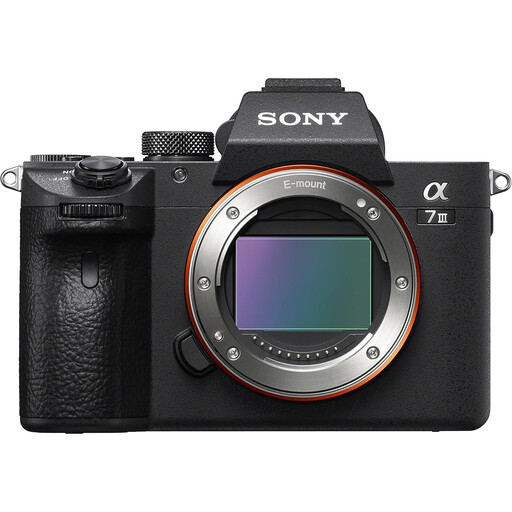 No image available
Sony Alpha 7 III full-frame camera body only
Consider this listing if you intend to choose a lens around the close-up framing your vintage-camera photographs require.
The title describes a body-only variant, but the listing also mentions a 28–70 mm lens elsewhere. Confirm exactly what is included before ordering.
View on Joybuy
 No image available
Sony A6700 APS-C with 16–50 mm lens
This APS-C kit gives you a supplied zoom for general framing if you plan to assess close-up lens needs separately.
Check the lens’s magnification and available working distance before choosing it for small controls or engravings. If you plan to use a polariser, confirm the fit with the lens you will actually use.
View on Joybuy
 No image available
Sony A6400 APS-C with 16–50 mm power-zoom lens
Consider this kit if you want an APS-C camera with a supplied zoom for full-object photographs.
The 16–50 mm lens named in the listing should be checked for close-focus framing before you depend on it for engraved details. Confirm filter compatibility if reflection control is part of your setup.
View on Joybuy
Frequently asked questions
Do I need a macro lens to photograph vintage cameras?
Not necessarily for a photograph of the whole camera, but a macro lens is worth checking when a small control or engraving must fill the frame. Nikon specifies 1:1 reproduction for the NIKKOR Z MC 105mm f/2.8 VR S, and Canon specifies up to 1.4x for its RF 100mm F2.8L Macro IS USM; check mount compatibility and the working room before choosing either route.
Will a circular polariser remove every reflection?
No. Cambridge in Colour explains that a polariser can reduce some reflections, with results depending on angle and rotation. Test it against the actual finish and light positions, and allow for the reduction in light reaching the camera.
What should I consider when disposing of an old camera in the UK?
Check an appropriate electrical-recycling route with your local authority or retailer. GOV.UK explains that the UK’s waste electrical and electronic equipment regulations aim to reduce this type of waste; check the arrangements available for the particular camera rather than assuming a general household-waste route is suitable.


