Choose the lens around the smallest costume detail your project must show, rather than choosing a camera by megapixels alone. A standard-zoom kit can cover full costumes and moderate close-ups, while a dedicated macro lens is the more relevant choice when stitching, weave or small trims need to occupy much of the frame. Close-up work also calls for careful focus, steady support and enough room to light the subject.
Who each set-up suits
Close-detail costume documenters
If stitches, weave, embroidery or small fastenings must be clearly visible, consider a dedicated macro lens. The close-up specifications published by Canon UK, Nikon UK and Sony UK show why the mounted lens matters as much as the camera body for this task.
One-kit school project photographers
If you mainly need full-costume photographs, portraits and moderate detail shots, a standard-zoom kit lets you change framing without changing lenses. Check its close-focus capability against the smallest feature you need to show.
Indoor and awkward-angle photographers
If you will photograph a costume on a wearer or mannequin, consider how you will frame high and low angles and keep static details sharp. A movable screen can help with framing, but it cannot change the mounted lens’s close-focus limit.
What matters when choosing
For a school project that needs both garment views and detail shots, decide which result is hardest to achieve with one lens, then check the exact body-and-lens combination.
| Concern | What to check | Who this matters to |
|---|
| Small costume details |
Check the lens’s maximum magnification and the space between its front and the subject at close focus. Canon UK lists the RF-S 18-45mm at 0.25x; Nikon UK lists the DX MC 35mm at 0.67x; Sony UK lists the E 30mm Macro at 1.0x. |
If stitching or weave must be prominent, I need the lens to render small features large enough without making lighting impractical; around 46% of consumers put close-detail reproduction first. |
| Whole-costume coverage |
Check the supplied zoom range and whether its close-focus ability also covers the project’s moderate detail shots. |
When I need the silhouette, a wearer and contextual images in the same session, changing lenses for every frame is less appealing; around 27% of consumers prioritise one-kit coverage. |
| Framing and sharpness |
Check the body’s screen movement and focusing controls, and plan stable support for static close-ups. Canon UK notes that depth of field becomes very small in macro photography. |
For costumes photographed indoors or from high and low angles, I need to see my framing and check that the intended detail is sharp; around 27% of consumers place handling in these positions first. |
Mistakes to avoid
-
Choosing by body megapixels alone
The mounted lens determines how large a tiny costume feature can appear in the frame. Canon UK lists 0.25x maximum magnification for its RF-S 18-45mm kit zoom, compared with 0.67x for Nikon’s DX MC 35mm macro lens and 1.0x for Sony’s E 30mm Macro.
Identify the smallest feature the project must show, then check the exact lens’s magnification and close-focus specifications before choosing a kit.
-
Assuming 1:1 magnification is automatically easier to use
Sony’s E 30mm Macro reaches 1.0x magnification, but its stated minimum working distance is 2.4 cm. With the lens that close, there may be little room to position a light around raised or textured details.
Check working distance as well as magnification. If the lens crowds the subject, consider a less-close position or a different lens approach.
-
Putting away the costume before checking close-ups
Canon UK notes that close-up photography has a very small depth of field, making precise focus important even for a static subject.
Use a tripod or other stable support where possible, take several shots with carefully placed focus and inspect the detail before ending the session.
-
Adding online reference images without checking rights
GOV.UK says photographs are generally protected by copyright and that permission is usually needed to copy or share them online. A school-project context does not, by itself, settle whether a particular use is permitted.
Use your own photographs where possible. For third-party images, check the licence or permission and ask your school about the intended use.
Relevant brands for reference
Canon
The EOS R50 with RF-S 18-45mm kit lens is a route to consider when full-costume photographs and moderate details are the main requirements.
- Canon UK lists the EOS R50 kit at 376 g with card and battery, with a vari-angle touchscreen. The RF-S 18-45mm lens reaches 0.25x magnification.
- For smaller details that need to fill more of the frame, assess a separate macro lens; Canon lists the RF 35mm F1.8 Macro at up to 1:2 magnification.
Nikon
The Z50II and NIKKOR Z DX MC 35mm f/1.7 form a detail-focused combination for projects centred on texture and construction.
- Nikon UK lists a vari-angle screen on the Z50II and a 0.67x maximum reproduction ratio for the DX MC 35mm lens.
- The macro lens is a separate prime to purchase and carry; confirm what other lens you would use for wider costume photographs.
Sony
The α6400 and E 30mm F3.5 Macro are worth examining when stated 1:1 magnification is important for small costume components.
- Sony UK lists 1.0x maximum magnification for the E 30mm Macro and 425 phase-detection autofocus points for the α6400.
- The macro lens’s stated 2.4 cm minimum working distance leaves limited clearance for lighting at its closest setting.
Joybuy camera kits for wider shots
These supplied-zoom camera kits are choices to examine for full costumes and contextual photographs. If small stitches or fabric texture must fill the frame, check the supplied lens’s close-up capability and whether you will need a compatible macro lens.
 No image available
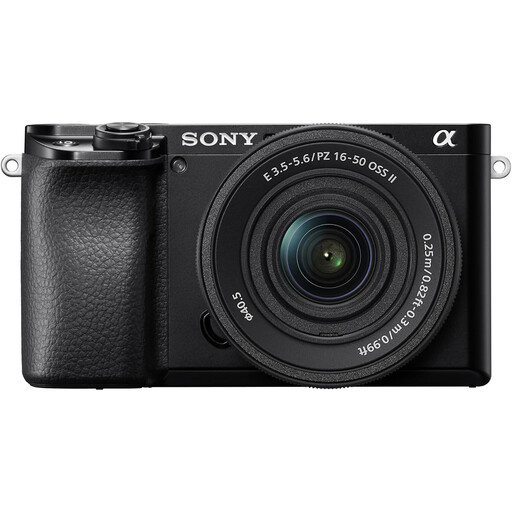
Sony A6400 APS-C with 16–50mm Power Zoom lens
Consider this supplied-zoom kit when the project includes complete costumes and contextual photographs.
The title identifies an APS-C camera and a 16–50mm lens. For prominent stitches or weave, check that lens’s maximum magnification and close-focus distance before ordering.
View on Joybuy
 No image available
Sony Alpha 7 III Full-Frame with 28–70mm zoom lens
Consider the supplied zoom for whole-garment photographs and portraits where close textile documentation is not the only requirement.
This is a full-frame camera with a 28–70mm lens. Check the supplied lens’s magnification and close-focus distance if small trims must appear prominently.
View on Joybuy
 No image available
Sony A6700 APS-C with 16–50mm lens and AI autofocus
The supplied zoom makes this a kit to consider when you need both full-costume and contextual frames.
The title specifies an APS-C camera, a 16–50mm lens and AI autofocus. Check the supplied lens’s close-up specifications before relying on it for small fabric details.
View on Joybuy
 No image available
Sony Alpha ZV-E10 II K with 16–50 mm f/3.5-5.6 Power Zoom
Consider the supplied zoom if the project needs complete-costume photographs alongside closer views.
The kit title specifies a 16–50 mm f/3.5-5.6 lens. Check its maximum magnification and close-focus distance for small details, and confirm the carrying weight of the complete kit.
View on Joybuy
 No image available
Sony A6100 APS-C with 16–55mm zoom lens
Consider this supplied-zoom kit for full costumes and photographs that show details in context.
The title specifies an APS-C camera and a 16–55mm lens. Confirm the exact supplied lens and its close-focus capability if fine stitching is central to the project.
View on Joybuy
Frequently asked questions
Do I need a macro lens for a school costume project?
Not necessarily if the project mainly needs full costumes and moderate close-ups. Canon UK lists its RF-S 18-45mm kit lens at 0.25x maximum magnification; if stitches or small trims must occupy much more of the frame, compare a dedicated macro lens such as Nikon’s 0.67x DX MC 35mm or Sony’s 1.0x E 30mm Macro.
Why do my closest fabric photographs look blurred?
A very small depth of field can leave parts of a close-up soft even when another part is in focus. Canon UK advises stable support for still-life macro work; place focus on the detail that matters and inspect a test shot before finishing.
Why check working distance as well as magnification?
Working distance tells you how much space remains between the lens front and the subject when shooting close up. Sony lists a 2.4 cm minimum working distance for its E 30mm Macro, so consider whether you can position light without the lens crowding or shadowing the costume.
Can I put photographs found online in my UK school project?
Check permission or the applicable licence before copying or sharing them. GOV.UK says photographs are generally copyright-protected and permission is usually needed to copy or share images online; your school can advise on the particular use you have in mind.
What should I check beyond the camera kit?
Check whether the exact kit includes a lens capable of the close-ups your project requires. If you need a separate macro lens, confirm its mount compatibility and the kit contents before ordering rather than assuming every standard-zoom bundle includes one.


