Detail-first mineral collectors
If you photograph small crystals, inclusions and surface textures, lens magnification, precise focus and stable support are central to your choice.


Choose a mirrorless system around the close-up lens you need, rather than choosing the body first. A 1:1 macro lens helps fill the frame with small mineral details, while a stable camera and focus stacking matter when you want more of a deep specimen sharp. For window-light work, decide whether you want stacking in the camera or are content to adjust focus and combine images yourself.
If you photograph small crystals, inclusions and surface textures, lens magnification, precise focus and stable support are central to your choice.
If you need a sharp record of an irregular, three-dimensional specimen, focus bracketing or stacking becomes useful when one focus plane cannot cover its depth.
If you mainly use daylight, consider how comfortably you can frame and check focus beside a window, as well as which macro lens you could add to the system.
Start with the lens’s magnification and working distance, then decide how you will handle a specimen that cannot be sharp in one exposure.
| Concern | What to check | Who this matters to |
|---|---|---|
| Close-up detail | Check the exact lens’s maximum magnification and working distance. Nikon UK describes 1:1 as life-size reproduction on the sensor; a short working distance leaves less room around the specimen. | When tiny crystal faces occupy little of the frame, I want them large enough to inspect without relying on a heavy crop. Around 36% of consumers put close-up detail first. |
| Sharpness across depth | Check whether the exact camera offers focus bracketing, in-camera stacking or manual-focus aids, and plan for stable support. Canon UK identifies bracketing and stacking on the EOS R7 and EOS R10; Panasonic says current LUMIX G models offer in-camera stacking. | If the front and rear faces both matter, I need a way to keep more of the specimen sharp while the camera and subject stay still. Roughly 36% of consumers prioritise sharpness across depth. |
| Window-light handling | Check whether the screen or viewfinder is comfortable to use at your planned camera position, and whether the body accepts your chosen close-up lens. Window light can change while you compose and focus. | Beside a window, I want to judge framing and focus comfortably as the light changes. About 28% of consumers put the daylight shooting workflow first. |
A camera body or standard zoom does not, by itself, establish that small details can be photographed at 1:1. Magnification belongs to the particular lens.
Identify a suitable lens for the mount, then choose the body controls and focusing workflow you need.
Nikon UK notes that camera shake is magnified in macro photography. Canon UK advises a sturdy tripod to keep a bracketed sequence aligned.
Keep the camera and specimen fixed, and try a short sequence to check alignment before making a larger stack.
Sony UK lists a 2.4 cm minimum working distance for the E 30mm F3.5 Macro. That close position can leave little space for a reflector or diffuser near a reflective mineral face.
Compare working distance as well as magnification if you need room to control reflections.
Kit contents and voluntary warranty terms are separate purchase questions from problems with faulty goods, which GOV.UK addresses in its consumer-rights guidance.
Check what the seller includes, keep your proof of purchase and contact the seller if the equipment is faulty.
The EOS R7 is an RF-mount APS-C body to consider if you want an in-camera focus-bracketing and stacking workflow.
The Micro Four Thirds route suits photographers who want to consider in-camera stacking for static specimens.
The α6400 is an APS-C E-mount option for photographers who want focus assistance while placing focus on small details.
The DX Z-mount route pairs a Z50II body with a separately chosen close-up lens.
These Sony APS-C camera kits offer starting points for a window-light setup. Check the included zoom and plan the close-up lens and focusing workflow around the size and depth of the mineral specimens you photograph.
 No image available
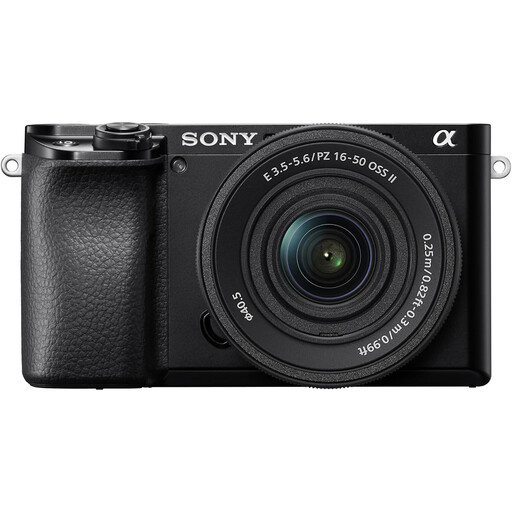
Consider this kit if you want the α6400’s focus-magnification aid for carefully placing focus on a crystal face. It includes a 16–50 mm power zoom; check that lens’s close-up magnification before relying on it for tiny details, and confirm your stacking workflow if you need sharpness across a deep specimen.
 No image available
Consider this APS-C kit if you want an interchangeable-lens camera and plan to choose a close-up lens for specimen details. The named kit lens is a 16–50 mm f/3.5–5.6 power zoom, and the product name specifies 26 MP; check the lens’s magnification and the body’s focus controls for your intended workflow.
 No image available
Consider this kit if you want an APS-C interchangeable-lens starting point and will check the close-up lens separately. Confirm the exact included zoom before ordering: the kit title says 16–55 mm, while other supplied product details say 16–50 mm. Check its magnification and the body’s focus controls against your specimen work.
Not for every photograph of a whole specimen, but a 1:1 macro lens is worth considering when tiny details need to fill the frame. Check the exact lens’s stated maximum magnification rather than assuming that a camera body or kit zoom provides it.
A stable tripod is particularly useful for close-ups and focus stacks. Nikon UK notes that shake is magnified in macro photography, while Canon UK advises sturdy support to keep bracketed frames aligned.
It can handle the stacking step on a supported camera when the specimen and camera remain still. Canon UK identifies in-camera stacking on the EOS R7 and EOS R10, and Panasonic says current LUMIX G models offer an in-camera mode; check the exact body and lens setup before choosing a workflow.
For faulty goods bought from a trader, consult GOV.UK’s consumer-rights guidance and contact the seller rather than relying only on a voluntary warranty. When electrical equipment reaches end of life, use an appropriate electrical-recycling route; GOV.UK explains that the UK WEEE framework addresses waste electrical and electronic equipment.