
24/7 Customer Support

Free returns

Same-day & Next-day Delivery

Quality Guaranteed

Unlock Your Welcome Offers: FREE Delivery | Up to 80% OFF | Free 30-day JoyPlus trial
Download the APP
A Moccamaster filter coffee machine can be a substantial purchase, particularly if you want a durable appliance rather than a low-cost machine that may need replacing after a short period. The key is to compare the features that affect everyday use, not simply the colour or claims on the box.
For UK households, three buying traps appear regularly:
The KBG Select and KBGT models listed here use a copper heating element designed to brew between 92 and 96°C. This is a useful specification because water temperature influences how ground coffee is extracted. A machine that brews too cool may produce a flat cup, while excessive heat can create harsh flavours.
The ECBC certification is another practical reference point. The European Coffee Brewing Centre assesses coffee machines against defined brewing requirements. Certification does not guarantee that every coffee will suit every palate, but it gives buyers an objective standard to look for when comparing a premium filter coffee machine.
Both models have a 1.25-litre capacity, described as up to 10 cups, with a full pot brewed in approximately six minutes. This format is useful for a family kitchen, meeting room or weekend entertaining.
The Moccamaster KBG Select includes a brew switch for either a full or half carafe. This helps avoid using a full-sized brewing programme when you only need a few cups. Check the machine’s minimum and maximum fill guidance, as brewing too little or too much can affect consistency.
The KBG Select is a coffee machine with hot plate. Its built-in hot plate is specified to maintain brewed coffee at approximately 80–85°C, and the machine switches off after 40 minutes.
The KBGT is a coffee machine with thermal carafe. Its stainless steel thermal jug is designed to retain heat without a hot plate. This can suit households that brew a pot and serve it gradually, or offices where coffee may be poured over an extended period. It also removes the need to leave a warming surface operating after brewing.
For either design, look for an auto drip-stop, which helps reduce spills when the jug is removed, and an automatic shut-off function. These details are less visually exciting than colour, but more relevant to daily convenience.
The right model depends on how you drink coffee, how many people you serve and whether the machine will stay in one kitchen or move between locations. The following options use the available product specifications to match different shopping priorities.
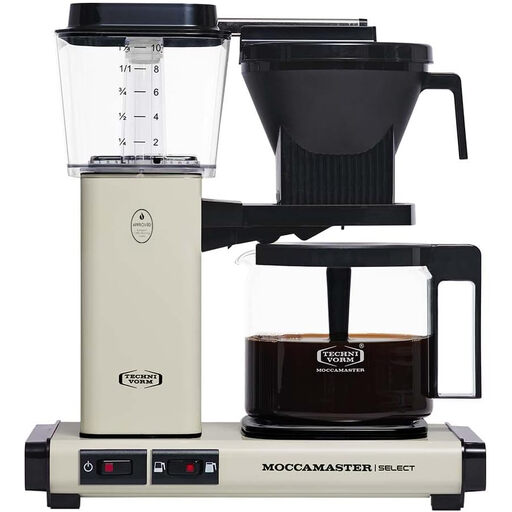
Why This Fits Their Persona: A practical starting point for a household wanting a full-size filter machine with a neutral finish that can work in a range of UK kitchen styles.
The half-carafe setting helps reduce the need to brew a full pot when making fewer cups, while automatic shut-off limits unattended hot-plate operation.
1.25-litre capacity, approximately six-minute full-pot brewing, ECBC certification and replaceable parts.
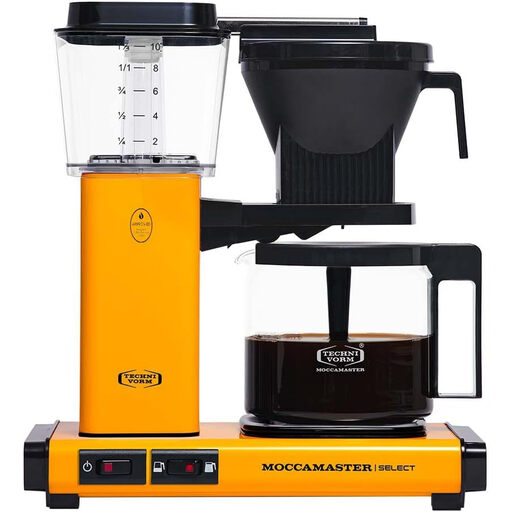
Why This Fits Their Persona: Suits design-led shoppers who want a colourful retro coffee machine alongside defined brewing controls and a repairable construction.
Its temperature range, ECBC certification and full or half-carafe switch provide specifications beyond the visual styling.
Copper heating element, 80–85°C hot plate, auto drip-stop and a five-year manufacturer’s warranty.
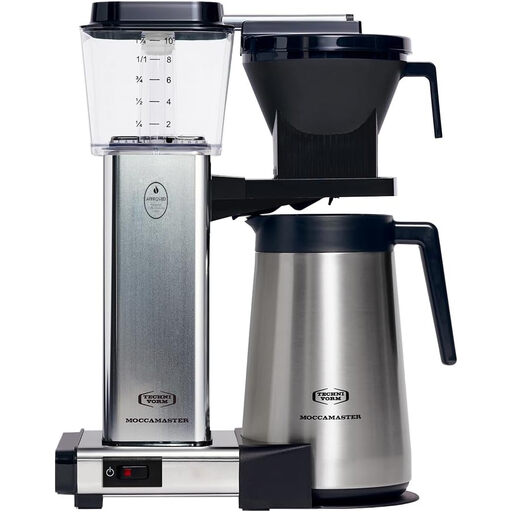
Why This Fits Their Persona: A suitable format for busy professionals, shared homes and offices where coffee needs to remain warm after brewing without relying on a hot plate.
The stainless steel thermal carafe avoids the common mismatch between a glass jug and a long serving period on a hot plate.
1.25-litre thermal jug, approximately six-minute brewing, ECBC certification and no hot plate.
We have compiled a complete, real-time list of products that fully satisfy these strict selection criteria and UK safety regulations.
Before ordering, measure the space beneath your kitchen cupboards and check access to a UK-compatible power socket. Allow room to remove the water reservoir and lift out the filter basket. A 1.25-litre coffee machine also needs a clear area for its jug and serving cups.
For longevity, use paper filters of the correct size, empty the basket after brewing and clean coffee oils from the jug regularly. Descaling frequency depends on water hardness and usage. UK homes in hard-water areas may need more frequent attention than homes in softer-water regions. Follow the manufacturer’s care instructions rather than relying on a fixed schedule.
A durable, repairable coffee maker can be more practical over time because replaceable parts may extend usable life. This does not remove the need for cleaning or guarantee that every component will last indefinitely, so check warranty terms and part availability before purchase.
Yes, particularly the KBG Select, which has a full or half-carafe setting. However, its 1.25-litre design is more substantial than compact single-serve machines. If you usually drink one small cup, measure your normal volume and consider whether the larger footprint is worthwhile.
Choose the KBG Select if you prefer a glass jug and want coffee held on a hot plate for a limited period. Choose the KBGT if you want a thermal jug that can retain warmth without a hot plate. The latter may be more convenient for serving coffee gradually at home or in an office.
Running cost depends on electricity use, brewing frequency, coffee and paper filters. Automatic shut-off helps prevent unnecessary operation after brewing. The KBG Select switches off after 40 minutes, while the KBGT uses a thermal carafe rather than a hot plate. To reduce waste, brew an amount suited to your household instead of routinely filling the entire jug.