
24/7 Customer Support

Free returns

Same-day & Next-day Delivery

Quality Guaranteed

Unlock Your Welcome Offers: FREE Delivery | Up to 80% OFF | Free 30-day JoyPlus trial
Download the APP
Choosing modern ceiling lights involves more than finding a shape that suits your décor. The wrong fitting can leave a room poorly lit, create installation difficulties or become expensive to adapt later. This guide from the Joybuy Product Recommendation Officer focuses on practical checks for UK homes, including dimensions, bulb compatibility, dimming and ceiling suitability.
A sculptural chandelier may look impressive in product photography but still provide limited everyday lighting. Check the number of light sources, bulb wattage and shade design. Glass shades can soften glare, while opaque materials may direct less light into the room.
For dining areas and living rooms, consider whether the fitting provides enough spread across the space. A Sputnik chandelier with several outward-facing arms may distribute light more widely than a single compact pendant, but room size and ceiling height still matter.
Some modern ceiling lights use replaceable bulbs, while others contain an integrated LED module. A fitting with an E27 ceiling light base gives you flexibility to select different bulb colours and brightness levels. However, bulbs may not be included.
An integrated LED pendant light can offer a streamlined appearance, but the light source is generally non-replaceable. If it fails, the complete fitting may need replacing. Also check whether dimming is supported: a product marked “dimmable” may require a compatible external dimmer switch, while some integrated LED designs are non-dimmable.
Product photography rarely shows the practical details of fitting a light. Hardwired ceiling lights require electrical work, and UK installations should be completed by a qualified electrician in accordance with BS 7671 and applicable local requirements.
Check the canopy size, mounting point, fixture weight, hanging length and whether your ceiling can support the fitting. An adjustable height ceiling light is useful for rooms with high or low ceilings, but the adjustment should be made before final installation where the design requires it.
Measure the available area before selecting a chandelier or pendant. A fitting measuring around 750–830mm wide may suit a generous dining table or open-plan living area, but it can overwhelm a narrow hallway or small bedroom.
Allow sufficient clearance around doors, walkways and furniture. Over a dining table, the fitting should provide visual presence without obstructing conversation or creating a head-height hazard. For sloped ceilings, look specifically for sloped ceiling compatibility, rather than assuming every adjustable cable will work safely.
Check the bulb base carefully:
Warm white lighting is often suitable for bedrooms, dining spaces and relaxed living rooms. For a more functional hallway or work area, consider the fitting’s light distribution and the bulb’s colour temperature.
A dimmable chandelier needs more than a dimmer symbol on the listing. Confirm whether the dimmer is supplied, whether it must be purchased separately and whether the selected bulbs support dimming.
Also review the voltage specification. The featured products listed here are designed for 220–240V, suitable for typical UK domestic supply, but installation must still be handled correctly. Turn off power at the circuit breaker before any maintenance and never exceed the stated wattage limit.
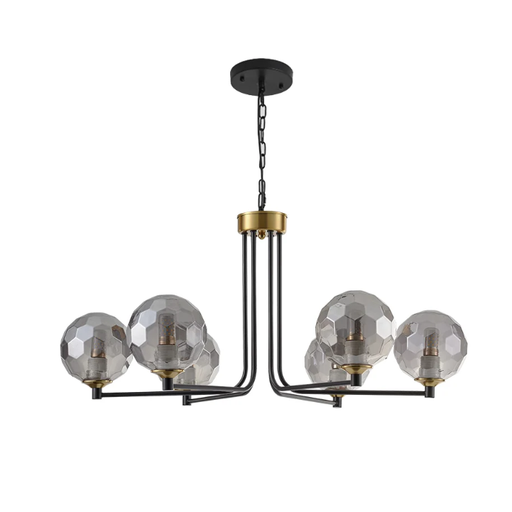
Why This Fits Their Persona: Its six-light layout and adjustable 1000mm chain give first-time renovators a versatile option for a dining room or larger lounge, without committing to an integrated light source.
The listing states the bulb base, maximum wattage and dimming requirement clearly, helping buyers budget for E27 bulbs and a compatible external dimmer.
Six grey glass globes provide diffused illumination; the black-and-gold finish suits mid-century modern lighting schemes.
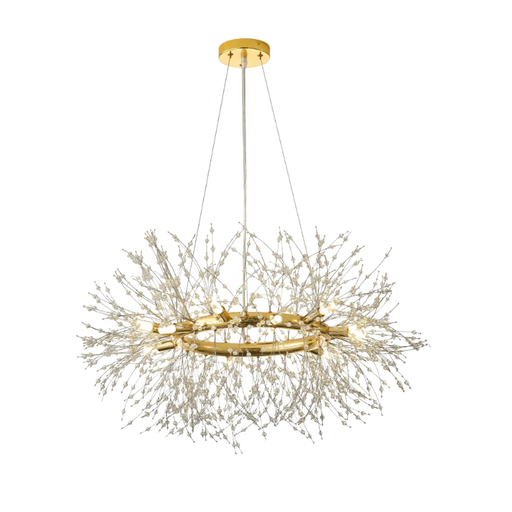
Why This Fits Their Persona: This larger statement fitting is suited to homeowners and interior designers creating a focal point above a dining table or in a spacious reception room.
The dimensions, 1000mm hanging length and non-dimmable specification are stated upfront, making it easier to assess room scale and control expectations.
The 749mm-wide design has 12 radiating arms, and the listing includes G9 LED bulbs with warm white light.
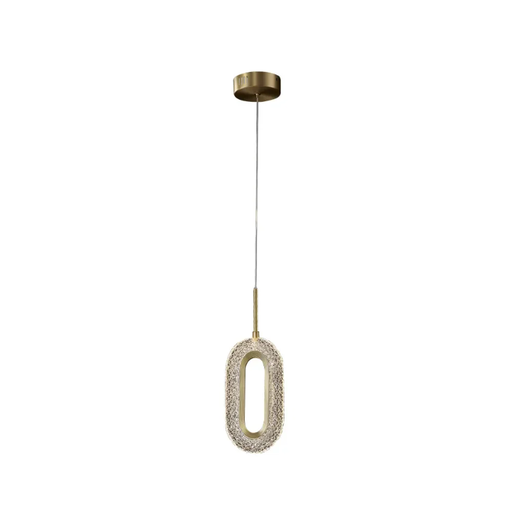
Why This Fits Their Persona: The slim oval profile works well in a hallway, bedroom, compact dining area or property with a sloped ceiling where a lighter visual form is preferred.
The 1500mm adjustable cable and stated sloped-ceiling compatibility address common fitting problems. Its non-dimmable design is also clearly identified.
The 24W integrated LED creates a minimalist appearance; brass and acrylic materials keep the oval form visually light.
We have compiled a complete, real-time list of products that fully satisfy these strict selection criteria and UK safety regulations.
Before ordering, confirm that the ceiling rose or junction box can support the fitting and that the mounting point is suitable for a hardwired installation. A qualified electrician should inspect existing wiring, particularly in older UK properties or during renovation work.
To estimate running costs, multiply the fitting’s total wattage by the number of hours used, then compare the result with your electricity tariff. For example, six bulbs rated up to 40W each could use considerably more electricity at full output than a 24W integrated LED fitting. Actual consumption depends on the bulbs selected and how long the light is operated.
Some are, but large chandeliers with long drops may not be practical. Look for a short fixture height or an adjustable cable and measure the distance from the ceiling to the lowest point before buying.
No. The chandelier, bulbs and external dimmer must be compatible. Replaceable LED bulbs should specifically be marked as dimmable, and installation should be completed by a qualified electrician.
Their lifespan depends on usage, heat management and component quality. Unlike an E27 or G9 LED fitting, the integrated LED module is generally non-replaceable, so the complete light may need to be changed if the module fails.