Students mapping dense, multi-generation trees
If branches, scanned records and browser windows compete for space, compare native resolution and readability at your preferred scaling rather than choosing by screen size alone.


For mapping a family tree in a student room, a 27-inch QHD monitor with an adjustable stand is a starting point if it fits the desk. Consider 4K when dense branches, scanned records and reference windows make native pixel space a priority, but check that your software remains readable at your preferred scaling. Choose USB-C charging only after confirming that your laptop supports video through the port and can use the monitor’s stated power delivery.
If branches, scanned records and browser windows compete for space, compare native resolution and readability at your preferred scaling rather than choosing by screen size alone.
Check the complete monitor and stand dimensions against the space left for a keyboard and other materials. The Health and Safety Executive advises placing a screen directly in front of you, with its top around eye level and the screen about an arm’s length away.
If you regularly reconnect a laptop after studying elsewhere, a USB-C monitor may simplify the desk setup. Check the laptop’s video output and charging requirements before relying on one cable.
For family-tree mapping in a student room, decide which constraint drives your choice: space for the tree and records, a workable screen position, or a convenient laptop connection.
| Concern | What to check | Who this matters to |
|---|---|---|
| Tree and record workspace | Compare native QHD and 4K resolution, then check your computer’s output and the readability of your software at your preferred scaling. | I want to keep dense branches and source material in view without losing readable text. Around 40% of consumers put this workspace need first. |
| Desk fit and positioning | Measure the available desk width and depth against the monitor and stand; check the adjustment range if screen height is difficult to change. | On a shallow desk, I need the screen to fit alongside my keyboard and sit in front of me. For around 30% of consumers, physical fit is the primary concern. |
| Laptop connection | Confirm USB-C video output, the laptop’s charging requirement and the monitor’s stated power delivery; check which cable is included. | If I reconnect my laptop often, I want a connection that handles my display and charging needs without extra desk clutter. Laptop integration comes first for around 30% of consumers. |
More pixels will not resolve a poor physical fit. The Health and Safety Executive advises positioning the screen directly in front of you, with its top around eye level and about an arm’s length away.
Measure usable desk width and depth, allowing for the stand, keyboard and laptop. Check the stand’s height adjustment or whether a suitable mount would help you position the screen.
A USB-C port alone does not establish that the laptop can send video to the monitor or use its stated charging power.
Compare the laptop manufacturer’s port specification and normal charger wattage with the monitor’s video-input and power-delivery specifications.
Dell labels the S2722DC unavailable on its model page. Its specifications can still help with comparisons, but the page does not establish that you can buy that model now.
Before ordering, check a current retailer listing for the exact model, its availability, warranty information and return arrangements.
UK government guidance says waste electrical and electronic equipment rules aim to reduce electrical waste sent to landfill or incineration.
When replacing a monitor, look for a retailer take-back route or a local electrical-waste collection service.
These model examples show different specifications to compare; a brand name alone does not establish desk fit or laptop compatibility.
Dell offers model examples for comparing a 27-inch 4K workspace with a QHD USB-C setup.
The GW2790QT is a QHD example for a laptop-centred desk where screen adjustment matters.
The 27U730A-B is a 4K example for readers considering a compatible USB-C laptop connection.
These monitors offer QHD or 4K routes for viewing a family tree and supporting records. Compare their stated connections and your available desk space before choosing a model.
 No image available
Consider this 4K option if viewing dense branches and records is your main screen-space priority.
The product name specifies a 27-inch IPS display, USB-C and a height-adjustable stand. Check its complete dimensions and your laptop’s USB-C video and charging compatibility before ordering.
 No image available
This is another 4K route to consider when a detailed tree and supporting windows drive your choice.
The product name specifies a 27-inch IPS display and USB-C 65 W power delivery. Check your laptop’s video and charging compatibility, desk space and whether model code 9S6-3PB19H-263 identifies the MD272UPSW variant you intend to buy.
 No image available
This QHD option suits a family-tree research setup where 4K resolution is not the deciding requirement.
The product name identifies an IPS WQHD display. If you plan to use USB-C for your laptop, check the monitor’s power-delivery rating against the laptop’s video and charging requirements; measure the stand against your desk too.
No image available
Consider this 4K display if tree branches and record images make native resolution a priority.
The product name specifies a 27-inch IPS screen, 60 Hz refresh rate, HDMI and DisplayPort connections. Check that your computer has a suitable display output and that the monitor and stand fit your desk.
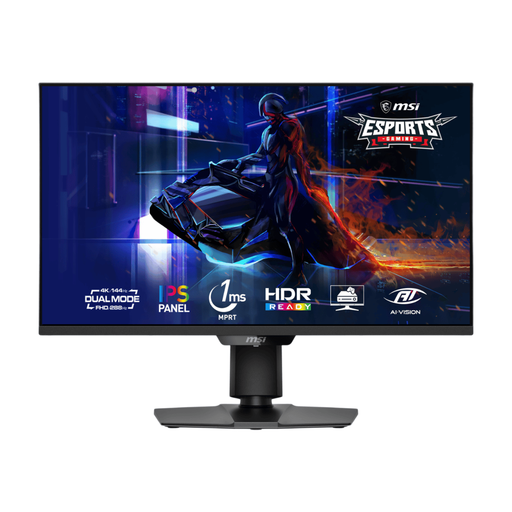 No image available
For family-tree work, assess this model by whether its UHD mode suits your mapping software, rather than by its gaming refresh rates alone.
The product name specifies a 27-inch display with UHD 144 Hz and Full HD 288 Hz modes. Check which resolution and mode your computer can output, as well as the monitor’s stand dimensions.
Choose between them according to how much native pixel space your tree and supporting records need: a 27-inch 4K screen has more pixels than a 27-inch QHD screen, while QHD may be sufficient for a less dense layout. Dell lists the S2725QC at 3840 × 2160, and BenQ lists the GW2790QT as QHD; check readability at your preferred scaling before deciding.
Height adjustment is especially useful if you cannot otherwise position the screen comfortably on your desk. The Health and Safety Executive advises keeping the screen directly in front of you, with its top around eye level and about an arm’s length away; measure the stand as well as checking its adjustment range.
It can do both only if the laptop supports video through its USB-C port and can use the monitor’s stated charging power. BenQ lists 65 W power delivery for the GW2790QT and LG lists 90 W for the 27U730A-B; compare those ratings with your laptop’s port specification and normal charger.
The Health and Safety Executive’s display-screen-equipment regulations guidance concerns employers and workers who regularly use screens as a significant part of their work, rather than setting a separate purchasing rule for an ordinary student. Its screen-position guidance can still help you arrange a study desk.
Look for an electrical-waste collection or retailer take-back route rather than putting the monitor in general waste. UK government guidance says waste electrical and electronic equipment rules aim to reduce electrical waste sent to landfill or incineration.