What matters when choosing?
Start with the space needed for minutes and reference documents, then check how the screen can be repositioned. Decide whether monitor-based docking adds anything to the desk’s existing connections.
| Concern |
What to check |
Who this matters to |
| Changing laptops |
Check USB-C video support, the laptop’s charging requirement and the monitor’s power-delivery output. Compare the available hub ports with the peripherals used at the desk. |
If I change laptops at a shared desk, I want to reconnect the display and peripherals without swapping several cables; around 33% of consumers put easier connections first. |
| Screen adjustment |
Check height, tilt, swivel and pivot adjustment. For a clamp mount, check desk fit and workplace approval. |
When several people use one workstation, I need to move the screen to suit different seating positions; roughly 27% of consumers make adjustability their main concern. |
| Document workspace |
Compare native resolution and screen size, and confirm the computer supports the intended display mode. Check text scaling and reflections at the desk. |
If I keep minutes and reference material open together, I need readable text and room to compare them; for around 27% of consumers, document workspace comes first. |
| Using an existing dock |
Check the dock, video cables, charging arrangement and monitor inputs before choosing built-in docking features. |
With a working dock already on the desk, I would rather use it than add connections I do not need; keeping the setup simple is the primary concern for around 13% of consumers. |
Joybuy products for shared desks
These monitors offer different amounts of document space and different connection arrangements for a shared desk. Compare their screen adjustment and exact laptop compatibility before choosing between built-in USB-C features and an existing dock or separate cables.
 No image available
ASUS ProArt PA278CV IPS WQHD
For minutes alongside reference documents, the listed 27-inch 2560 × 1440 IPS display provides QHD workspace, while height, tilt, swivel and pivot adjustment let users reposition it.
The listing describes USB-C with power delivery. Check the charging wattage, hub configuration and each laptop’s video and charging compatibility before relying on one-cable docking.
Joybuy
 No image available
ASUS ProArt PA278CFRV IPS QHD 100 Hz
For text work at a desk shared by users with different viewing positions, the listing specifies a 27-inch 2560 × 1440 IPS display and height, tilt, pivot and swivel adjustment.
Check the exact regional variant’s USB-C video, charging and hub functions against the laptops that will use the desk.
Joybuy
 No image available
ASUS ProArt PA24ACRV IPS QHD
For a desk where a smaller screen is preferable, the listing specifies a 24-inch 2560 × 1440 IPS display with height, tilt, swivel and pivot adjustment. Check that this size leaves enough room for the documents users need open together.
The listing states USB-C video and up to 96 W power delivery; confirm laptop charging compatibility and the exact variant’s hub configuration.
Joybuy
 No image available
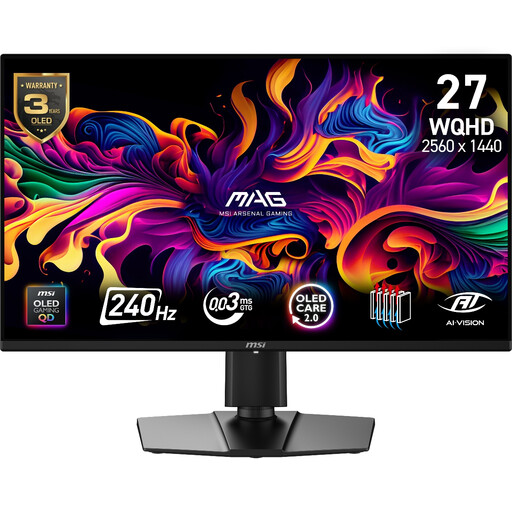
MAG 274QP QD-OLED X24 27-inch WQHD 240 Hz
For a desk using an existing dock or separate video cables, the listing specifies a 2560 × 1440 display, HDMI and DisplayPort connections, and height, tilt, swivel and pivot adjustment.
The title says 27 inches, while the detailed panel specification says 26.5 inches; confirm the size if it affects desk fit. Check the exact ports before planning any USB-C docking or laptop charging.
Joybuy
 No image available
ASUS ProArt PA248CRV IPS WUXGA
For a compact document workstation, the listing specifies a 24.1-inch WUXGA IPS display with height, swivel, pivot and tilt adjustment. Check whether its workspace suits users who keep multiple documents open.
The description states USB-C video, data and up to 96 W power delivery. Confirm laptop compatibility and the hub configuration of the exact regional variant.
Joybuy
Frequently asked questions
When does a shared-desk workstation need an assessment?
For workers covered by Great Britain’s display-screen-equipment rules who use it daily as part of normal work continuously for an hour or more, the Health and Safety Executive says employers must carry out a workstation assessment. That assessment covers the workstation and working conditions, not just the monitor.
Does an adjustable monitor make a shared desk compliant on its own?
No. Under Health and Safety Executive guidance, screen adjustment is only one consideration: the assessment also needs to address the wider workstation and any identified risks, including when a new user starts or the setup changes.
When is USB-C charging worth choosing for this desk?
It is useful when compatible laptops are connected frequently and the monitor’s stated power delivery meets their charging requirements. Check video support, charging power and the required peripheral ports for each laptop; a USB-C connector alone does not confirm all three functions.
Can a display-screen-equipment user request an eye test?
Yes. The Health and Safety Executive says that, under the rules it administers in Great Britain, employers must arrange and pay for an eye and eyesight test when a display-screen-equipment user asks for one. Its guidance distinguishes that test from glasses, which employers need to provide only when special glasses are required specifically for the display-screen viewing distance.


