Detailed-score proofreaders
If you spend long sessions checking note placement, articulations and dynamics across several staves, prioritise a legible page view, manageable reflections and a screen you can position comfortably.


A 27-inch 4K monitor with height and pivot adjustment is a practical starting point for notating piano scores at a conventional home-office desk. Consider a 31.5-inch display if you want a physically larger page view and have room to position it comfortably; check reflections at your desk, and count on USB-C charging only if the monitor and laptop support the connections you need.
If you spend long sessions checking note placement, articulations and dynamics across several staves, prioritise a legible page view, manageable reflections and a screen you can position comfortably.
If your desk has limited depth or width, a 27-inch 4K display with an adjustable stand may be easier to accommodate than a larger panel. Check the space available for the screen and stand before choosing.
If you enter notation on a laptop, a USB-C or Thunderbolt monitor may simplify the desk connection. One-cable video and charging depend on the laptop port, the monitor’s power delivery and a suitable cable.
Start with a score view you can read at your desk, then check screen positioning. Treat laptop connectivity and specialist colour features as requirements only if they serve your wider workflow.
| Concern | What to check | Who this matters to |
|---|---|---|
| Notation clarity and page space | Compare 27-inch and 31.5-inch screens at a comfortable viewing position; check 4K output and the notation app’s page scaling. | If I need to inspect dense staves and markings, I want a legible score without repeatedly changing zoom. Around 34% of consumers put notation clarity and usable page space first. |
| Positioning and desk fit | Check height and pivot adjustment, plus desk depth; for a clamp stand, check mounting clearance against its instructions. | During longer score-entry sessions, I need to place the screen comfortably without crowding my desk. Positioning and desk fit come first for roughly 25% of consumers. |
| Laptop connection | Confirm USB-C or Thunderbolt video support and compare the monitor’s power delivery with the laptop’s charging requirements. | If I move my notation laptop on and off the desk, fewer separate connections would make the setup simpler. About 25% of consumers prioritise laptop connectivity and cable reduction. |
| Colour-sensitive work | Check the exact model’s stated colour coverage and calibration features if it will also be used for visual production. | When I also prepare colour-sensitive artwork or publishing assets, the display has to serve that work as well as notation. Mixed creative work is the primary concern for around 16% of consumers. |
A 31.5-inch screen offers a larger physical page view than a 27-inch screen, but it also needs more room to position. A shallow desk can make that trade-off awkward.
Measure usable desk width and depth, then consider where the screen and your notation materials will sit before deciding on size.
A matching connector does not establish that the laptop can send video through it or receive enough power from the monitor.
Check the laptop’s USB-C DisplayPort or Thunderbolt capability, its charging requirement and the cable specification against the monitor you intend to use.
Wide colour coverage and calibration features address colour-sensitive work; they do not replace a suitable score view or an adjustable screen position.
Give those features priority if the same monitor will also handle work such as photography or publishing graphics.
Screen adjustment cannot resolve every issue with the desk, chair, keyboard position or lighting. The Health and Safety Executive advises assessing the workstation and reducing risks for workers covered by display-screen-equipment rules.
Set up the monitor alongside the rest of the workspace and review the arrangement if discomfort develops during notation sessions.
Dell’s UltraSharp U2725QE is relevant to a 27-inch 4K desk setup that also needs screen adjustment and laptop connectivity.
BenQ’s Creative Pro PD2725U suits a desk that combines piano-score notation with colour-sensitive creative work.
LG’s UltraFine Ergo 32UN880K-B is a larger-screen option for a desk that can accommodate its clamp-mounted stand.
ASUS’s ProArt PA279CRV is relevant when a 27-inch 4K notation display must also support laptop use and colour-sensitive projects.
These monitors offer different ways to build a home-office score-notation desk, from 27-inch 4K screens with laptop-oriented connections to displays chosen for other stated features. Compare each model’s screen finish, positioning and computer connection with your own setup.
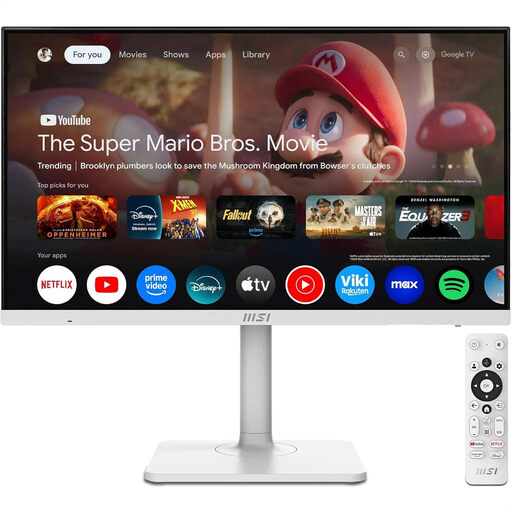 No image available
Consider this for a 27-inch score workspace if a laptop connection also matters. Its listed features include USB-C 65W power delivery, Google TV and Dolby Audio; check your laptop’s video and charging compatibility, and the screen finish if reflections matter at your desk.
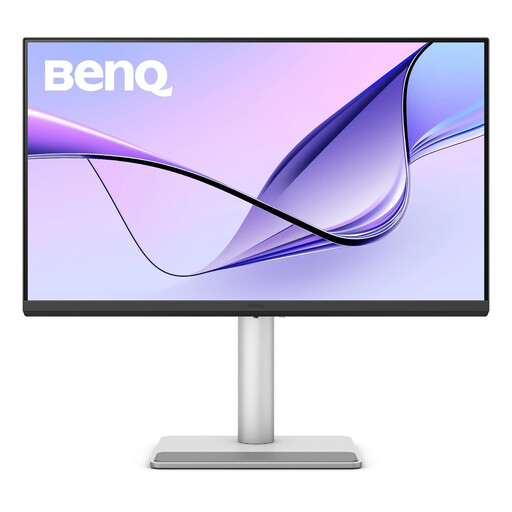 No image available
This is a 27-inch score-workspace option for a desk where its Nano Glossy finish suits the lighting. The title also identifies USB-C and a height-adjustable stand; check the finish for reflections and confirm the connection and charging requirements of your laptop.
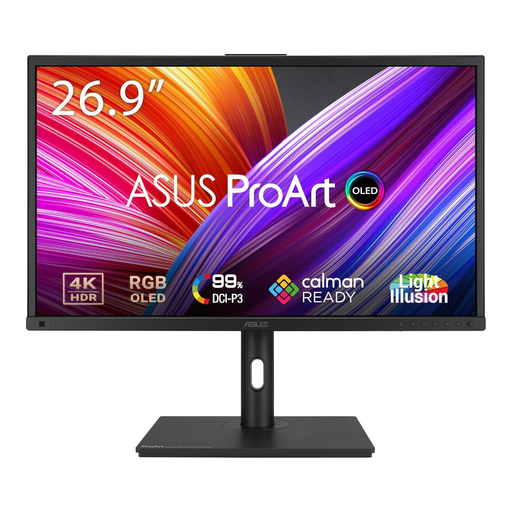 No image available
Consider this model if you are comparing an OLED display for score work alongside other uses. Its named specification is 4K UHD OLED; check the intended computer connection and charging arrangements rather than assuming USB-C will provide a one-cable laptop setup.
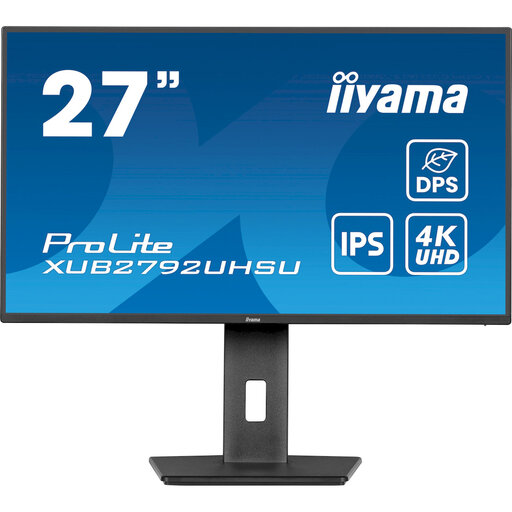 No image available
A 27-inch 4K screen is worth considering when desk space and score detail both matter. Check the screen finish in your lighting and confirm the required video connection and any laptop-charging capability before planning a one-cable setup.
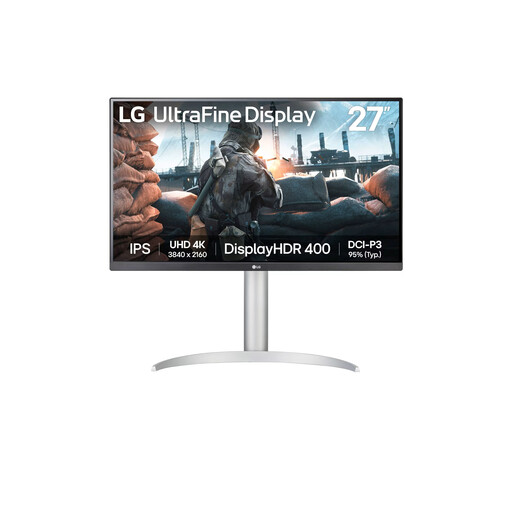 No image available
This 27-inch display is an option for a compact score workspace when HDMI or DisplayPort suits your computer. Its named features include a 60Hz refresh rate and built-in speakers; check the screen finish if reflections affect your desk, and do not assume a one-cable USB-C laptop connection.
Choose the size to suit the workstation rather than treating 27 inches or 4K as a legal minimum. The Health and Safety Executive says employers must assess workstations and reduce risks for workers covered by display-screen-equipment rules; those rules can apply to permanent or long-term home workers.
It can if the laptop accepts USB-C charging and the monitor’s power delivery meets its requirements; video over the same cable also needs compatible ports and a suitable cable. ASUS UK specifies up to 96W for the PA279CRV, Dell UK up to 90W for the U2725QE, BenQ UK 65W for the PD2725U and LG UK up to 60W for the 32UN880K-B. Those ratings do not establish compatibility with your laptop.
Portrait orientation can help if you prefer a taller page view in your notation application, but it is not necessary for every score or workflow. Check for pivot adjustment if you expect to rotate the screen; Dell UK, BenQ UK, LG UK and ASUS UK specify pivot capability on the U2725QE, PD2725U, 32UN880K-B and PA279CRV respectively.
Check the available electrical-equipment collection or take-back route rather than putting an old monitor in general waste. The Office for Product Safety and Standards and the Department for Environment, Food & Rural Affairs describe the UK waste electrical and electronic equipment framework as a means of reducing electrical waste sent to landfill or incineration; ask your local authority or retailer which service applies to you.