Replacing a desktop display
If your ageing work monitor connects to an existing computer, begin with its video output and the replacement screen’s inputs. Microsoft Support lists HDMI, DisplayPort, DVI and VGA among the ports you may encounter.


Start with your existing computer: match its video output to the monitor input before choosing a screen or cable. A compact Full HD monitor can suit a straightforward wired desk, while a larger QHD display is worth considering if you want more on-screen workspace and have room for it. For a laptop desk, a USB-C hub monitor is useful only if the laptop supports video through that port and the monitor can meet its charging needs.
If your ageing work monitor connects to an existing computer, begin with its video output and the replacement screen’s inputs. Microsoft Support lists HDMI, DisplayPort, DVI and VGA among the ports you may encounter.
If you want the monitor to connect peripherals and charge your laptop, check the laptop’s USB-C video capability and charging requirement against the exact monitor specification. A USB-C connector alone does not establish either function.
If screen space or desk placement is the main problem, consider resolution and physical size alongside stand adjustment. Check mounting specifications separately if you intend to use an arm.
Confirm the connection path first, then choose the screen and desk arrangement that suit your work. For a USB-C laptop setup, check video support and charging as separate requirements.
| Concern | Buying check | Who this matters to |
|---|---|---|
| Connection compatibility | Match the computer’s video output to a monitor input; check the cable or adapter needed for that connection. | If I am replacing a failing screen, I need the new one to connect to the computer I already use. About 36% of consumers put connection compatibility first. |
| Usable screen space | Compare screen size and native resolution with your desk space; confirm the computer can use the intended setting. | When work windows feel cramped, I want a screen layout that fits both my tasks and my desk. Usable screen space is the primary concern for about 29% of consumers. |
| USB-C laptop docking | Confirm USB-C video support and compare the monitor’s power-delivery rating with the laptop’s charging requirement. | At a fixed laptop desk, I want to connect the display and desk peripherals without juggling separate connections. About 21% of consumers chiefly want a compatible one-cable setup. |
| Desk placement | Check the stand’s adjustments and footprint; for an arm, match the mounting pattern and supported weight. | If desk space is tight, I need to know where the screen and its stand or arm will actually fit. Placement is the main concern for about 14% of consumers. |
Video over USB-C requires a supported display mode, and a monitor’s power-delivery rating must meet the laptop’s needs if you intend to charge through it.
Compare the laptop manufacturer’s USB-C video and charging specifications with those of the exact monitor before relying on one cable.
If those functions do not match, you may need to keep a separate charger or use a compatible dock.
Computer outputs and monitor inputs vary; a connector that fits one end does not establish a usable display path.
Identify the computer output and monitor input, then select a cable or adapter specified for that combination.
Connecting two screens is not, by itself, confirmation that the computer can show independent workspaces on both.
Check the computer or dock manufacturer’s external-display support and the intended connection arrangement before adding another screen.
Mounting patterns, screen weights and desk clamps have model-specific limits. LG lists a 100 × 100 mm mounting pattern for its 27QN880, but that specification cannot be applied to other monitors.
Check the exact monitor’s mounting pattern and weight against the arm’s limits, and measure the space needed for its clamp.
Dell’s office-monitor range includes conventional work displays and USB-C hub models. Compare individual models rather than assuming the same connections or stand on every screen.
ThinkVision includes office displays aimed at laptop workstations, including models with USB-C docking connections.
LG’s monitor range offers examples of both conventional displays and models with more involved desk-placement features.
These standalone monitors offer screen choices for an existing home-office computer. Check your computer’s output, the screen’s stated inputs and the space available before choosing a model.
 Image unavailable
Consider this WQHD monitor if you want to assess a higher-resolution work screen. Confirm that its dimensions fit your desk and that your computer supports the intended setting through your chosen connection. If you plan to charge a laptop through the monitor, compare its stated power delivery with the laptop’s requirement.
 Image unavailable
The 24-inch FHD format is a conventional option to consider for a home-office desk. Check the monitor’s inputs against your computer’s output and confirm which cable you will need.
 Image unavailable
If you are considering a larger work display, measure the available desk space against this model’s dimensions rather than choosing by resolution alone. Confirm that your computer and connection support the WQHD setting you intend to use.
 Image unavailable
The 22-inch Full HD format is worth considering where the available desk space favours a smaller screen. Before ordering, check the inputs, stand dimensions and cable requirements for this exact model.
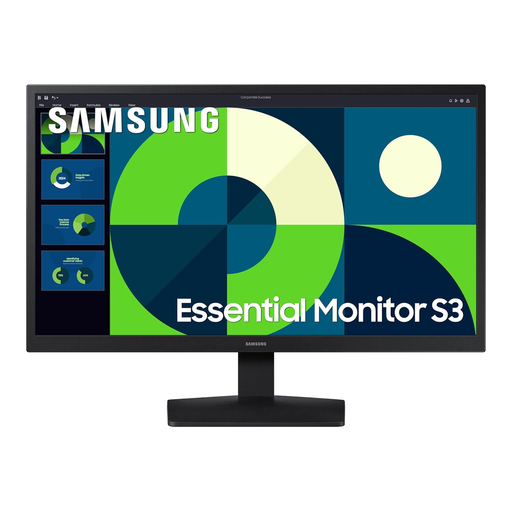 Image unavailable
For everyday work on an existing computer, compare this model’s screen dimensions and inputs with your desk and video output. Check its stand adjustment and supplied cables if either matters to your setup.
Identify the computer’s video output and the new monitor’s input, then check the cable between them. Microsoft Support lists HDMI, VGA, DVI and DisplayPort as typical ports; for USB-C video, check the computer’s documentation rather than relying on the connector’s shape.
No: the laptop must support video through its USB-C port, and the monitor’s power delivery must meet the laptop’s charging needs. VESA explains that DisplayPort over USB-C can carry video, data and power, but the supported functions and charging rating still need checking for both devices.
Do not assume a splitter provides two independent workspaces. Check how the computer or dock supports multiple external displays and which connections its manufacturer specifies for an extended desktop.
GOV.UK says retailers selling a new version of a household electrical item must provide a way for customers to dispose of the old one. Check the seller’s take-back arrangements before arranging disposal of your monitor.
Check the exact model’s included stand and cables, published warranty terms, any stated dead-pixel policy and the seller’s returns information. Those details can differ between models and sellers, so confirm them for the listing you intend to use.