What to check before choosing
For one touring-car racing screen at a small desk, establish the space left after fitting your controls, then decide how much detail you want and which display modes your device can output.
Compact Full HD
Choose when: A 23.8–24-inch screen makes it easier to keep the wheel, controls and display in a workable position.
Trade-off: Full HD has fewer pixels than QHD, and a smaller diagonal alone does not guarantee that the stand will fit.
27-inch QHD
Choose when: You have room to position the larger screen comfortably and want 2560×1440 detail.
Trade-off: Rendering more pixels can demand more of your graphics hardware at the game settings you choose.
Curved QHD
Choose when: You specifically prefer the shape of a curved single screen and can accommodate its stand.
Trade-off: Curvature does not compensate for a screen that sits too close or occupies space needed by the wheel.
| Concern |
What to check |
Who this matters to |
| Desk fit and placement |
Measure usable width and depth with the wheel in place; check the exact stand footprint and adjustment or mounting options. |
If my wheel and controls leave little room, I need to centre the screen without bringing it uncomfortably close. Around 33% of consumers would make physical fit their primary concern. |
| Detail and motion |
Compare native resolution, refresh modes and VRR support; distinguish grey-to-grey (GtG) from moving-picture response time (MPRT) ratings. |
I want to read cockpit information while following fast-moving racing scenes, without choosing more pixels than my setup can handle. Roughly 42% of consumers would prioritise this balance of detail and motion. |
| Connection compatibility |
Match the monitor’s resolution and refresh rate by input to your device and cable; check VRR compatibility for the exact setup. |
If I rely on a particular PC or console output, I need the display mode I choose to work through that connection. About 25% of consumers would put connection compatibility first. |
Documented monitor shortlist
This composite shortlist is ordered for the stated small-desk setup: physical fit first, followed by documented resolution, refresh features and adjustment. It is not an external test or measured performance ranking. The model details come from ASUS, AOC, Samsung and Joybuy product information respectively.
| Rank |
Monitor |
Main specifications |
Reason for inclusion |
Platform |
| 1 |
ASUS TUF Gaming VG249QL3A |
23.8-inch Full HD Fast IPS; 180Hz; height adjustment. |
ASUS documents a compact format with high refresh and an adjustable stand, relevant when desk fit leads the choice. |
Manufacturer product page |
| 2 |
AGON by AOC Q27G4XF |
27-inch 2560×1440 Fast IPS; 180Hz; Adaptive Sync; height adjustment. |
AOC documents the QHD route for consumers who can place a larger screen comfortably and want more pixel detail. |
Manufacturer product page |
| 3 |
Samsung Odyssey G5 G50F LS27FG502EUXXU |
27-inch QHD; 180Hz; G-SYNC Compatible and AMD FreeSync. |
Samsung documents another 27-inch QHD, high-refresh option; its physical fit still needs checking against the desk. |
Manufacturer product page |
| 4 |
MSI MAG 27CQ6F |
27-inch 2560×1440 curved Rapid VA; 1500R; 180Hz. |
The Joybuy listing documents a curved single-screen alternative for consumers who prefer that shape and can accommodate its stand. |
Joybuy |
Joybuy monitors for this setup
These monitors offer compact Full HD and 27-inch higher-resolution options for a single-screen touring-car setup. Compare their actual dimensions and connection modes against your desk and device; the 27-inch models are not substitutes for a compact screen when viewing distance is limited.
 No image available
LG UltraGear G8 27G850A, 27-inch 4K dual-mode monitor
Consider this 27-inch option if your desk accommodates a larger screen and you want to choose between the listed 4K 240Hz and 1080p 480Hz modes.
The title specifies a Nano IPS panel, 1ms GtG rating, AMD FreeSync Premium Pro, DisplayPort 2.1 and HDMI 2.1. Check which mode your device and chosen connection can run before ordering.
View on Joybuy
 No image available
Samsung Odyssey G6 S27DG612, 27-inch QHD OLED
This is a 27-inch QHD option for a setup with enough viewing distance and a device suited to the resolution you intend to use.
The title lists a 240Hz refresh rate and 0.03ms response rating. Check the refresh mode available through your chosen input rather than assuming every connection reaches the headline rate.
View on Joybuy
 No image available
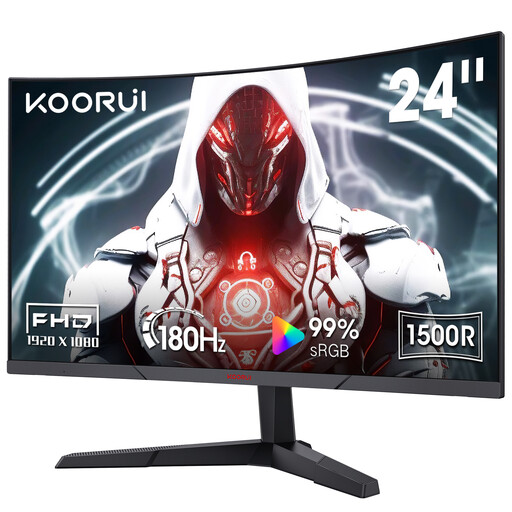
KOORUI MG24A12FV2, 24-inch curved Full HD monitor
The 24-inch format is worth considering when a 27-inch screen would sit too close to your wheel position; measure the supplied stand as well as the panel.
The title lists a 1500R curved VA panel, 180Hz, Adaptive Sync, tilt adjustment and VESA compatibility. Confirm the exact ports and refresh rate by input for your device.
View on Joybuy
 No image available
MSI MAG 274QF, 27-inch WQHD Rapid IPS monitor
This 27-inch WQHD model suits a desk with room for a larger screen when QHD detail is part of the decision.
The title lists 180Hz and Adaptive Sync. Check the intended refresh rate by connection and whether the stand positions the screen appropriately beside your wheel.
View on Joybuy
 No image available
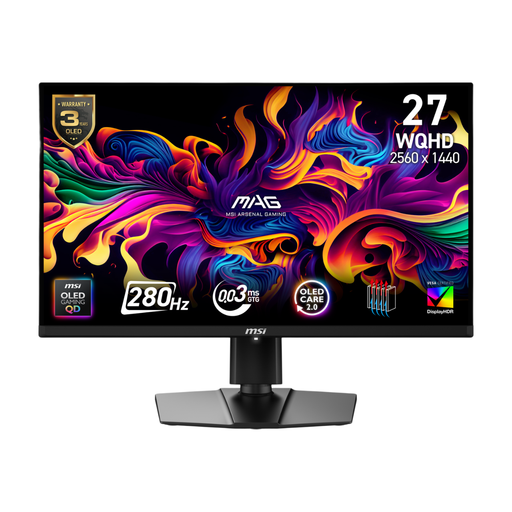
MSI MAG 271QP QD-OLED X28, 27-inch QHD monitor
Consider this 27-inch QHD model only if its screen and stand can sit at a comfortable distance from your racing position.
The title lists a QD-OLED panel, 280Hz and a 0.03ms response rating. Confirm the stand footprint, VRR compatibility and refresh mode for the connection you plan to use.
View on Joybuy
Frequently asked questions
Should I choose a 24-inch or 27-inch screen for a small racing desk?
Choose a 23.8–24-inch screen when the wheel setup leaves a short viewing distance or little free desk space; consider 27-inch QHD when you can position the larger display comfortably and want more pixel detail. The Health and Safety Executive advises keeping the screen about an arm’s length away, with its top around eye level.
Will a 180Hz monitor run at 180Hz through HDMI?
Not necessarily: the available refresh rate can depend on the exact monitor and input. Dell lists up to QHD 180Hz through DisplayPort 1.4 for the G2725D, compared with up to QHD 144Hz through its HDMI 2.1 ports; check your chosen monitor, source device and cable together.
Will Adaptive Sync, FreeSync or G-SYNC compatibility eliminate tearing?
These features are intended to coordinate refresh with compatible output, but a named feature alone does not guarantee the result for your setup. Confirm support for your device and monitor combination, then check the relevant settings after connecting them.
Can I compare an MPRT rating directly with a GtG rating?
No. MPRT and GtG measure response differently: AOC lists both 0.5ms MPRT and 1ms GtG for the Q27G4XF, while BenQ lists 1ms MPRT and 2ms GtG for the EX240. Neither pair of figures alone establishes how the two monitors compare in measured motion clarity.


