For string-quartet arranging at a shared office desk, a 27-inch QHD IPS monitor with an adjustable stand is a starting point if you want room for notation and timelines while keeping controls comfortable to read. Consider 4K when finer detail matters and you can check scaling in your arranging software; add USB-C charging, a hub or device switching only when your computers can use those features. As the Health and Safety Executive explains, applicable UK display screen equipment duties concern the whole workstation, not the monitor alone.
Who this setup suits
Score-and-timeline arrangers
If you regularly move between quartet notation, instrumental parts and MIDI or audio regions, consider how much of each view remains legible at the screen scale you prefer. More pixels are useful only if the resulting controls and markings are comfortable to read.
Laptop hot-desk users
If you bring a laptop to a shared desk, check whether the monitor can carry its video signal, connect the peripherals you use and supply enough power for that particular computer. A USB-C socket alone does not establish a one-cable setup.
Long-session office users
If arranging keeps you at the screen for sustained periods, screen positioning matters alongside resolution. The Health and Safety Executive advises assessing the whole workstation and reducing risks for workers covered by UK display screen equipment requirements.
What to prioritise
Start by checking notation and control sizes in your arranging software, then match the monitor’s connections and adjustment options to the computers and people using the desk. A 4K panel offers a finer pixel grid than QHD at the same size, but scaling determines how much of that detail is practical for you.
| Concern |
What to check |
Who this matters to |
| Score and timeline space |
Compare QHD and 4K at the intended screen size; check notation, menus and timelines at your preferred software scaling. |
If I need the score, parts and timeline visible together, I want enough room without shrinking their controls beyond comfortable reading size. Around 40% of consumers put usable arranging workspace first. |
| Shared-desk connections |
Check the laptop’s USB-C video capability and power needs against the monitor’s inputs and power delivery; consider hub or switching features only if you will use them. |
When I move my laptop between desks, connecting it without repeatedly changing chargers and adapters matters most. For around 30% of consumers, straightforward laptop connection is the primary concern. |
| Workstation fit |
Check stand height and other adjustments, available desk space and whether a suitable monitor arm is needed. |
For a long arranging session at a desk others also use, I need to position the screen for myself rather than accept a fixed setup. Comfortable workstation fit comes first for around 30% of consumers. |
Buying pitfalls
-
Assuming every USB-C monitor provides one-cable video and charging
USB-C describes the connector, not every function available through it. BenQ explains that video over USB-C depends on a compatible DisplayPort Alt Mode connection, while charging capacity varies by monitor and must suit the laptop.
Before ordering, check the laptop’s video-output specification and charging requirement against the monitor’s power delivery, and confirm which cable comes with the chosen model.
If the connection or charging capacity does not fit, you may still need a separate charger, dock or video adapter.
-
Choosing 4K without checking arranging-software scaling
A 27-inch 4K screen has a finer pixel grid than a 27-inch QHD screen, but notation, plug-in controls and menus may appear too small at an unsuitable scaling setting. The useful workspace depends on both the operating system and the application.
Check your normal score layout and controls at the scaling you intend to use. If larger controls matter more to you than fine detail, compare a QHD display at the same desk position.
-
Relying on monitor features instead of adjusting the workstation
An adjustable stand can help different people position a screen, but it does not assess the desk, seating or work routine. The Health and Safety Executive says UK display screen equipment duties apply to workers who use such equipment daily for continuous periods of an hour or more; employers must assess their workstations and reduce risks.
Check the screen position for the person using it and follow the office workstation assessment process where those duties apply.
Positioning the screen appropriately may also require a compatible monitor arm or changes to the desk arrangement.
Relevant monitor brands
These examples describe particular monitor models, not every display from each brand. Check the exact model number before relying on a connection, charging rating or stand adjustment.
BenQ
The GW2790QT is an example of a 27-inch QHD monitor aimed at an adjustable, laptop-connected desk.
- BenQ specifies USB-C video and data, 65W power delivery, a USB hub and height, tilt, pivot and swivel adjustment for the GW2790QT.
- Its 65W charging rating must be checked against the laptop’s needs, and the laptop must support compatible USB-C video output.
Dell
The P2725DE is a QHD office-monitor example for a desk that also needs a wired network connection.
- Dell specifies a 27-inch 2560 × 1440 IPS panel, 90W USB-C power delivery, RJ45 Ethernet and height, pivot, tilt and swivel adjustment.
- It is a QHD rather than a 4K option; choose between those resolutions by checking the detail and scaling you need in your software.
LG
The 27UP85ZK-W represents a 27-inch 4K route for arranging alongside other visually detailed work.
- LG specifies a 4K IPS panel, USB-C connectivity, charging up to 90W and height, pivot and tilt adjustment for this model.
- Check the size of notation and application controls at your preferred scaling before choosing a 27-inch 4K screen.
Philips
The 27B2U6903/00 is a 4K example for a shared desk that regularly switches between compatible computers.
- Philips specifies Thunderbolt 4, power delivery and Smart KVM for connecting and switching devices.
- Check the ports and protocol support on every computer; switching and docking features bring little practical value if the desk does not use them.
Joybuy monitor choices
These QHD and 4K monitors give you different starting points for a shared-office arranging desk. Compare the score and timeline view you can read comfortably, then check the connections and screen positioning required by your own setup.
 No image available
BenQ MA270UP Nano Glossy 27-inch 4K Mac Monitor
Consider this 4K display if fine score detail is important, but check the size of your arranging software’s notation and controls at your preferred scaling.
The product name specifies an IPS panel, USB-C and a height-adjustable stand. Confirm compatible laptop video output and sufficient charging power before planning around a single cable.
View on Joybuy
 No image available
MSI MD272UPSW 27-inch 4K Smart Monitor with Google TV
This is another 4K option for checking detailed notation on one screen; try your usual arranging interface at a comfortable scaling setting before choosing it.
The product name identifies an IPS panel and USB-C 65W charging. Verify that your laptop supports the required display connection and that 65W meets its charging needs; Google TV is a separate feature rather than an arranging requirement.
View on Joybuy
 No image available
ASUS ProArt PA278CV IPS WQHD Monitor
Consider this QHD model if your priority is a notation and timeline view with controls you can read comfortably, rather than choosing 4K detail by default.
Its product name identifies an IPS WQHD display. Check the stand adjustment and the laptop’s video and charging requirements against the exact desk setup you intend to use.
View on Joybuy
 No image available
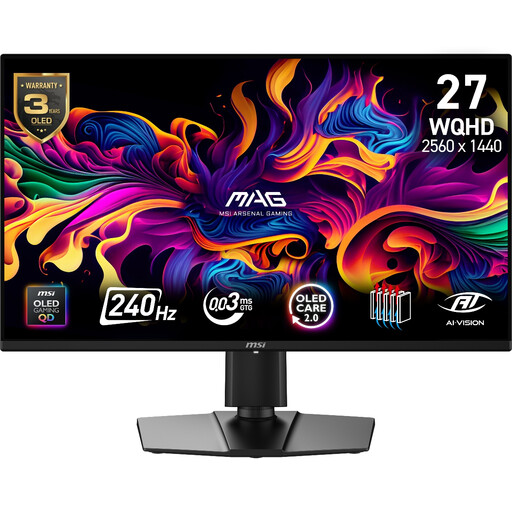
MAG 274QP QD-OLED X24 27-inch WQHD Monitor
This QHD option is worth comparing if the notation and timeline fit you want is available without relying on a 4K scaling setting.
The product name specifies a QD-OLED display, 240Hz refresh rate and HDMI and DisplayPort connections. Check whether those inputs fit your laptop and whether the screen can be positioned appropriately at the shared desk.
View on Joybuy
 No image available
LG 27UP650K 27-inch 4K IPS Monitor, White
Consider this 4K model if fine score detail matters to you and the notation and menus remain readable at your chosen scaling.
The product name specifies HDMI and DisplayPort inputs and built-in speakers. Check how your laptop will connect and whether the monitor’s positioning options fit the workstation.
View on Joybuy
Common questions
Is a 27-inch 1080p monitor enough for arranging a string quartet?
It may be enough for a particular application and layout, but a software minimum does not tell you whether a score, parts and timeline will fit comfortably together. Steinberg lists 1920 × 1080 at 100% interface scaling for Backbone; check the requirements and layout of the arranging software you actually use, then compare how a QHD screen displays your usual workspace.
Will any USB-C monitor send video and charge my laptop?
No. The laptop must support video output compatible with the monitor’s USB-C connection, and the monitor’s power delivery must meet the laptop’s charging needs. BenQ explains the role of DisplayPort Alt Mode in USB-C video connections; also check the chosen monitor’s charging rating and supplied cable.
Does a shared office need a special monitor for UK display screen equipment rules?
No particular monitor model, on its own, fulfils the workstation duties described by the Health and Safety Executive. For workers who use display screen equipment daily for continuous periods of an hour or more, the employer must assess the workstation and reduce risks; an adjustable screen can help with positioning, but the desk and work routine matter too.


