For oval-racing practice on one screen, start by considering a curved 34-inch, 3440 × 1440 ultrawide: it offers a wider format than 16:9 without the width or pixel count of a 49-inch Dual QHD display. Choose 49-inch Dual QHD when uninterrupted screen width is your priority and your rig and PC can accommodate it; choose 32-inch 4K when image detail matters more than horizontal coverage. Whichever format you prefer, check the available space, your PC’s output modes and the panel’s care terms before ordering.
Who each format suits
Single-screen racers seeking more side visibility
If you want a wider panel without aligning multiple monitors, compare a curved 34-inch 21:9 screen with a 49-inch super-ultrawide. The larger route also needs more cockpit space and graphics-card capacity.
Racers focused on smooth motion
Prioritise a refresh mode and adaptive-sync support that your PC and connection can use at the chosen resolution. A monitor’s quoted response time or maximum refresh rate does not establish the frame rate your simulator will deliver.
Buyers balancing rig space and GPU demands
Check screen width, mounting clearance and resolution together. A 49-inch panel or a 4K display may change what fits your rig or what frame rate your PC can sustain.
What to check before choosing
34-inch curved ultrawide
Choose it when: You want a 21:9 single-panel view and have room for a 34-inch screen, but not the footprint of a 49-inch model.
Trade-off: It does not provide the physical width of a 49-inch screen; check OLED care and warranty terms if choosing an OLED version.
49-inch Dual QHD
Choose it when: Uninterrupted horizontal screen width matters most and your cockpit has space for it.
Trade-off: A 5120 × 1440 image has more pixels to render than 3440 × 1440, alongside a substantially wider physical footprint.
32-inch 4K
Choose it when: 4K image detail takes priority and a conventional 16:9 shape suits your racing and other desktop use.
Trade-off: It offers less horizontal panel width than either ultrawide format, while 4K increases the number of pixels your PC must render.
| Concern |
What to check |
Who this matters to |
| Horizontal view |
Compare aspect ratio and usable rig width; check how your simulator handles the chosen field of view. |
I want more of the racing scene across one uninterrupted screen without moving to triples. Around 33% of consumers put horizontal view first. |
| Motion consistency |
Confirm the resolution and refresh mode for your intended input, plus compatible adaptive sync. |
When cars move quickly around me, I care most about a display mode my PC can drive consistently. For around 25% of consumers, motion is the primary concern. |
| GPU and rig fit |
Test the target resolution where possible, and measure mounting and stand clearance. |
I need the screen to fit my cockpit without choosing a resolution that makes my preferred graphics settings impractical. Around 25% of consumers prioritise this balance. |
| Panel upkeep |
Assess room lighting, then read the exact panel-care instructions and warranty terms. |
For long sessions with a persistent racing HUD, I would rather choose a panel whose upkeep suits my routine. Panel and room considerations come first for around 17% of consumers. |
Avoid these buying mistakes
-
Choosing width without checking GPU headroom
Based on the native resolutions published by LG, Samsung and ASUS, 5120 × 1440 contains about 1.49 times as many pixels as 3440 × 1440; 3840 × 2160 contains about 1.67 times as many. That can affect achievable frame rates at comparable settings.
Test your main racing simulator at the intended resolution where possible before committing to a higher-pixel-count screen.
-
Judging cockpit fit by diagonal size alone
A 34-inch 21:9, 49-inch Dual QHD and 32-inch 16:9 monitor differ in shape as well as resolution. The diagonal measurement will not tell you whether the panel, stand or mount fits your rig.
Measure the available width, stand depth or monitor-arm clearance, and your usual eye-to-screen distance.
-
Assuming the quoted refresh rate works through every connection
The available mode depends on the monitor’s input, your GPU output and the cable. Dell, for example, specifies 3440 × 1440 at 240Hz for the Alienware AW3425DW through DisplayPort 1.4 with DSC, alongside a specified HDMI mode.
Match the manufacturer’s resolution-and-refresh information to the connection you intend to use.
-
Overlooking OLED care during long racing sessions
A persistent racing HUD makes the exact model’s panel-care guidance relevant. Manufacturer-described protection features do not remove the need to understand maintenance and warranty conditions.
Read the chosen monitor’s manual and warranty terms, particularly if your simulator keeps the same interface elements on screen for extended periods.
Relevant brands and models
LG UltraGear
The 34GS95QE-B illustrates the curved 34-inch OLED ultrawide route.
- LG UK specifies a 3440 × 1440, 21:9, 800R panel with 240Hz refresh and G-SYNC Compatible and FreeSync Premium Pro support for this model.
- Check whether your PC can drive the mode you want, and review the exact OLED-care and warranty terms.
Alienware
The AW3425DW is another 34-inch-class, 3440 × 1440 QD-OLED ultrawide to compare.
- Dell UK specifies 240Hz operation and lists G-SYNC Compatible, FreeSync Premium Pro and VESA AdaptiveSync support for this model.
- Confirm the intended input mode and read the model-specific panel-maintenance and warranty documentation.
Samsung Odyssey
The 49-inch Odyssey OLED G95SD represents the very wide, single-panel route.
- Samsung UK specifies 5120 × 1440 and 240Hz for this model, with a glare-reduction feature.
- Its 49-inch footprint and higher pixel count than 3440 × 1440 make rig clearance and PC performance important checks.
ASUS ROG
The 31.5-inch ROG Swift OLED PG32UCDM represents a detail-led 4K, 16:9 alternative.
- ASUS ROG UK specifies 3840 × 2160, 240Hz and G-SYNC compatibility for this model.
- Its conventional shape offers less horizontal panel width than an ultrawide; assess 4K performance and the exact OLED-care guidance.
Joybuy monitors for these routes
These monitors cover 34-inch ultrawide, 49-inch Dual QHD and 32-inch 4K choices for a one-screen racing setup. Compare the format first, then check the exact model’s connection modes and fit.
 No image available
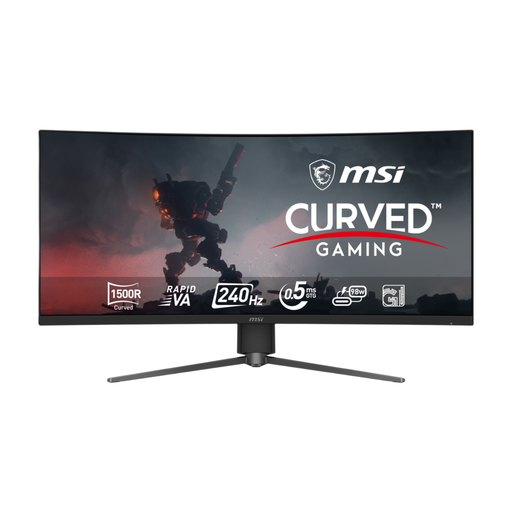
MSI MPG 346CQRF X24 34-inch curved monitor
Consider this 34-inch ultrawide if you want a curved, wider-format screen for one-monitor racing. Its title identifies a Rapid VA panel, UWQHD format and Adaptive Sync; confirm that your GPU and chosen connection support the mode you plan to use.
View on Joybuy
 No image available
LG UltraGear 34GX900A-B 34-inch OLED monitor
This is an OLED option for the 34-inch ultrawide route, with a stated 240Hz refresh rate. If your racing HUD remains on screen for long sessions, check the model’s screen-protection guidance and warranty terms.
View on Joybuy
 No image available
Acer X Predator X49X 49-inch QD-OLED monitor
Consider this 49-inch, 32:9 Dual QHD route when screen width is your priority and your rig can accommodate it. The product title states a 1800R curve and 240Hz; confirm the refresh mode available through your intended input, along with OLED-care and warranty terms.
View on Joybuy
 No image available
CRUA 49-inch curved Dual QHD VA monitor
This non-OLED, 49-inch option suits a width-first setup where a large screen and suitable mount will fit. Its title states 5120 × 1440, 165Hz, a 1500R curve and VESA 75 × 75 mounting; check the refresh mode for the input you intend to use.
View on Joybuy
 No image available
Samsung Odyssey OLED G8 LS32DG802SUXXU 32-inch monitor
Choose this conventional-format Ultra HD option if image detail matters more to you than ultrawide panel width. Confirm the 4K refresh mode available through your PC’s chosen connection and whether its adaptive-sync support meets your needs.
View on Joybuy
Common questions
Should I choose a 34-inch or 49-inch ultrawide for oval racing?
Choose a 34-inch 3440 × 1440 screen if you want a wider-than-16:9 format with a more manageable footprint. A 49-inch 5120 × 1440 screen suits a width-first setup if your rig and PC can accommodate it; those stated resolutions mean the 49-inch route has about 1.49 times as many pixels to render.
Do I need a 240Hz monitor to practise oval racing?
No: a 240Hz specification is useful only if your PC, simulator settings and connection can make use of that mode. Check performance at the monitor’s native resolution rather than treating its maximum refresh rate as a frame-rate promise.
Which connection should I check before buying?
Check the exact resolution and refresh rate supported through both your GPU output and the monitor input you plan to use. For the Alienware AW3425DW, Dell specifies up to 3440 × 1440 at 240Hz through DisplayPort 1.4 with DSC and also lists HDMI support at that resolution and refresh rate.
What should I check if my racing HUD stays on an OLED screen?
Follow the care routine for the exact OLED model and read its warranty conditions before purchase. Features intended to manage image retention are not a reason to assume that extended static HUD use needs no attention.
What should I do with an old monitor when replacing it?
Arrange an electrical-waste collection or recycling route rather than putting the monitor in ordinary household rubbish. GOV.UK’s guidance covers waste electrical and electronic equipment in the UK; ask the retailer about its takeback arrangements or check your local collection options.


