Dark-scene players
If night battles, fog and smoke are central to your games, compare OLED or QD-OLED with local-dimming displays for the dark-scene presentation you prefer. Check the coating against any lamps or window reflections in your room.


Prioritise dark-scene contrast and readable maps over a refresh-rate figure alone. A 4K OLED or QD-OLED monitor is a route if deep blacks and fine detail matter most in a consistently dim room; a well-specified Mini-LED monitor is worth considering if you place more weight on its stated HDR brightness and local dimming. Whichever route you take, check the coating, desk fit, panel-care terms and the resolution and refresh rate your devices can deliver through the available ports.
If night battles, fog and smoke are central to your games, compare OLED or QD-OLED with local-dimming displays for the dark-scene presentation you prefer. Check the coating against any lamps or window reflections in your room.
If you spend long sessions reading terrain, unit labels and dense menus, a roughly 32-inch 4K display is a useful comparison point. Check your viewing distance, text scaling and whether your graphics hardware can run your chosen games at acceptable settings.
If you switch devices, shortlist monitors by the modes available through their actual HDMI, DisplayPort or USB-C inputs. Confirm adaptive-sync compatibility for the device and connection you intend to use.
For dark-room historical games, compare OLED’s black-level presentation with the stated HDR brightness and local dimming of a specific Mini-LED model; a high-refresh LCD is another route if motion matters most, but its refresh rate does not answer the contrast or map-detail questions. Then check the screen format and the modes your devices can actually output.
| Concern | What to check | Who this matters to |
|---|---|---|
| Dark-scene contrast | Compare the exact panel, HDR specification and screen coating under your room lighting. | When night battles and smoke fill the screen, I want dark areas to remain distinguishable without distracting reflections. Around 36% of consumers put dark-scene contrast first. |
| Map detail | Check native resolution and screen size, then test whether your graphics hardware and interface scaling suit your viewing distance. | For long campaign sessions, I need to read unit labels and terrain without leaning towards the screen. Roughly 29% of consumers make map and interface detail their primary concern. |
| Motion | Confirm refresh rate at your chosen resolution and the required device, port and adaptive-sync mode. | If rapid camera moves or competitive battles are a regular part of play, I care more about fluid motion. About 21% of consumers prioritise that need. |
| Setup and panel care | Check device inputs, desk fit and stand adjustment; for OLED, read the exact panel-care and warranty terms. | When I share a desk between devices or leave strategy interfaces on screen for long sessions, the monitor has to fit that routine. Approximately 14% of consumers put setup and panel-care checks first. |
A 240Hz monitor does not mean your PC or console can deliver 4K at 240Hz in your games. The headline figure can also draw attention away from contrast and coating in a dark room.
Decide which resolution and game settings you intend to use, then check the frame rate your hardware can provide and the monitor input and cable needed for that mode.
VESA describes DisplayHDR True Black as a standard for emissive displays, while Mini-LED monitors use local dimming. Neither a certification name nor a zone count describes every aspect of a particular monitor’s dark-scene presentation.
Compare the exact model’s panel technology, stated HDR capability, local-dimming implementation where relevant, and coating.
Historical strategy games may leave maps and interface panels visible for long periods. Manufacturer protection features do not guarantee an outcome for every use pattern or establish what a warranty covers.
Follow the selected model’s panel-care instructions and read its written warranty terms before choosing it for long sessions with static elements.
A large or curved screen may not fit your viewing distance, and the presence of a port does not establish that it supports the mode you need.
Measure the available desk space, list your source devices, and check stand movement or mounting options alongside the required input modes.
The Dell-listed AW3225QF is a curved, 4K QD-OLED model for comparison with other large dark-room gaming displays.
Samsung’s UK-listed G80SD offers a 4K QD-OLED route with a manufacturer-described glare-reduction treatment.
BenQ’s EX321UX and EX321UZ provide distinct Mini-LED and OLED models to compare for this use.
These OLED gaming monitors offer different screen formats for dark-room play, from a 27-inch QHD display to a wide 49-inch layout. Match each format to your maps, available desk space and connected devices.
 No image available
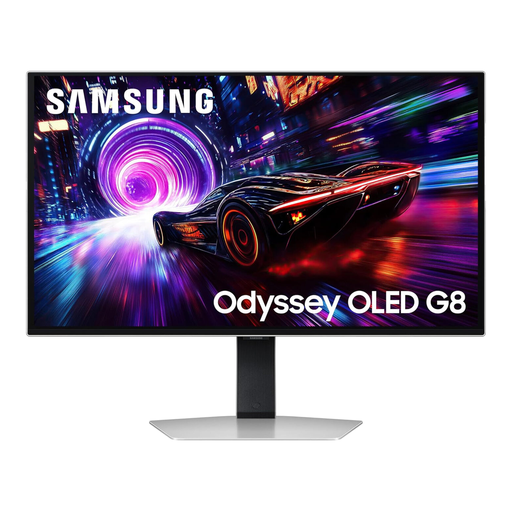
Consider this 32-inch OLED model if dark-scene presentation is a priority. Check its native resolution, the input mode needed for your device, and the written panel-care and warranty terms before ordering.
 No image available
The curved 4K format is worth considering if you want space for detailed maps and can accommodate the screen shape. The product name specifies 3840 × 2160, 165Hz and Type-C 65W. Check the coating, adaptive-sync compatibility and written panel-care terms against your setup.
 No image available
The 27-inch QHD format suits consideration where a smaller screen or fast motion matters more than choosing 4K for map detail. The product name specifies 240Hz; confirm the refresh mode available through your intended input and read the OLED warranty terms.
 No image available
Consider the ultrawide layout if your games and desk arrangement suit a broad campaign view. Its stated format is 32:9 with an 1800R curve, Dual QHD resolution and 240Hz; Dual QHD is not 4K. Check game display settings, viewing distance, input modes and the written OLED warranty terms.
No. OLED or QD-OLED is a route when deep blacks are your main priority; the Video Electronics Standards Association describes DisplayHDR True Black as a standard designed for emissive displays and subdued-light viewing. A specific Mini-LED model may instead suit a preference for high stated HDR peak brightness and local dimming. Compare coatings, connections and warranty terms on the exact monitors you are considering.
Not necessarily. A high refresh rate may matter more if you regularly play fast battles or competitive modes, while contrast and map readability may take priority during slower campaigns. To use a particular resolution and refresh rate together, check your game performance, source device, cable and monitor input; Dell specifies particular HDMI and DisplayPort capabilities for 4K at 240Hz on the AW3225QF.
Read the exact monitor’s panel-care instructions and written warranty, especially if maps or interface elements remain on screen for long periods. Use its maintenance features as directed, but do not treat their presence as a guarantee against image retention.
Match each PC or console to a monitor input that supports the resolution and refresh mode you intend to use. BenQ lists HDMI 2.1, DisplayPort 2.1 and USB-C for the EX321UX, while Dell lists HDMI 2.1 and DisplayPort 1.4 with DSC for the AW3225QF; those model-specific port lists do not establish the modes available on a different monitor.