What should you check before choosing?
Decide whether terrain detail, cockpit width or a supported high-frame-rate mode takes priority when those aims conflict.
32-inch 4K QD-OLED
Choose it when: You want detailed terrain and dark-space scenes on a conventional screen shape.
Allow for: Your PC must drive the resolution and frame rate you want; a console will not use a panel’s full 240Hz rating merely because it is available.
Curved ultrawide OLED
Choose it when: A wider cockpit or lunar horizon matters more than a conventional 16:9 image.
Allow for: The screen needs room on your desk, and your games and source device may not use its full width.
High-refresh 1440p
Choose it when: You also play faster games and place more weight on maintaining responsive motion than on 4K terrain detail.
Allow for: The lower resolution gives you less fine detail than 4K, and your PC and game still need to deliver the intended frame rate.
| Concern | What to check | Who this matters to |
|---|
| Dark scenes and terrain detail |
Compare the exact resolution and HDR support, then check whether your PC or console can output the mode you want. |
If I want to pick out surface detail against a dark sky, I put the image ahead of extra screen width. Around 42% of consumers put dark-scene and terrain detail first. |
| Panoramic cockpit view |
Measure desk width and depth; check whether your games support the monitor’s aspect ratio. |
When cockpit instruments and the horizon are central to play, I want a broader view that fits my setup. For around 33% of consumers, panoramic presentation comes first. |
| Connections and usable frame rate |
Check the supported resolution, refresh rate and variable refresh rate (VRR) on the input you will use, alongside your source device and cable. |
If I switch between devices or faster games, I need the display mode to work with my actual connection. Connection and motion compatibility is the first concern for around 25% of consumers. |
Joybuy monitor choices
These choices cover 4K OLED detail, wider OLED screens and a curved 1440p high-refresh alternative for moon-landing simulation play. Compare each monitor’s size and connections with your desk, games and source device.
 No image available
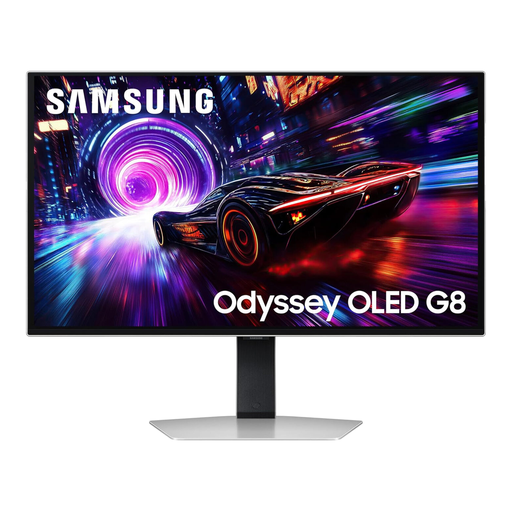
Samsung Odyssey OLED LS32FG810SUXXU 32-inch monitor
Consider this conventional-size screen if lunar terrain detail matters more to you than ultrawide width.
Samsung specifies the G81SF as a 4K QD-OLED monitor at 240Hz. Check the modes available through your intended input and follow the model’s OLED-care guidance.
View on Joybuy
 No image available
LG UltraGear 34GX900A-B 34-inch OLED monitor
Consider this wider screen if a cockpit view takes priority over the conventional 4K format.
The product name specifies WQHD and 240Hz. Check its exact resolution, desk fit, game-format support and your headphone connection.
View on Joybuy
 No image available
Dahua 32-inch curved 4K 165Hz OLED monitor
This is a curved, conventional-size option if you want to prioritise 4K terrain detail without moving to an ultrawide screen.
The product name specifies 3840 × 2160 resolution, 165Hz and HDR400. Check the supported mode on your chosen input and the model’s OLED-care guidance.
View on Joybuy
 No image available
Acer Predator X49X 49-inch curved QD-OLED monitor
Consider this especially wide screen only if your desk and games can accommodate its format.
The product name specifies a 32:9 aspect ratio, 1800R curve and 240Hz. Check the exact resolution and refresh rate available on the input you intend to use.
View on Joybuy
 No image available
CRUA 32-inch black 1500R curved QHD monitor
This 1440p-class choice fits a decision to prioritise high refresh over 4K terrain detail.
The product name specifies 2560 × 1440 resolution and 165Hz, with HDMI and DisplayPort connections. Check which refresh rate your chosen connection supports.
View on Joybuy
Common questions
Do I need 240Hz for a moon-landing simulation?
No: if you mainly explore cinematic scenes, resolution and screen format may matter more to your choice. A 240Hz monitor is worth considering if you also play faster games and your PC and games can supply high frame rates; the panel rating alone cannot make a game run at 240 frames per second.
Can a PS5 use a 4K 120Hz monitor?
Yes, if the monitor and connection support the mode. PlayStation Support states that PS5 supports HDMI 2.1 and 4K 120Hz video output; check the connected display’s supported modes in the console’s Screen and Video settings, including VRR and HDR where relevant.
What should I check for Xbox Series X at 4K and 120Hz?
Check the Xbox Series X, cable and display together rather than relying on the monitor’s headline refresh rate. Xbox Support specifies an Ultra High Speed HDMI cable and an HDMI 2.1-capable display for its 4K-at-120Hz setup; the game must also support the frame-rate mode you want.
Do monitor speakers matter if I use headphones?
Speakers can be a secondary consideration when your audio already comes through headphones. Confirm that your intended connection through the PC, console, controller or monitor works for your setup, then compare the display features you will use.
How should I dispose of an old monitor?
Use an appropriate electrical-equipment collection, reuse or recycling route rather than putting the monitor in general waste. GOV.UK identifies waste electrical and electronic equipment as a regulated category; check your local authority’s or retailer’s current collection arrangements for the route available to you.


