
24/7 Customer Support

Free returns

Same-day & Next-day Delivery

Quality Guaranteed

Unlock Your Welcome Offers: FREE Delivery | Up to 80% OFF | Free 30-day JoyPlus trial
Download the APP
Navigating the dark corners of our homes, from a gloomy hallway to the back of a deep wardrobe, is a common frustration. Finding what you need under a kitchen cabinet can feel like a search party mission, and a poorly lit staircase is a genuine safety concern. For years, the only solution was to call in an electrician for a costly and disruptive rewiring job.
Fortunately, there is now a simpler, more flexible way to brighten up your space. Modern motion sensor lights indoor offer a convenient and affordable solution. These clever devices provide light exactly when and where you need it, without any complex installation. This guide is designed to help you understand what to look for and to highlight some practical options available for your home.
Choosing the right light involves more than just picking the first one you see. Here are a few key factors to consider to ensure you get a solution that fits your needs perfectly.
The power source is a crucial consideration. Traditional battery operated lights are simple to set up, but the ongoing cost and hassle of replacing batteries can add up. A more modern and sustainable alternative is rechargeable led lights. These models typically feature built-in batteries and offer convenient USB charging. While the initial cost might be slightly higher, they save you money in the long run and are a more environmentally friendly choice.
One of the biggest advantages of these lights is the tool-free installation. Most models offer two primary methods:
Consider where you will be using the light. For focused illumination in a small space like a drawer or a small cupboard, compact led puck lights are an excellent choice. For broader coverage, such as along a set of stair lights or under a long kitchen counter, a strip-style light might be more suitable. Also, look for features like adjustable brightness and colour temperature. A cool white light is great for task-oriented kitchen lights, while a warmer, softer light is often preferred for a wireless night light in a hallway or bedroom.
Here are a few recommendations that offer a great balance of functionality, ease of use and value.
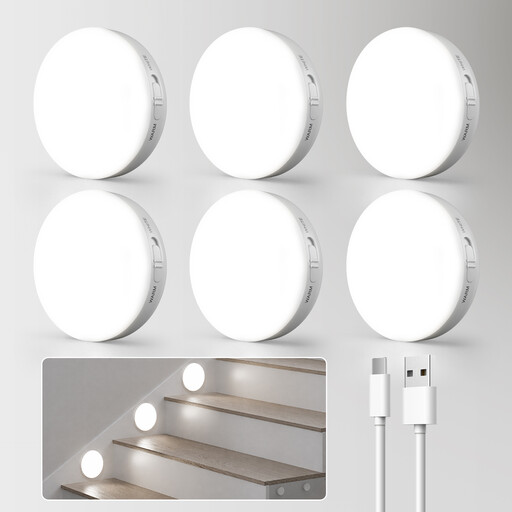
Why It Stands Out: This 6-pack offers exceptional value, allowing you to illuminate multiple areas of your home with a single purchase. The standout feature is the ability to switch between a brighter cool white and a softer warm yellow light, making them adaptable for different environments, from task lighting to ambient night lighting.
Pros:
Who is it for? This is an ideal choice for anyone needing a cost-effective solution to light up several dark spots around their home, such as a wardrobe light, stairwell or corridor.
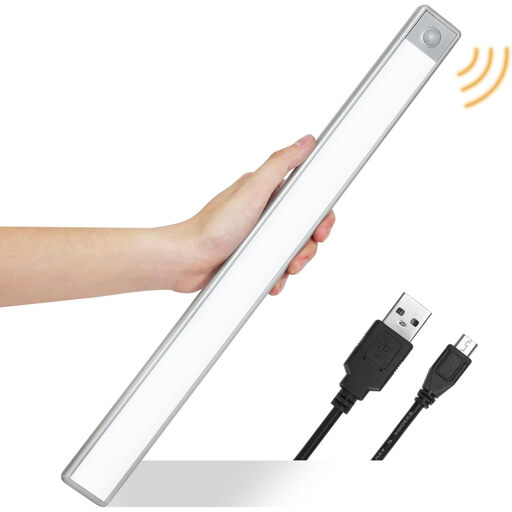
Why It Stands Out: With its slim, brushed aluminium casing, the EverBrite light brings a touch of modern design to functional lighting. It packs 70 LEDs that produce a bright 350 lumens, making it significantly brighter than many puck-style lights and perfect for task lighting.
Pros:
Who is it for? This is for those who need powerful, high-quality under cabinet lighting in their kitchen or workshop and appreciate a more refined, minimalist aesthetic.
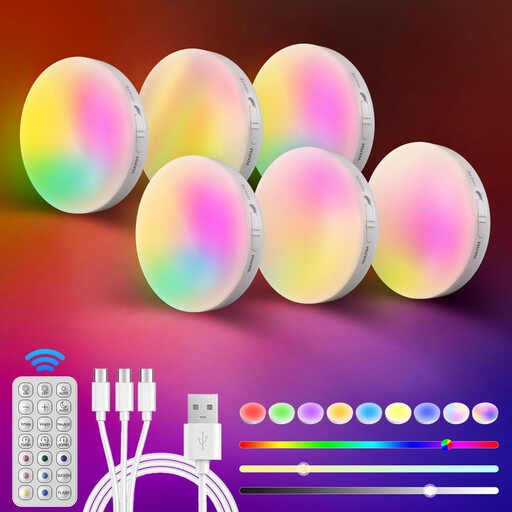
Why It Stands Out: This set combines practicality with personality. In addition to standard motion-sensing capabilities, these lights come with a remote control that allows you to choose from 7 RGB colours, 3 shades of white and 5 brightness levels. This makes them incredibly versatile for both safety and decorative accent lighting.
Pros:
Who is it for? Perfect for users who want more than just a simple wireless night light. These are great for creative individuals, families with children or anyone looking to add customisable ambient lighting to their living space.
The products highlighted here are excellent starting points, but the world of wireless lighting is vast. If you're looking for different sizes, strip-style lights or other specialised designs to perfectly match your home's unique needs, there are many more choices to discover.
Explore our full collection of wireless cabinet lights to find the ideal fit for your project.
Q1: How do indoor motion sensor lights work? Most indoor motion sensor lights use a Passive Infrared (PIR) sensor. This sensor detects the infrared energy (body heat) emitted by people and pets. When you walk into its detection range in a dark environment, it triggers the light to turn on. After a set period of no movement (usually 20-30 seconds), it automatically turns off to conserve battery.
Q2: Are stick on lights reliable for mounting under cabinets? Yes, when installed correctly. The key is to start with a clean, dry and smooth surface. Wiping the area with an alcohol-based cleaner first can help ensure a strong bond. For heavier lights or textured surfaces, using the included magnetic plates with screws (if provided) or choosing a model with strong built-in magnetic lights can offer extra security.
Q3: How long do rechargeable LED lights last on a single charge? This varies significantly based on several factors: the battery's capacity (measured in mAh), the light's brightness and how often it is activated. In "Auto" or sensor mode, a light might last anywhere from a few weeks to over two months. If left in "On" mode continuously, the battery will drain in a matter of hours. Always check the product specifications for estimated battery life.