
24/7 Customer Support

Free returns

Same-day & Next-day Delivery

Quality Guaranteed

Unlock Your Welcome Offers: FREE Delivery | Up to 80% OFF | Free 30-day JoyPlus trial
Download the APP
Navigating your home after dark can be a challenge. Whether it's a late-night trip to the kitchen, checking on a child or simply avoiding that stray toy on the landing, fumbling for a light switch can be disruptive and unsafe. A bright overhead light can jolt you (and everyone else) awake, while leaving a standard night light on all night can be an unnecessary energy drain.
A motion sensor night light offers a simple and effective solution. It provides just enough light to guide your way safely, exactly when and where you need it, without disturbing your sleep. This guide is designed to help you understand the key features to look for and to present some practical options for illuminating your hallways, bedrooms and wardrobes.
Before you buy, consider these three key factors to ensure you find the perfect fit for your home.
Your first decision is how the light will be powered.
How and where you install your light is crucial for its effectiveness. Many modern units offer tool-free installation. A magnetic under cabinet light, for example, can be attached to any metal surface in seconds. Others use strong adhesive pads, allowing you to place them on walls, door frames or inside furniture without drilling.
For optimal performance, place the sensor where it will detect movement along your intended path. On stairways, positioning lights low to the ground illuminates each step. In a child's room, place it so it activates when they get out of bed, lighting a clear path to the door.
The quality of the light itself is just as important as the sensor.
Here are a few options that stand out for their practical features and design.
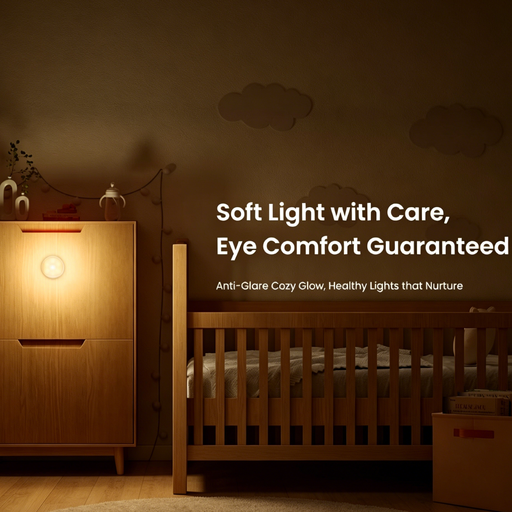
Why It Stands Out: This light’s main appeal is its sheer versatility. The combination of a rechargeable battery and a magnetic base means you can place it almost anywhere, move it easily and even carry it with you as a portable torch.
Pros:
Who is it for?: This is an excellent choice for renters, families with young children or anyone who needs a flexible lighting solution that can be moved from a hallway to a wardrobe with ease. It serves well as a children's motion sensor light.
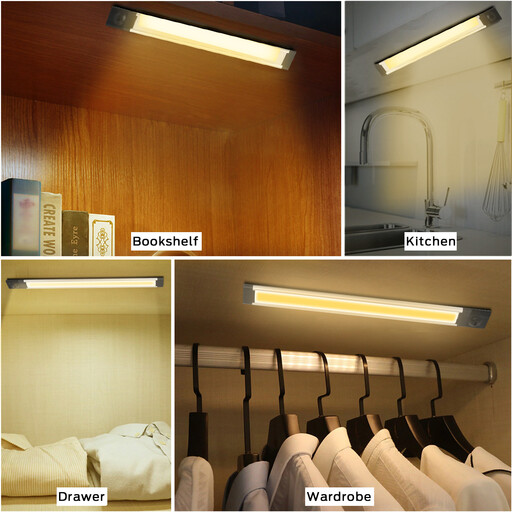
Why It Stands Out: This model offers impressive functionality with its gesture control feature, allowing you to adjust brightness without touching the device. Its high luminous flux makes it suitable for areas requiring more than just a faint glow.
Pros:
Who is it for?: Ideal for use as a magnetic under cabinet light in the kitchen, a bright stick on wardrobe light or in workshops and garages where hands-free operation and adjustable, bright light are needed.
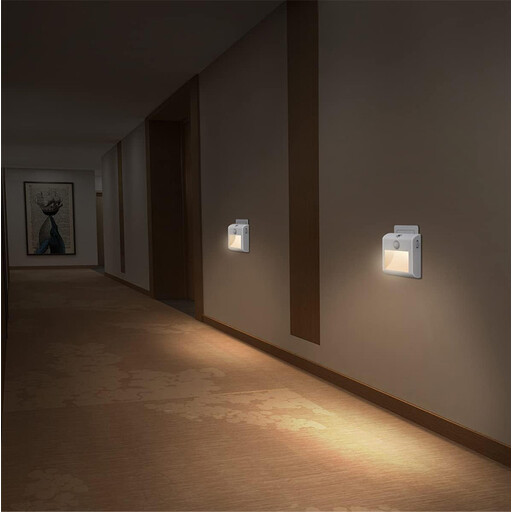
Why It Stands Out: This is a highly practical and cost-effective package. You get two lights, allowing you to illuminate multiple areas of your home at once. The touch dimming and memory function add a layer of convenient customisation.
Pros:
Who is it for?: A great starting point for homeowners looking to add automated lighting to several key areas like a hallway and a bathroom. The memory function is particularly useful for bedside use.
While these recommendations cover a range of common needs, your perfect lighting solution might be different. If you're looking for other styles, features or specific designs for your home, there are many more choices available.
Explore our full range of Bedroom LED lights to discover more smart and efficient lighting solutions.
1. Where is the best place to put a motion sensor night light? For hallways and stairs, position the light low on the wall (about 30-60 cm from the floor) to illuminate the walking path without shining directly into your eyes. In bedrooms, place it away from your bed to prevent it from turning on every time you move in your sleep. For a children's motion sensor light, ensure it lights the path from their bed to the door.
2. Do motion sensor lights use a lot of electricity? No, they are highly energy-efficient. A modern LED night light consumes very little power, often just 1W or less. Because they only activate when motion is detected, they use significantly less electricity than a light that is left on continuously through the night.
3. Can you make a motion sensor light stay on? Some models, like the 2-pack plug-in lights featured above, come with a dual-mode function. This allows you to switch the light to an 'always on' mode if you need constant, low-level illumination for a period of time, giving you the best of both worlds.