
24/7 Customer Support

Free returns

Same-day & Next-day Delivery

Quality Guaranteed

Unlock Your Welcome Offers: FREE Delivery | Up to 80% OFF | Free 30-day JoyPlus trial
Download the APP
Navigating a dark hallway for a late-night glass of water or fumbling inside a dim wardrobe shouldn't be a daily challenge. A battery powered motion sensor night light seems like a simple fix, yet many UK households find their purchase gathering dust in a drawer after just a few months. Why? Because not all lights are created equal.
As a Joybuy Product Recommendation Officer, my role is to help you see past the marketing gloss and focus on what makes a product genuinely useful. Many shoppers fall into common traps, wasting money on devices that fail to deliver. Before you buy, be aware of these pitfalls:
stick on night light that peels away from the wall after a few days. The adhesive pads supplied are often not suited for the varied surfaces and slight humidity found in many UK homes.To avoid these issues, it pays to look at a few key specifications. These details determine whether your light will be a reliable convenience or a short-lived gadget.
The heart of any battery operated sensor light is its power source. You generally have two options: disposable batteries (like AAA) or a built-in rechargeable battery.
Nearly all these devices use a PIR (Passive Infrared) sensor to detect movement. It works by sensing the heat given off by a person or pet. For it to work effectively in your space, check two figures:
wireless closet light.automatic stair lights.A light is only useful if it stays where you put it. While most are designed for adhesive mounting, look for those that specify high-quality double-sided tape. For a secure fit, always apply it to a clean, dry and smooth surface. The housing material, often ABS plastic, should feel sturdy and durable enough to withstand the occasional knock.
Based on these practical criteria, we have matched a few products from our catalogue to different household needs.
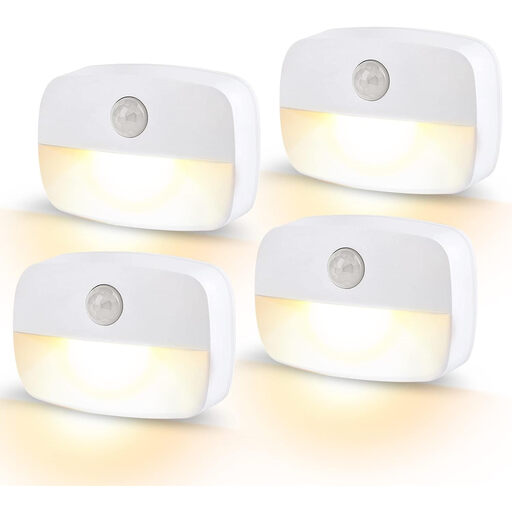
Why This Fits Their Persona: This household needs a straightforward, cost-effective solution to light up multiple areas like the landing, under-stairs cupboard and hallway. This LED sensor light 4 pack offers excellent value without requiring any wiring or technical skill.
Its low 0.5W power consumption and 20-second auto-off timer are designed to maximise the life of its AAA batteries, directly countering the battery drain pitfall.
Provides a warm white glow that is gentle on the eyes at night. The 4–6 metre detection range is ample for most indoor spaces.

Why This Fits Their Persona: For those who value aesthetics and functionality, this ultra-thin light bar is perfect for providing seamless illumination under kitchen cabinets, inside wardrobes or along display shelves. It offers a sleek, integrated look rather than a bulky puck.
This model is USB-rechargeable with a high-capacity 1100mAh battery, eliminating the cost and hassle of disposable batteries entirely.
It features three adjustable colour temperatures (warm, daylight and cool white) to match your room's existing lighting. The slim profile is highly discreet.
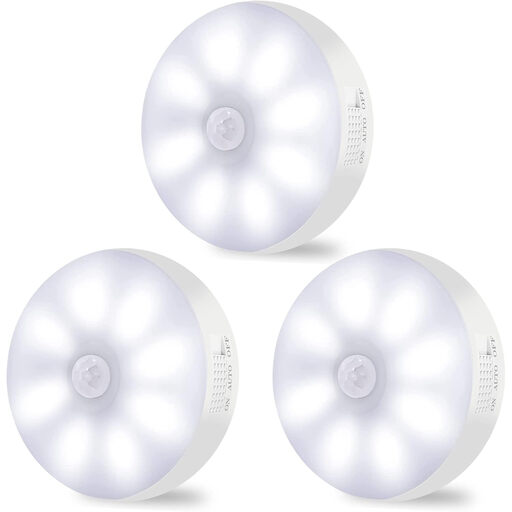
Why This Fits Their Persona: For families with young children or elderly relatives, reliable lighting on stairs and in bathrooms is a safety priority. This rechargeable pack offers flexibility and control, ensuring light is always available where needed.
The inclusion of an 'On' mode, in addition to 'Auto', provides manual control. This overcomes the unreliable sensor issue by allowing the light to be kept on when continuous light is needed.
Being rechargeable, it offers long-term savings and convenience. The three-mode switch (Auto/On/Off) gives users complete control over the light's operation.
We have compiled a complete, real-time list of products that fully satisfy these strict selection criteria and UK safety regulations.
How long do batteries typically last in a motion sensor night light? This varies greatly depending on the model and usage. For a quality battery operated sensor light with low power consumption (around 0.5W) that activates 8-10 times per night, a set of 3 AAA batteries can last anywhere from 3 to 6 months. Rechargeable models can often last for 1-2 months on a single charge.
Where is the best place to install an indoor motion sensor light? For hallways, place the light about knee-height to avoid it being triggered by distant movement. For stairs, position one at the top and one at the bottom, pointing down the steps. In cupboards or pantries, mount it on the inner frame of the door so it activates as soon as you open it. Avoid placing them opposite reflective surfaces or heat sources like radiators, which can cause false triggers.
Can the sensors be too sensitive? Yes, this is a common issue with lower-quality models. A well-designed sensor should not be triggered by ambient light changes or movement outside its specified range. If you find a light is activating too frequently, it may be positioned in a high-traffic area or near a heat vent. Unfortunately, most simple models do not have adjustable sensitivity, which is why choosing one with a reliable PIR sensor from the outset is important.