
24/7 Customer Support

Free returns

Same-day & Next-day Delivery

Quality Guaranteed

Unlock Your Welcome Offers: FREE Delivery | Up to 80% OFF | Free 30-day JoyPlus trial
Download the APP
Motion sensor night lights can make bedrooms, hallways, stairways, wardrobes and cupboards easier to navigate after dark. They can also reduce the need to switch on bright overhead lighting during the night.
However, product listings often make similar lights appear interchangeable. In practice, differences in sensor behaviour, battery design, brightness and installation can affect whether a light is genuinely useful in a UK home. The following guide explains the main buying pitfalls and the specifications worth checking before you choose.
A PIR sensor may detect movement several metres away, but that does not mean the light will illuminate a large area. A compact light with a low lumen output may be suitable beside a bed but inadequate for a staircase or deep wardrobe.
Check both the detection range and the brightness rating. For example, some indoor motion sensor lights provide a 3–5 metre detection range, while other models specify a 120-degree sensing angle. These figures describe sensing performance, not how far the light shines.
Wireless cabinet lights and battery-operated night lights avoid permanent wiring, but they still require either battery replacement or regular charging. A rechargeable model may be more convenient for frequently used areas, while AAA or AA battery lights can be practical where there is no nearby USB charging point.
Look for the battery capacity, charging method and stated runtime. A higher-capacity battery can be useful for wardrobe lights or hallway lights that activate often, although actual runtime depends on brightness, detection frequency and operating mode.
No-drill installation is useful for renters, but adhesive tape may not adhere reliably to dusty, damp, textured or freshly painted surfaces. Magnetic LED lights offer a different arrangement: the light can often be removed for charging while its mounting point stays in place.
Before buying, check the mounting method and measure the available space. An under-cabinet light that is too long may not sit neatly beneath a shelf, while a very short light may leave parts of a worktop or cupboard in shadow.
Most PIR sensor lights detect movement through changes in infrared radiation. For bedroom night lights, a light-sensitivity setting is particularly useful because the lamp can activate in darkness rather than during daylight.
Some models specify activation at or below 20 LUX, while others simply state automatic night-time operation. If the light will be used in a nursery, hallway or beside a bed, a sensor mode with automatic shut-off can help prevent unnecessary illumination.
Also consider the sensor position. A light installed inside a cupboard may need to face the opening, while a hallway light should be positioned where approaching movement crosses the sensor’s field.
Brightness is commonly stated in lumens. Around 20–35 lumens may suit gentle bedroom or nursery lighting, whereas a brighter under-cabinet light may be more appropriate for finding items in a kitchen cupboard.
Colour temperature affects the atmosphere:
Dimmable night lights provide more flexibility. Five-step dimming is simple to adjust, while touch or stepless controls allow finer changes. Do not assume that every product offering several colour temperatures also includes brightness adjustment; check both features separately.
Rechargeable LED night lights should state their battery capacity and USB input. Common specifications include 5V USB charging, with compatibility for a laptop, power bank or USB charger. Use the charging equipment specified by the manufacturer and stop using any light if its battery becomes swollen, damaged or unusually hot.
For plug-in models, check that the product is suitable for the intended UK socket and follow the supplied instructions. Keep mains-powered lights away from water unless the product is specifically rated for that environment. Bathrooms and areas near sinks require particular care.
For running costs, use this simple calculation:
Power in watts × hours used ÷ 1,000 = kilowatt-hours used
Automatic shut-off and low-power LED operation can reduce unnecessary running time, but the actual cost depends on your electricity tariff and how frequently the light activates.

Why This Fits Their Persona: The two-light format gives renters and first-time buyers a practical way to cover a cupboard, shelf or short kitchen cabinet without drilling.
It specifies a 3–5 metre PIR range, three colour temperatures and adhesive mounting, rather than relying only on vague “smart lighting” language.
Two 200 mm lights, 21 LEDs per unit, an 800mAh rechargeable battery and three colour temperature options.
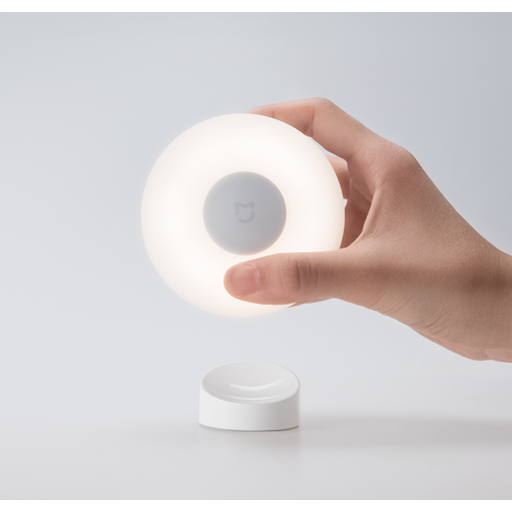
Why This Fits Their Persona: Suitable for shoppers who value adjustable positioning and app-based control in a bedroom, hallway or stair area.
Its specifications separate sensor range, brightness and battery requirements, helping buyers judge suitability instead of relying on a general “long-lasting” claim.
120-degree infrared sensing, up to 6 metres’ forward detection, two brightness levels, a rotatable magnetic design and Bluetooth app control.
Why This Fits Their Persona: The longer format suits wide kitchen units, wardrobes, shelves and worktops where a small night light may leave dark sections.
The 400 mm length and stated 61-LED layout make coverage easier to assess before installation, while adhesive mounting avoids permanent holes.
Two 400 × 38 × 10 mm lights, 1100mAh rechargeable batteries, three colour temperatures and PIR detection from 3–5 metres.
We have compiled a complete, real-time list of products that fully satisfy these strict selection criteria and UK safety regulations.
LED lighting generally uses relatively little power, and automatic shut-off limits the time the lamp remains illuminated. Rechargeable and battery-powered models avoid continuous mains use, but charging or battery replacement remains part of ownership. Compare the wattage, brightness and activation frequency rather than relying on a general low-energy label.
Common locations include hallways, stair landings, bedrooms, nursery entrances, wardrobes, cupboards and beneath kitchen cabinets. Mount the light high enough to avoid accidental knocks but low enough for the sensor to detect movement. For stairs, use more than one light if a single unit cannot illuminate each step adequately.
Runtime varies according to battery capacity, brightness, colour temperature and the number of activations. A listed 500mAh or 800mAh battery provides a useful comparison between models, but it is not a guaranteed number of nights. Choose a higher-capacity unit for frequently used areas and check the charging connection is accessible after installation.