
24/7 Customer Support

Free returns

Same-day & Next-day Delivery

Quality Guaranteed

Unlock Your Welcome Offers: FREE Delivery | Up to 80% OFF | Free 30-day JoyPlus trial
Download the APP
Fumbling for a light switch in a dark hallway or struggling to find the right spice in a shadowy kitchen cupboard is a common frustration. While traditional lighting requires complex wiring and professional installation, there is a simpler, more elegant solution. Modern motion sensor under cabinet lights offer a convenient and cost-effective way to illuminate those awkward, unlit corners of your home, from wardrobes to pantries.
These clever devices provide light exactly when and where you need it, without you having to lift a finger. As a Joybuy Product Recommendation Officer, my role is to help you navigate the options. This guide will walk you through the key features to consider and present a few carefully selected recommendations to help you make an informed choice.
Finding the ideal lighting solution involves more than just picking the first one you see. Here are a few practical points to consider to ensure you get a product that fits your needs perfectly.
The convenience of wireless kitchen cabinet lights largely depends on their power source. While some models use disposable batteries, a rechargeable wardrobe light with a built-in battery is often a more sustainable and economical choice. Look for models that use a standard USB port (like USB-C) for charging. This allows you to power them up easily with the same cables you use for your phone or other devices, eliminating the recurring cost and hassle of buying new batteries.
One of the biggest advantages of these lights is their tool-free installation. Most are designed as stick on lights for cupboards, using strong adhesive tape that won't damage your surfaces. This is ideal for renters or anyone hesitant to drill into their cabinetry. For even more flexibility, consider a magnetic led light for closet use. These typically come with a separate adhesive magnetic strip. You stick the strip to your surface, and the light bar attaches to it magnetically, allowing you to easily remove the light for recharging without disturbing the adhesive.
The "motion sensor" part is what makes these lights so practical. Most use a PIR sensor light (Passive Infrared) to detect movement. When you walk into a room or open a cabinet door, the sensor detects your body heat and automatically turns the light on. It then switches off after a set period of inactivity, conserving battery life. Consider the detection range and angle to ensure it's suitable for your intended space, whether it's for a compact cupboard or a longer automatic hallway light.
After reviewing the features and functionality of various models, here are our recommendations for motion sensor lights that offer practical solutions for UK homes.
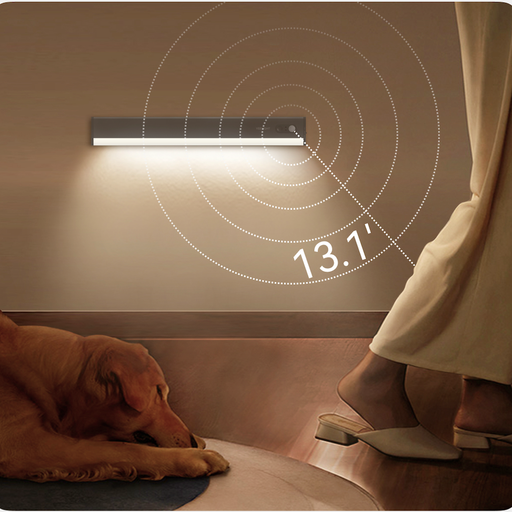
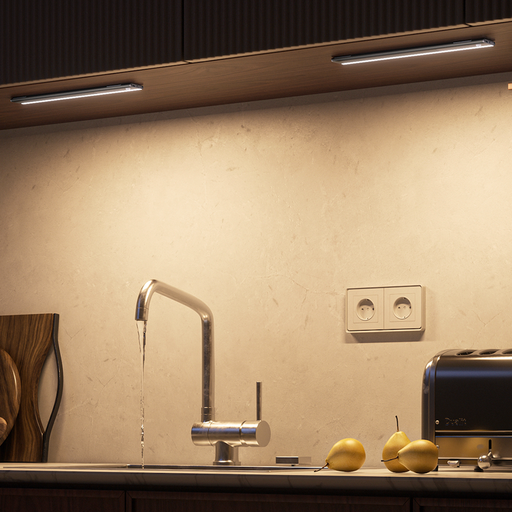

While these recommendations cover a range of common needs, every home is unique. If you're looking for different lengths, brightness levels or other smart features, there are many other options available.
For a wider selection of efficient lighting solutions, we invite you to explore our full range of ultra LED lights.
1. How do stick-on motion sensor lights work? Most use a Passive Infrared (PIR) sensor that detects the heat and motion of a person. When you enter its detection range (typically 3-5 metres), the light turns on. It stays on as long as it detects movement and then automatically switches off after a short period of inactivity (usually 15-30 seconds) to save power. They are mounted using pre-applied adhesive strips or magnetic plates.
2. How long do the batteries last on rechargeable wardrobe lights? Battery life varies depending on the battery capacity (measured in mAh), the brightness setting and how often the light is activated. For typical use in a wardrobe or cabinet that is opened a few times a day, a single charge can often last from several weeks to a couple of months.
3. Can I install motion sensor lights without drilling? Absolutely. This is one of their main benefits. The vast majority of battery operated led strip lights are designed for drill-free installation. They typically use either a strong, double-sided adhesive tape to stick directly to a surface or a magnetic mounting system where an adhesive metal plate is attached to the surface, allowing the light to be snapped on and off.