
24/7 Customer Support

Free returns

Same-day & Next-day Delivery

Quality Guaranteed

Unlock Your Welcome Offers: FREE Delivery | Up to 80% OFF | Free 30-day JoyPlus trial
Download the APP
Whether you ride a dirt bike across muddy trails, commute by motorcycle or take an MTB over uneven ground, motorcycle protective pants can add useful coverage around the hips, thighs and knees. The challenge is separating practical protection from vague marketing language.
A low-priced pair may look suitable online but become uncomfortable when worn under riding trousers. Another design may include hard shells but allow the pads to shift during movement. Before buying, focus on fit, coverage, materials and the activity for which the garment is intended.
Terms such as “anti-fall”, “shock-absorbing” and “high-impact” describe design features, not automatically a recognised safety rating. For motorcycle armour trousers, check whether the listing clearly states the relevant CE marking and applicable EN standard, such as EN 1621-1 for certain limb impact protectors. Do not assume that every pair of motocross protective pants has been assessed to the same standard.
The supplied product details for the pants featured below describe PP hard shells and EVA foam, but do not provide a stated EN certification. Treat them as additional protective equipment rather than a replacement for a complete, properly rated motorcycle riding kit.
Motorcycle hip and knee protection only works as intended when the shells sit over the correct areas. A pair that fits the waist but has loose leg openings can allow the knee armour to rotate or ride upwards. Check the seller’s size chart, leg length and adjustment system. Stretch fabric, waist fasteners, Velcro closures and leg straps can help maintain positioning, but they still need correct sizing.
More padding is not automatically more practical. Bulky armour can restrict hip movement, trap heat and make it tempting to remove the garment during longer rides. For summer trail use, look for breathable mesh, stretch panels and removable pads. For wet UK conditions, also verify whether “waterproof” refers to the complete garment or simply a material feature in the product description.
A useful pair of unisex motorcycle safety pants should state exactly which areas are protected. Hard-shell coverage around the hips and outer thighs can address common contact points during a sideways fall, while knee shells should align with the kneecap when standing, sitting and bending.
The products featured here specify protection for the hips, thighs and knees, using PP or PE hard shells with shock-absorbent EVA foam. This gives broader coverage than separate knee pads, but it does not protect the lower leg, spine or upper body.
Common construction combinations include:
For hot-weather riding, mesh panels and moisture-wicking fabric can make a noticeable difference. For cooler rides, consider whether the pants fit comfortably beneath your outer motorcycle trousers without creating pressure points.
The protectors should remain aligned while walking, sitting on a bike and moving over rough terrain. Fasten all zips, Velcro sections and straps before riding. Remove the pads before hand-washing where instructed, use cold water and mild detergent, then air-dry away from direct heat. Inspect seams and shells regularly; replace the garment if the armour is cracked, badly deformed or no longer stays in position after a crash.
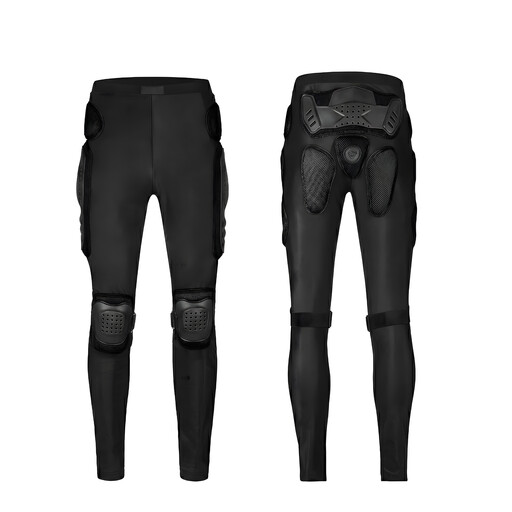
Why This Fits Their Persona: A practical starting option for adult riders who want hip, thigh and knee coverage for occasional MTB, dirt bike or motocross use without choosing a separate protector for each area.
The product description identifies the protected zones and specifies PP hard shells, EVA foam and breathable mesh rather than relying only on a general safety slogan.
Adult unisex design; listed weight of approximately 0.56 kg; stretch mesh construction for flexible movement.
Why This Fits Their Persona: Suitable for riders who place greater emphasis on construction details, adjustability and coverage when selecting protective motorcycle armour trousers for regular use.
The design combines removable protective pads with adjustable waist and leg fastenings, helping address the common problem of armour shifting during movement.
Stretch Lycra and breathable mesh; specified PP hard shell and shock-absorbing foam; adult unisex sizing.
Why This Fits Their Persona: A flexible option for frequent off-road riding, cycling, skating or other outdoor activities where repeated bending and a wider range of movement are important.
The integrated pads are attached to stretchy mesh leggings, while waist and leg adjustments help maintain coverage without depending on rigid standalone guards.
Listed weight of approximately 0.58 kg; coverage includes hips, thighs and knees; removable pads simplify hand-washing.
We have compiled a complete, real-time list of products that fully satisfy these strict selection criteria and UK safety regulations.
Before your first ride, follow these steps:
Remember that protective pants are only one part of dirt bike protective gear. A helmet, suitable boots, gloves, jacket and visibility equipment remain important. Bicycle helmets are not intended for motor vehicle use, and MTB protective pants should not be treated as a substitute for motorcycle-specific equipment where higher speeds or road traffic are involved.
They may provide additional coverage beneath riding trousers, but suitability depends on the product’s stated design and safety certification. The featured pants list off-road motorcycles, street motorcycles, MTB and other activities, but their supplied details do not state an EN armour certification. Check the product information and use them as part of a complete riding system.
There is no fixed lifespan. Inspect the hard shells, foam, seams and fasteners regularly. Replace the garment after a significant impact, or sooner if the armour cracks, deforms, becomes loose or no longer aligns correctly. Frequent washing, UV exposure and heavy off-road use can also accelerate wear.
The featured designs are described for MTB, cycling, skating, skateboarding and other outdoor sports. However, assess the fit and protection required for your activity. MTB protective pants can be suitable for flexible hip and knee coverage, while high-speed motorcycling calls for equipment specifically designed and rated for that use.