
24/7 Customer Support

Free returns

Same-day & Next-day Delivery

Quality Guaranteed

Unlock Your Welcome Offers: FREE Delivery | Up to 80% OFF | Free 30-day JoyPlus trial
Download the APP
For UK riders, motorcycle protective trousers can add useful coverage when commuting, riding trails or taking part in motocross. However, product listings often make it difficult to compare genuine design details with broad marketing language. A pair that looks protective in a photograph may still be uncomfortable, poorly positioned or unsuitable for your riding speed and surface.
The most useful approach is to check coverage, fit, materials and intended use before considering appearance or price. This guide explains the main buying pitfalls and highlights practical options for adult off-road and mixed-sport use.
Some products list several “protective zones” without explaining which parts are actually covered. For riding, check whether the garment includes protection for the hips, thighs and knees, rather than only the kneecaps. Motorcycle hip and knee protectors can be particularly useful because a simple knee sleeve may leave the upper leg and side of the pelvis exposed.
Also check whether the pads are integrated into a garment or attached with separate straps. Independent pads may shift during movement if they are not adjusted correctly.
A small, medium or large label is not a universal measurement. Motorcycle armour trousers need to remain close to the body so that the pads stay aligned, but they should not restrict squatting, mounting or standing on footrests.
A loose waistband or oversized leg opening can allow armour to move during a fall. Conversely, overly tight Lycra or mesh can cause pressure points during a long ride. Always compare the seller’s measurements with your waist, hip and thigh measurements, and consider the clothing worn underneath.
Terms such as impact-resistant, “anti-fall” and “shock-absorbing” describe product features, not a guarantee of protection in every crash. A listing may mention PP or PE shells and EVA foam without stating a recognised protective-equipment standard.
For road use and organised events, look for clearly stated certification and markings applicable to the product and activity. If a listing does not provide the relevant documentation, treat the garment as supplementary protection rather than a substitute for properly certified motorcycle clothing. It should also be worn with suitable boots, gloves, jacket and helmet.
For motocross protective trousers and enduro protective gear, look for shells positioned over the hips, thighs and knees. Hard PP, PE or PVC panels can help spread contact across a wider area, while EVA or other foam padding can add cushioning between the shell and the body.
The position matters as much as the material. When standing, sitting and bending your knees, the hard sections should remain over the intended joints and bones. Check the fastening system, including waist adjusters, leg straps, zips and hook-and-loop closures.
Protective trousers should allow a full range of movement for mounting a dirt bike, leaning into a turn or walking between trails. Stretch Lycra and breathable mesh can make a close-fitting layer easier to wear under riding trousers.
For UK weather, consider how the garment will work with waterproof over-trousers. A bulky shell can create pressure beneath an outer layer, while a close-fitting design may be easier to layer. “Unisex motorcycle armour” can be practical, but the fit must still suit the wearer’s individual proportions.
Breathable motorcycle protection is useful during summer trail rides and indoor storage-to-road transitions. Mesh panels and moisture-wicking fabric may improve airflow, but ventilation does not make a garment suitable for every temperature or weather condition.
Check care instructions before purchasing. The featured motorcycle protective trousers should be hand-washed in cold water with mild detergent, with the pads removed first, then air-dried away from direct heat and strong sunlight. Regularly inspect seams, straps and shells. Replace the garment if the protective panels are cracked, badly deformed or no longer remain securely positioned.
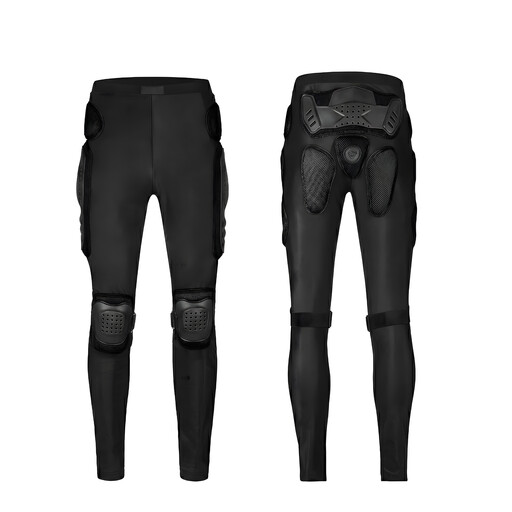
Why This Fits Their Persona: A compact adult option for a new MTB, dirt bike or motocross rider who wants coverage across the hips, thighs and knees without buying separate guards.
The product description identifies hard-shell coverage and gives fitting instructions for aligning the pads before fastening the closures.
PP hard shells, EVA foam and breathable mesh; listed weight is 0.54kg.
Why This Fits Their Persona: Suitable for an adult rider prioritising a structured, close-fitting layer for repeated off-road trips, commuting or mountain biking.
Stretch panels and adjustable waist and leg fastenings help address pad movement, while the listing clearly identifies the covered areas.
Stretch Lycra, moisture-wicking mesh, PP shells and shock-absorbing foam; listed weight is 0.58kg.
Why This Fits Their Persona: Gives larger-framed adult riders an option to investigate for trail riding, motocross practice and other outdoor activities requiring hip, thigh and knee coverage.
The product is available in a larger listed size and uses adjustable closures, but measurement checking remains essential before ordering.
PP hard-shell and foam construction with breathable mesh; listed weight is 0.62kg.
Use this short checklist:
We have compiled a complete, real-time list of products that fully satisfy these strict selection criteria and UK safety regulations.
They can provide additional hip, thigh and knee coverage beneath or alongside other riding clothing. Check the fit under your trousers and confirm that the product has the certification required for your specific road or work use. They should complement, not replace, a helmet, jacket, gloves and suitable footwear.
They should be snug enough to keep each pad aligned without restricting leg movement. Fasten all zips, straps and hook-and-loop closures, then bend your knees and move through a riding position. If the armour shifts away from the joints or creates painful pressure, choose another size or design.
There is no universal replacement period. Lifespan depends on frequency of use, washing, storage and whether the garment has experienced an impact. Inspect the shells, foam, seams and closures regularly, and replace the trousers after a significant fall or if any protective component is cracked, torn or deformed.