Dual-monitor checkout tester
If both displays belong to one computer, you may move repeatedly between browser windows, long pages and form fields. Pointer control and scrolling matter more than pairing the mouse with multiple devices.


If both screens connect to one computer, choose a mouse for controllable pointer movement, scrolling and hand fit; two monitors alone do not call for multi-device switching. If checkout testing moves between separate computers or tablets, check device switching and compatibility instead. For long sessions, consider the whole workstation as well as the mouse; a simple wired model may suffice at a fixed, single-computer station.
If both displays belong to one computer, you may move repeatedly between browser windows, long pages and form fields. Pointer control and scrolling matter more than pairing the mouse with multiple devices.
If testing alternates between a desktop, laptop or tablet, you need to check how the mouse pairs with and switches between those separate devices. Logitech describes device switching for supported mice, but compatibility depends on the model and each test device.
Repeated checkout and accessibility checks make hand fit and desk position worth considering alongside navigation controls. The Health and Safety Executive advises placing the mouse in line with the elbow and considering the whole workstation.
Establish whether the two screens share one computer before comparing controls, connections and comfort: switching between displays is not the same task as switching between devices.
| Concern | What to check | Who this matters to |
|---|---|---|
| Controlled navigation | Try pointer sensitivity and scrolling against your display arrangement and checkout pages. Logitech specifies adjustable DPI for the MX Master 3S for Business and two scrolling modes for the M720; these are model-specific features. | If I repeatedly move between browser windows, form fields and long pages, I want control without overshooting small targets. Around 36% of consumers put navigation first. |
| Separate-device switching | Count the separate computers or tablets, then check each device's operating system, pairing method and available ports. | When my checkout tests move between separate machines, I need one mouse that can switch between them. Device switching is the primary need for around 29% of consumers. |
| Hand and workstation fit | Check hand-size and handedness guidance, then position the mouse at the desk. The Health and Safety Executive advises keeping it in line with the elbow and considering the whole workstation. | During long regression sessions, I need a shape that fits my hand without overlooking desk position. Comfort and fit come first for around 21% of consumers. |
| Simple fixed-station setup | Check the computer's USB port, cable routing and whether basic controls cover your workflow. Logitech describes its M100 as a wired, ambidextrous USB mouse. | If I test on one fixed computer, I would rather keep the input setup straightforward than add device switching I will not use. Around 14% of consumers prioritise that simplicity. |
Pairing with separate devices solves a different problem from moving a pointer between two displays attached to the same computer.
Identify how many computers or tablets you actually use before making device switching a requirement.
DPI describes pointer sensitivity, not checkout-testing accuracy. A setting that feels too sensitive can make small controls harder to target.
Adjust sensitivity against your desk space, display settings and the actual checkout fields you test.
Logitech positions its Lift vertical mouse for small-to-medium hands, while the Health and Safety Executive advises considering mouse position and the whole workstation.
Check the exact model's hand-size and handedness guidance, then review desk, chair and screen placement as well as mouse position.
Logitech lists a Logi Bolt receiver for the MX Master 3S for Business and a Unifying receiver for the M720.
Check the exact mouse and receiver family, or confirm that Bluetooth suits each computer you plan to use.
Its cited models span productivity controls, device switching, vertical fit and a basic wired setup; capabilities differ by model.
The cited Basilisk V3 is a gaming-oriented option for testers who want configurable controls.
The cited M75 Wireless offers an ambidextrous, gaming-oriented shape as an alternative to productivity-focused designs.
These mice cover different priorities within two-screen checkout testing, from navigation on one computer to fit and connections for separate devices. Match the exact model to your workstation and test machines rather than treating every mouse as interchangeable.
 No image available
For repeated checkout navigation on one computer, check whether its wheel and button layout fit the actions you perform most often.
If you need customised controls or a receiver connection, confirm software compatibility and the connection method for your exact test setup.
 No image available
If hand support matters during long testing sessions, consider the detachable wrist rest alongside how the mouse fits your hand and desk position.
Check dimensions, handedness suitability and any software requirements before relying on it for a particular workstation.
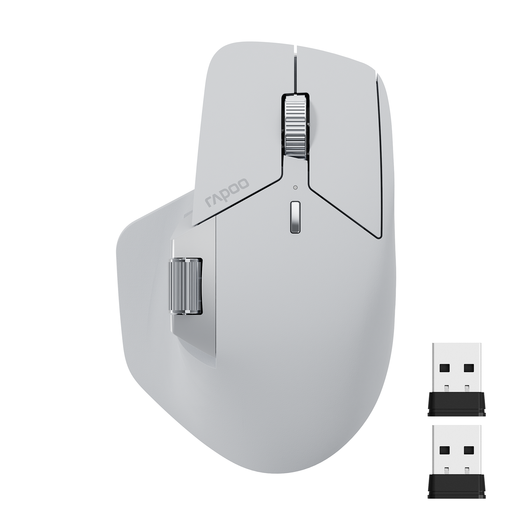 No image available
For testing across separate computers, establish how the MT760L-LG switches between the devices in your setup.
Its described cross-computer function requires a driver and computers on the same Wi-Fi or Ethernet network. Confirm the exact mouse shape before choosing it for a vertical grip; wireless charging requires a P3 module.
 No image available
If you prefer an upright grip for longer checkout sessions, check the MW500BT against your hand size and desk position.
Its named configuration includes Bluetooth and 2.4 GHz connections, six buttons and adjustable sensitivity up to 1600 DPI. Confirm the switching method if you need to use it with separate test devices.
 No image available
For a checkout setup that may use separate devices, check how this M311 pairs and switches with each test machine.
The named variant has multiple DPI levels and uses one AA battery. Check wheel behaviour and hand fit if long-page navigation or extended sessions are priorities.
No, not if both displays connect to one computer: look first at pointer control, scrolling and comfort. Device switching becomes relevant when checkout tests move between separate computers or tablets; Logitech describes pairing with multiple devices for supported Easy-Switch models.
Choose the connection that each test machine supports and that fits its available ports. Bluetooth needs compatible hardware and pairing; a receiver needs a suitable USB port. Logitech specifies Bluetooth Low Energy or Logi Bolt for the MX Master 3S for Business, but Bluetooth or a Unifying receiver for the M720, so check the exact receiver family.
A vertical shape is a fit choice, not a substitute for reviewing the workstation. Check the model against your hand size and handedness; the Health and Safety Executive advises keeping the mouse in line with the elbow and considering equipment, furniture and working conditions together.