Choose a quiet Bluetooth mouse if nearby people and limited USB ports are your main concerns; prioritise controlled or horizontal scrolling if the timetable involves long, wide sheets. For extended sessions, check hand fit and wrist position as well as the computer connection: a different mouse will not, by itself, address an unsuitable desk setup.
Who should consider these features?
Quiet shared-desk organisers
If you revise a club timetable beside other people, click noise and a tidy connection may matter more than extra buttons. Logitech describes its M240 Silent as a receiver-free Bluetooth mouse, while HP specifies quieter left and right buttons on its 280 Silent Wireless Mouse.
Spreadsheet-heavy schedule editors
When the timetable stretches across many rows or columns, pay attention to wheel controls rather than DPI alone. Logitech specifies controlled scrolling and configurable tilt-wheel actions for its M325S.
Regular-session comfort prioritizers
If planning sessions run for extended periods, assess the mouse against your hand and the whole workstation. The Health and Safety Executive includes mouse and trackball use in its display-screen-equipment workstation checklist; an ergonomic shape still needs to fit its user.
What matters when choosing a mouse?
For a club timetable at a shared desk, identify the issue that matters most during your sessions, then check the connection and controls against the computer and workspace you actually use.
| Concern | What to check | Who this matters to |
|---|
| Quiet clicks |
Look for a model-specific quiet-click claim and check which buttons it covers. |
When I edit beside someone else, repeated clicks are the interruption I most want to limit. Around 33% of consumers may put quiet operation first. |
| Timetable navigation |
Check vertical-scroll control and whether horizontal scrolling works with your software and operating system. |
If my schedule spans long lists and wide columns, moving through it without losing my place matters most. Navigation is likely the primary need for around 27% of consumers. |
| Connection and desk clutter |
Confirm Bluetooth support or an available USB port, and whether the mouse uses a receiver. |
When I clear the shared desk or change computers, I want a connection I can set up without juggling ports or a loose receiver. For around 20% of consumers, that simplicity may come first. |
| Fit during longer sessions |
Check hand-size guidance, handedness and grip shape; assess the wider desk setup too. |
If I spend sustained periods preparing the timetable, a shape that suits my hand takes priority over compactness. Around 20% of consumers may place fit first. |
What should you avoid overlooking?
-
Assuming wireless means quiet
Wireless describes the connection, not the sound of the buttons. Ordinary clicks may still disturb someone working alongside you.
Check the exact model’s quiet-click claim and the buttons covered. HP, for instance, specifies noise reduction for the left and right buttons of its 280 Silent Wireless Mouse.
-
Choosing a receiver without checking the computer
A USB receiver needs a suitable port, which may already be in use at a shared desk.
Check the computer’s Bluetooth capability and available USB ports before choosing a Bluetooth, receiver-based or dual-mode mouse.
-
Assuming every ergonomic shape will fit
Hand size and compatibility still matter. Kensington describes its Pro Fit Ergo Wireless Mouse as designed for small to medium-sized hands and says Windows ARM-based computers are currently unsupported.
Check the intended user’s hand size, handedness and operating system before choosing a larger shape.
-
Relying on a mouse change to fix the whole workstation
The Health and Safety Executive’s display-screen-equipment checklist considers the mouse alongside the display, furniture and working environment.
For regular extended work, review the desk setup and work routine, and ask the employer or organisation about an appropriate workstation assessment.
Relevant brands to consider
Logitech
Its relevant models cover receiver-free quiet clicking, receiver-based scrolling controls and multi-device Bluetooth use.
- Logitech specifies Bluetooth with no dongle for the M240 Silent and micro-precise scrolling with a configurable tilt wheel for the M325S.
- Choose by model: M325S customisation is not available on Linux, and a Logi Bolt receiver is not included with the MX Anywhere 3S.
Kensington
The Pro Fit Ergo Wireless Mouse is relevant when grip shape and a choice of Bluetooth or 2.4 GHz connectivity matter.
- Kensington specifies a built-in wrist rest, neutral-grip design and quiet clicking for this model.
- It is designed for small to medium-sized hands; Kensington states that Windows ARM-based computers are currently unsupported.
HP
The 280 Silent Wireless Mouse is a receiver-based option for a desk where button noise matters.
- HP specifies a 2.4 GHz dongle, a thumb rest and up to 90% noise reduction on the left and right buttons.
- Its dongle uses a USB port, so it does not provide a receiver-free Bluetooth setup.
Joybuy mouse choices for this task
These mice offer different starting points for shared-desk timetable work: quiet-click designs, alternative grip shapes and receiver or Bluetooth connections. Match the individual model to your computer and the way you navigate the timetable.
 No image available
HOFOTEK M311 2.4G+BT Silent Mouse, White-Grey
Consider this model when quieter clicking and a choice of Bluetooth or 2.4G connection matter at the shared desk.
Its named configuration includes adjustable multi-level DPI and one AA battery. If you work across wide timetable sheets, check the wheel controls; check the shape against your hand for longer sessions.
View on Joybuy
 No image available
V7 MW500BT Bluetooth Vertical Mouse, 2.4GHz
Consider the vertical shape if grip position is your main concern during longer planning sessions, but check that it suits your hand.
The named model has Bluetooth and 2.4GHz connections, six buttons and an adjustable sensor specified at 1600 DPI. Check click noise, scrolling and computer compatibility before choosing it for the shared desk.
View on Joybuy
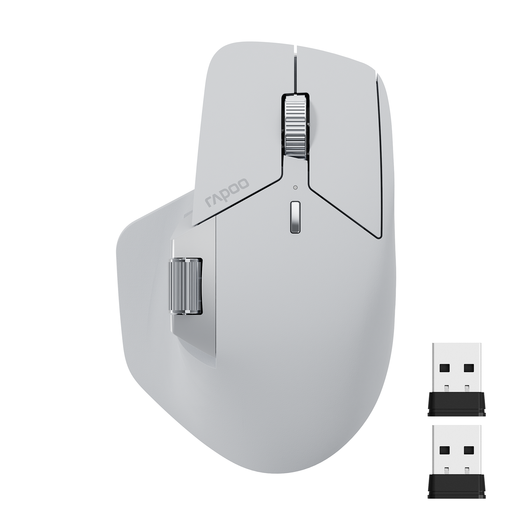 No image available
RAPOO Mice-MT760L-LG
If you are considering this model for timetable work, confirm that the supplied version has the connection and scrolling controls you need.
Check its grip shape, button noise and operating-system compatibility against the intended computer and shared workspace before relying on those features.
View on Joybuy
 No image available
Philips 3000 Series SPK7378B/00 Silent-Click Mouse, EU Version, Black
Consider this model if quiet clicks are a priority and the shared computer has a port for its USB receiver.
The named variant specifies a 2.4GHz connection and 1600 DPI. Check its wheel controls if your timetable involves long or wide sheets, and assess hand fit for sustained use.
View on Joybuy
Frequently asked questions
Is a silent mouse worth choosing at a shared desk?
It is worth prioritising when frequent clicks would disturb someone nearby. Check the claim for the exact model rather than assuming wireless mice are quiet; HP specifies noise reduction on the left and right buttons of its 280 Silent Wireless Mouse.
Should I choose Bluetooth or a USB receiver?
Choose Bluetooth when the computer supports it and you want to keep a USB port free; a receiver-based mouse needs a suitable port. Logitech specifies the M240 Silent as receiver-free, while Kensington offers both connection types on its Pro Fit Ergo Wireless Mouse.
What helps with a wide spreadsheet timetable?
Horizontal scrolling can help you move across columns, provided the mouse controls and computer software support it. Logitech specifies configurable tilt-wheel actions for the M325S; check how those actions work in your timetable software.
Does a shared desk require a particular mouse under UK guidance?
The Health and Safety Executive’s display-screen-equipment guidance does not identify a particular mouse model for a shared desk. Its guidance applies to workers using display screen equipment daily for continuous periods of an hour or more and considers mouse use as part of the wider workstation setup.
Can an ergonomic mouse replace a workstation assessment?
No. The Health and Safety Executive’s workstation checklist covers the mouse or trackball alongside the display, furniture and working environment. If timetable preparation is regular extended work, assess the overall setup rather than relying on a mouse’s ergonomic description alone.


