For drafting and editing a short story, start with a mouse that fits your hand and desk position, then consider scrolling, click noise and device switching according to how you work. A vertical shape is worth considering if a more upright hand position is your priority, but its size and handedness must suit you; extra buttons matter more if you regularly move between documents or devices. Whatever the shape, the Health and Safety Executive advises keeping the mouse within easy reach so you can use it with a straight wrist.
Who these choices suit
Writers at a desk for long sessions
If drafting, research and revision keep you at the same desk, consider hand fit alongside your workstation layout. The Health and Safety Executive advises placing the mouse within easy reach so your wrist can remain straight.
Writers concerned about wrist or forearm comfort
Consider the mouse shape, your grip and where it sits on the desk rather than assuming a different mouse will resolve discomfort. The NHS notes that repetitive strain injury can involve repeated use of a body part.
Editors working across devices
If your notes, manuscript and research sit on different computers, check how a mouse pairs with and switches between them. Microsoft, for example, says its Bluetooth Ergonomic Mouse can pair with up to three PCs.
What matters when choosing
Conventional productivity mouse
Consider it when: You want a familiar shape for selecting text, moving through research and editing long documents.
Trade-off: A sculpted right-handed shape may not suit a left-handed user, and extra controls may need setup you will not use.
Vertical mouse
Consider it when: You want to try a more upright hand position and can find a model sized for your hand and preferred side.
Trade-off: Cursor control may feel unfamiliar at first; a vertical shape does not replace good mouse placement.
Ambidextrous or convertible mouse
Consider it when: You use your left hand, share the desk or want the option to change hands.
Trade-off: Check palm support and button placement for each user rather than assuming flexibility guarantees a comfortable fit.
| Concern |
What to check |
Who this matters to |
| Comfort over long sessions |
Check shape, hand-size guidance and handedness. Leave enough desk space to keep the mouse within easy reach. |
If drafting and revision keep my hand on the mouse for long stretches, I want a shape I can hold comfortably without stretching across the desk. Around 36% of consumers put long-session comfort first. |
| Low-distraction clicks |
Check the model-specific quiet-click claim and consider wheel noise separately. |
When I write near someone else, repeated clicks are the distraction I most want to reduce. Quiet operation is the main concern for around 29% of consumers. |
| Document and device navigation |
Check scrolling controls, device switching and whether shortcuts require compatible software. |
If I move between a manuscript, research and another computer, I want navigation that fits that routine without unnecessary setup. Around 21% of consumers place workflow convenience first. |
| Handedness and shared use |
Check the exact left-handed variant or conversion mechanism, as well as button placement. |
If I use my left hand or share a workstation, a mouse designed only for another grip could rule it out. Handedness flexibility is the deciding need for around 14% of consumers. |
Buying pitfalls
-
Assuming any vertical mouse will fit
A more upright shape does not settle hand size, handedness or how far you must reach to use the mouse.
Check the maker’s fit guidance and the exact left- or right-handed variant, then make room to position the mouse close to you.
-
Choosing mainly by DPI
A sensitivity figure alone says little about whether a mouse is comfortable for selecting text and moving through a manuscript.
Prioritise physical fit and the navigation controls you will use; compare sensitivity settings if you have a particular cursor-control need.
-
Reading “quiet clicks” as “silent mouse”
A button-noise claim need not describe the scroll wheel or sounds made against your desk surface.
Check which clicks the claim covers and consider scrolling and desk-surface noise separately.
-
Expecting a new mouse to resolve persistent pain
Repeated use and workstation position also matter. The NHS identifies repeated use as a factor in repetitive strain injury, while the Health and Safety Executive advises keeping the mouse within easy reach.
Review your workstation and work routine. If symptoms persist or worsen, seek medical advice rather than relying on a mouse purchase.
Brands to consider
Logitech
Logitech offers conventional productivity and vertical mouse shapes relevant to different writing setups.
- Logitech lists Quiet Clicks and MagSpeed scrolling for the MX Master 3S, while its Lift vertical mouse is positioned for small-to-medium hands and has a left-handed option.
- Check the exact shape and variant: the MX Master 3S has a sculpted right-handed design, and Lift’s stated hand-size guidance will not fit everyone.
Microsoft
Its Bluetooth Ergonomic Mouse is relevant if your writing and editing take place across Windows PCs.
- Microsoft says the mouse has two customisable thumb buttons and can pair with up to three PCs.
- Microsoft says it works best with Windows 11 or Windows 10; full customisation and Smart Switch depend on Microsoft Mouse and Keyboard Center.
Targus
Its ErgoFlip provides a convertible option for a left-handed writer or a shared desk.
- Targus says ErgoFlip converts between right- and left-handed use and supports ChromeOS, Windows and macOS.
- Check how its size and button positions feel for each intended user; conversion does not establish the fit of a dedicated hand-specific mouse.
Razer
The Pro Click V2 is a feature-rich route for writers who also want configurable controls and device switching.
- Razer describes an extended thumb rest, programmable shortcuts, two scrolling modes and multi-device connectivity.
- Consider whether you will use those controls and whether their software setup suits your devices; simple drafting may not call for them.
Joybuy mice for writing and editing
These mice cover conventional wireless options for desk-based writing and vertical shapes to consider if you prefer a more upright grip. Compare fit and connection requirements before choosing between them.
 No image available
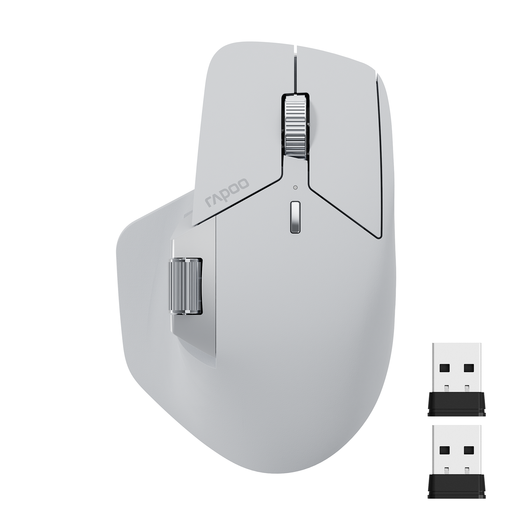
RAPOO MT760L-LG Mouse
Consider this model if moving through documents and between computers is central to your writing routine. Check its physical shape before buying; cross-computer cursor switching requires a driver and computers on the same Wi-Fi or Ethernet network.
View on Joybuy
 No image available
HOFOTEK M311 2.4G+BT Silent Office Mouse, White-Grey
A model to consider if click noise and wireless connection choices matter at a shared desk. Its name specifies adjustable DPI, 2.4G+BT connectivity and one AA battery; the silent-click description does not establish how loud the scroll wheel will be. Check its dimensions against your preferred grip.
View on Joybuy
 No image available
Philips 3000 Series SPK7378B/00 Wireless Mouse, Black, EU Version
Consider this mouse if you want receiver-based wireless use and quieter clicks while writing. The name specifies a 2.4GHz connection, USB receiver, 1600 DPI and Windows and Mac compatibility. Check the wheel behaviour and physical fit for your desk routine.
View on Joybuy
 No image available
HP 920 Ergonomic Wireless Mouse, Black, with Detachable Wrist Rest
Consider this option if you want to assess a vertical shape for your writing desk. The model has a detachable wrist rest; check its dimensions and handedness before buying. If you want button customisation, confirm that HP Accessory Center works with your computer.
View on Joybuy
 No image available
V7 MW500BT Bluetooth Vertical Mouse
Another vertical shape to assess if grip position is your main consideration. Its name specifies Bluetooth and 2.4GHz connection modes, six buttons and an adjustable 1600 DPI sensor. Check its dimensions and preferred-hand fit, and allow for a different feel from a conventional mouse.
View on Joybuy
Common questions
Where should I put my mouse on a home-office desk?
Keep it within easy reach so you can use it with a straight wrist, as the Health and Safety Executive advises. Leave space to support your forearm and avoid stretching towards or gripping the mouse tightly.
Will a vertical mouse treat wrist pain?
A vertical mouse is not a treatment for wrist pain or repetitive strain injury. Assess its fit and your workstation together; if symptoms persist or worsen, seek medical advice rather than relying on a change of mouse.
Should I choose Bluetooth or a USB receiver?
Choose a connection your computer supports and that fits how you use its USB ports. Microsoft specifies Bluetooth 4.0 or later for its Bluetooth Ergonomic Mouse, while Logitech says Lift can connect through Bluetooth Low Energy or a Logi Bolt receiver; check the requirements of the exact model you intend to buy.
What upkeep does a wireless writing mouse need?
Keep its sensor area and desk surface clean, and replace or recharge its battery as applicable. Check the model’s power requirements: Microsoft says its Bluetooth Ergonomic Mouse uses two AAA batteries and can be switched off when not in use.


