What matters when choosing?
For shared-office lesson planning, decide whether click noise or comfort is your main reason to change mice; then check connection and navigation features against the devices you actually use.
Quiet conventional mouse
Consider it when: Frequent clicks near colleagues are the main issue and you prefer a familiar mouse shape.
Trade-off: Quiet buttons do not establish hand fit or connection compatibility; check both on the exact model.
Vertical mouse
Consider it when: Your priority is trying a different grip during long planning sessions, provided the stated hand-size range fits.
Trade-off: A vertical shape may take getting used to and does not resolve a poorly arranged workstation on its own.
| Concern |
What to check |
Who this matters to |
| Click noise |
Check which buttons the exact model describes as quiet, as well as its connection method. |
If I edit plans beside colleagues, repeated clicks could disturb them, so reducing that noise comes first. Around 31% of consumers put quieter clicking ahead of their other mouse needs. |
| Long-session comfort |
Compare hand-size and handedness guidance, and whether the mouse can sit in line with your elbow. |
When planning keeps me at the desk for extended periods, I want a grip and workstation arrangement I can use comfortably. Comfort is the primary concern for around 31% of consumers. |
| Connection across desks |
Confirm operating-system support, permitted Bluetooth pairing and the ports needed for a receiver. |
If I change school computers or desks, the mouse needs to connect wherever I work. Around 23% of consumers make connection flexibility their first priority. |
| Document navigation |
Compare wheel behaviour and check whether button customisation works on your assigned device. |
Moving between long plans and teaching resources makes scrolling and reachable controls important to me. Navigation comes first for around 15% of consumers. |
Joybuy mouse choices
These mice cover different lesson-planning priorities: quieter conventional models, ergonomic shapes and options to consider for switching devices or navigating documents. Check the exact variant against your work computer and your main reason for changing mice.
 No image available
Logitech MX Master 3S Ergonomic Mouse, Black
Consider this ergonomic-shaped model if long document sessions and moving between computers are priorities. Check that its shape fits your hand, and confirm whether a Logi Bolt receiver is included before planning to use one.
View on Joybuy
 No image available
HOFOTEK M311 2.4G+BT Silent Mouse, White-Grey
Consider this model if click noise and connection choices matter at changing desks. Its title specifies 2.4G+BT connectivity, adjustable DPI and one AA battery; confirm that your work device permits the connection you intend to use, and check hand fit before buying.
View on Joybuy
 No image available
Philips 3000 Series SPK7378B/00 Quiet Mouse, EU Version, Black
This receiver-based choice is worth checking if quieter clicks are your priority and your computer has a suitable USB port. The title specifies a 2.4 GHz connection, USB receiver and 1600 DPI; confirm compatibility with your assigned device.
View on Joybuy
 No image available
HP 920 Ergonomic Wireless Mouse with Detachable Wrist Rest, Black
Consider the vertical HP 920 if you want to compare a different grip for longer planning sessions and switch between work devices. HP lists connection to up to three devices and five programmable buttons; check hand fit, click-noise requirements and whether your workplace permits any software needed for customisation.
View on Joybuy
 No image available
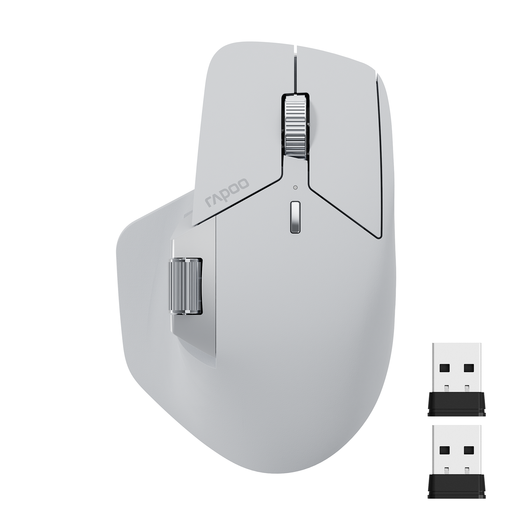
RAPOO Mice-MT760L-LG
Consider this model if switching devices and navigating documents are more important to you than a stated quiet-click feature. Check its connection methods, hand fit and any workplace restrictions on the software needed for cross-computer functions; confirm what is required if you plan to use wireless charging.
View on Joybuy
Common questions
Should I choose a quiet mouse before a vertical one?
Choose quieter clicks first if disturbing colleagues is your main concern, but check the same mouse for hand fit and computer compatibility. If your current grip feels uncomfortable during long planning sessions, compare vertical shapes too and consider your whole workstation, as the Health and Safety Executive advises.
Do workplace display-screen rules matter when choosing a mouse?
They may matter if you use display screen equipment at work daily for continuous periods of an hour or more: the Health and Safety Executive says UK display screen equipment regulations apply to workers in that situation. Its workstation guidance considers equipment, furniture and working conditions together, so discuss your setup with your employer rather than relying on a mouse change alone.
Where should I place my mouse for long planning sessions?
Place the mouse in line with your elbow, as the Health and Safety Executive advises. Arrange the desk so you do not have to reach awkwardly for it, and consider the position of your other equipment as part of the same workstation setup.
How do I choose between Bluetooth and a USB receiver at work?
Choose the method your assigned computer supports and your workplace permits. Check enabled Bluetooth, available USB ports and operating-system compatibility for the exact mouse: Logitech describes the M240 as connecting by Bluetooth without a dongle, while HP specifies a 2.4 GHz receiver for the 280.


