Long-list editors
If you repeatedly scan references, sort entries and move between browser pages or spreadsheets, controllable scrolling and reachable navigation buttons may matter more than a different mouse shape.


Choose a conventional productivity mouse with controllable fast scrolling if you regularly move between long lists and detailed edits. A vertical mouse puts hand fit and a more upright grip first; a thumb trackball stays in place when desk space is tight. Whichever shape you prefer, check its connection, controls and fit against your own setup.
If you repeatedly scan references, sort entries and move between browser pages or spreadsheets, controllable scrolling and reachable navigation buttons may matter more than a different mouse shape.
If hand position is your priority during sustained desk work, compare the fit of conventional and vertical mice. A thumb trackball is another control method to consider, but none of these shapes suits every hand.
Books, papers and other devices can leave little room to move a mouse. A stationary trackball addresses that constraint, while quiet clicks or device switching may be more relevant at a shared desk.
For reading-list editing, choose the control method that fits your desk and hand first, then decide whether faster scrolling, quiet clicks or switching between devices would help with the work you actually do.
Choose it when: You alternate between checking individual entries and travelling through long pages; Logitech specifies both precise and faster scrolling for the Signature M650.
Consider: Fast scrolling does not settle whether the mouse fits your hand or sits comfortably on your desk.
Choose it when: You prefer a more upright grip and can find a shape suited to your hand; Logitech positions Lift for small-to-medium hands.
Consider: Pointer control feels different from a conventional mouse, and a vertical shape is not a universal fit.
Choose it when: Papers or books leave little room to move a mouse; Logitech says the ERGO M575 stays in place while the thumb controls the pointer.
Consider: Thumb-led control takes a different approach from moving a conventional mouse and may not suit your preference.
| Concern | What to check | Who this matters to |
|---|---|---|
| Controllable navigation | Check the exact wheel’s precision and faster-scrolling behaviour, plus whether useful button assignments work on your computer. | If I move through long bibliographies but still need to select individual entries accurately, I want both speed and control. Around 36% of consumers put that navigation need first. |
| Hand fit and position | Compare handedness and hand-size guidance, then check whether the mouse can sit in line with your elbow. | During a long desk session, I would rather have a shape that fits my hand than extra scrolling features. That fit-led need comes first for around 29% of consumers. |
| Desk space | Check the area available beside your keyboard and whether you would be comfortable using thumb-led trackball control. | When papers occupy the space beside my keyboard, I need to control the pointer without sweeping a mouse across the desk. Around 21% of consumers prioritise that space-saving need. |
| Quiet, flexible connection | Confirm click behaviour, supported devices, Bluetooth requirements or receiver-port needs, and any software needed for custom controls. | I share the room or switch between computers, so quiet clicks and straightforward connection matter more to me than a specialised shape. Around 14% of consumers put those conveniences first. |
Shape and size vary even within one range: Logitech positions Lift for small-to-medium hands, while Signature M650 has different size and left-handed versions.
Check the manufacturer’s sizing and handedness guidance for the exact version. If you cannot try it first, check the seller’s applicable return terms before ordering.
The Health and Safety Executive advises looking at the display-screen workstation as a whole and placing the mouse in line with the elbow. Mouse shape alone cannot address an awkward desk layout.
Review your desk, chair, screen and mouse positions together. If a display-screen equipment assessment applies to your work, use your employer’s assessment process when equipment or setup changes are needed.
Device switching and button customisation depend on the particular mouse and computer. Microsoft specifies Bluetooth 4.0 or later for its Bluetooth Ergonomic Mouse and says it is designed to work best with Windows 10 or Windows 11.
Before buying, check your operating system, Bluetooth capability or available USB port, and whether your intended controls need companion software.
Moving quickly through a long page is different from stopping at the right reference or selecting an individual item.
If you do both, check for a precision mode, adaptive wheel or adjustable scroll settings rather than choosing on scrolling speed alone.
These brands offer different mouse designs relevant to reading-list work; compare the stated features of individual models rather than assuming they apply across a brand’s range.
Its cited range spans conventional scrolling mice, the Lift vertical mouse and the stationary ERGO M575 trackball.
The Bluetooth Ergonomic Mouse is a model to examine for a Windows-focused desk with a need for thumb-button customisation.
The compact, ambidextrous HP 710 is relevant if quiet clicks and switching between devices are priorities.
The Pro Click V2 range includes conventional and vertical designs for people comparing grip shape and navigation controls.
These mice offer conventional, vertical, quiet multi-device and wired options for a home-office reading list. Use the shape and connection checks above to narrow them down; the cards do not represent trackball choices.
 No image available
Consider this conventional mouse if navigating long reading lists is a priority. Check how the wheel handles both rapid movement and precise item-by-item editing, and whether the sculpted shape fits your hand.
 No image available
Consider this vertical option if an upright grip and wrist-rest configuration appeal to you. Its title specifies a detachable wrist rest; check hand fit and wheel behaviour before relying on it for long-list navigation.
 No image available
Consider this model if you want a vertical grip with navigation buttons. The product name specifies Bluetooth and 2.4 GHz connection, six buttons and an adjustable 1600 DPI sensor; check hand fit, wheel behaviour and compatibility with your computer.
 No image available
Consider this mouse where click noise matters at a shared desk. Its product name specifies 2.4G+BT connection, adjustable DPI and a 1xAA battery; check how it switches devices and how the wheel and shape suit your reading-list work.
 No image available
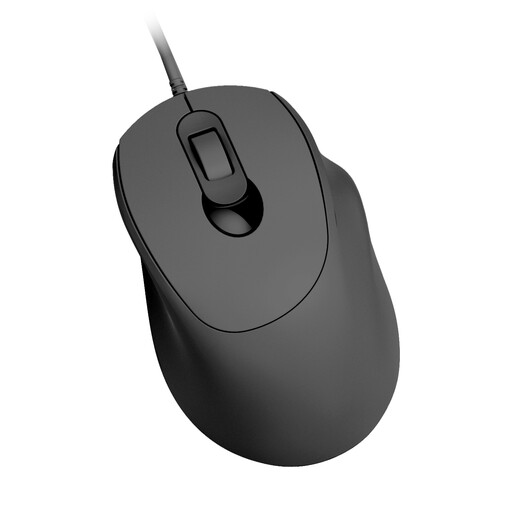
Consider this wired option if you have a suitable USB port and prefer not to manage a wireless connection. Its product name specifies four buttons, silent clicks and 1000/1200/1600 DPI settings; check the wheel and hand fit for longer editing sessions.
No: choose a vertical mouse if you prefer its more upright grip and the particular model fits your hand. Logitech positions Lift for small-to-medium hands and offers a left-handed version; if familiar pointer control and controllable fast scrolling matter more, compare conventional mice too.
Keep the mouse within comfortable reach and in line with your elbow, as the Health and Safety Executive advises. Check the desk, chair and screen arrangement alongside the mouse rather than judging the mouse shape in isolation.
Choose according to the exact mouse and the connections your computer offers: Bluetooth can leave a USB port free, while a receiver needs a compatible port. Logitech describes both as wireless connection methods, but individual models can have different Bluetooth and software requirements.
Where UK display-screen equipment requirements apply and a workstation assessment indicates that equipment must be provided, the Health and Safety Executive says workers cannot be charged for it. Its home-working guidance identifies display-screen equipment users as workers who use it daily for continuous periods of an hour or more; discuss the applicable assessment with your employer rather than assuming every home-office purchase is covered.