Transcript navigators
If you repeatedly scroll, select and revise passages while comparing a transcript with notes on another screen, wheel control and a few reachable shortcuts deserve attention.


Choose a productivity mouse with controllable scrolling and reachable customisable buttons if moving through transcripts and repeating edit commands are your priorities. If hand position or reaching to the side matters more, consider a vertical or centred design after checking fit and desk layout. Two screens alone do not call for a specialist mouse.
If you repeatedly scroll, select and revise passages while comparing a transcript with notes on another screen, wheel control and a few reachable shortcuts deserve attention.
If you repeat the same application commands throughout an edit, configurable mouse buttons may be useful—provided the controls are easy to reach and the software works with your computer.
If hand position or reaching for the mouse is your main concern during extended desk work, assess its shape and placement together. The Health and Safety Executive advises keeping the mouse within easy reach and using it with a straight wrist.
For transcript work, start with how you move through text and which commands you repeat. Then consider hand fit and desk position; connection features matter most when you switch between computers, not merely between screens.
| Concern | What to check | Who this matters to |
|---|---|---|
| Transcript navigation | Look for scrolling that lets you travel through a long document and stop at a precise passage. Check side scrolling only if you use wide timelines or notes. | When I move repeatedly between distant passages and close edits, I want to reach the right line without overshooting it. Around 36% of consumers would put navigation first. |
| Long-session comfort | Check hand fit, handedness and button reach; keep the mouse close enough to use without stretching. | If reaching sideways or holding the mouse becomes my main concern, its shape and position matter more to me than extra controls. Roughly 29% of consumers would prioritise comfort. |
| Editing shortcuts | Check whether useful buttons are reachable and whether customisation software supports your operating system. | When I use the same edit commands throughout a transcript, I want a few of them at my fingertips. Around 21% of consumers would make shortcut access their primary concern. |
| Connections and noise | Check connection methods and device-switching controls for the exact model; consider its click behaviour if you work in a shared or quiet room. | If I switch between separate computers or need quieter clicks near other people, those details can govern my choice. About 14% of consumers would place connections or noise first. |
A high maximum pointer-sensitivity setting does not tell you how easily you can stop at a line in a long transcript or reach a repeated command.
Check cursor movement across both screens, then assess the wheel and button positions against the actions you perform most often.
A vertical or centred device still needs a workable position. The Health and Safety Executive advises placing the mouse within easy reach and using it with a straight wrist.
Assess mouse reach and forearm support alongside the device. For work-related display screen use, ask about a workstation assessment where applicable.
Extra controls are less useful if their software does not work with your computer or the buttons are awkward to reach.
Check operating-system and customisation support before purchase, and decide which frequently used commands you would actually assign.
Two displays connected to one computer do not, by themselves, call for multi-device switching.
Check whether you need to move the mouse between separate computers or tablets before making device pairing a priority.
Its MX Master productivity range and Lift vertical mouse illustrate different approaches to transcript editing.
The Basilisk V3 is an option to examine if numerous physical shortcuts are central to your workflow.
The 685 Comfort and 920 Ergonomic Wireless Mouse offer different office-mouse layouts to compare.
These mice cover conventional productivity controls, vertical designs and a gaming-oriented option for editors considering configurable commands. Choose by the task that matters most to you, then check the exact model’s fit and software support.
 No image available
Consider this productivity-mouse format if scrolling through transcripts and assigning a small set of editing shortcuts are your priorities.
Check hand fit and Logi Options+ compatibility with your operating system before relying on button customisation.
 No image available
This vertical model is worth considering if an upright hand position matters more to you than a conventional mouse shape.
The named variant includes a detachable wrist rest. Check hand fit and button reach; if you need device switching, confirm how it works on the selected variant.
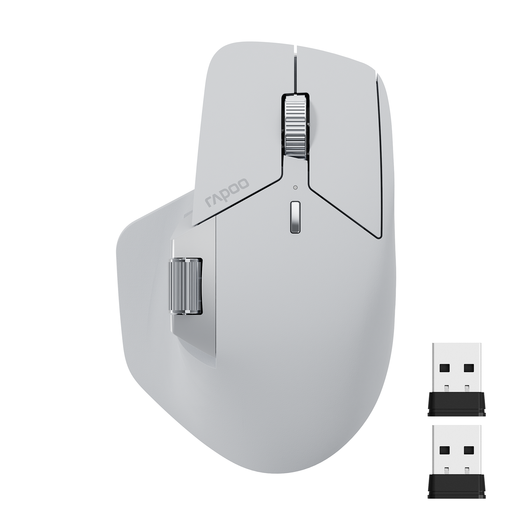 No image available
If you work with wide notes or repeat editing commands, check whether this model’s side-scrolling and button controls match those tasks.
Confirm the exact MT760L-LG shape before choosing it for hand position, and check software compatibility if you plan to customise buttons.
 No image available
Consider the vertical shape if you prefer an upright grip for transcript work, while checking that the mouse fits your hand and its buttons are reachable.
The named variant specifies Bluetooth and 2.4GHz dual-mode connection, six buttons and an adjustable 1600 DPI sensor. Check shortcut customisation and wheel behaviour if those govern your choice.
 No image available
This gaming-mouse format is relevant if you want to assess button mapping for repeated application commands, rather than selecting on pointer sensitivity alone.
The named variant specifies a PAW3311 sensor rated at 24000 DPI and BT/2.4G/USB-C connection modes. Check driver compatibility, button reach and wheel behaviour for your editing setup.
No: choose the mouse for what you do across the screens, such as moving through long transcripts or repeating edit commands. Check pointer settings and operating-system support if you intend to customise its controls.
It is worth considering when an upright hand position is a priority, provided the mouse fits your hand and desk layout. Logitech describes Lift as a 57° vertical mouse for small to medium hands; that specification does not establish how another model, or any particular person’s hand, will fit.
Keep it within easy reach and aim to use it with a straight wrist. The Health and Safety Executive also advises sitting close to the desk and supporting the forearm; mouse choice should be considered alongside the workstation arrangement.
Yes, if the exact model supports the connections and switching method you need. HP’s UK listing says its 920 Ergonomic Wireless Mouse connects to three devices; confirm the selected variant’s connection methods and controls before buying.
Health and Safety Executive guidance calls for assessing the workstation rather than prescribing a particular mouse model. It says employers must assess workstations for workers who use display screen equipment daily as part of normal work, continuously for an hour or more; the assessment should address the workstation and the work being done.