Budget-conscious brunch households
You are feeding several people or want leftovers for later in the week, so pack size and comparable product information matter more than a premium recipe.


For a larger Sunday-brunch pack, Alpen No Added Sugar Muesli 950g is the clearer choice when lower declared sugars matter: Alpen’s official nutrition panels list 18g per 100g, compared with 21g per 100g for Alpen Original. Choose Alpen Original if you prefer its standard fruit-and-nut recipe, but check the exact pack carefully when guests need to avoid wheat, oats, milk or nuts.
You are feeding several people or want leftovers for later in the week, so pack size and comparable product information matter more than a premium recipe.
You want to compare the nutrition panel rather than rely on a front-of-pack name. Alpen’s official panels declare 18g sugars per 100g for No Added Sugar and 21g per 100g for Original.
You need to check the exact current pack for wheat, oats, milk, nuts and possible cross-contact statements before putting muesli out for brunch.
Choose it when: You want a 950g pack and prefer the lower declared sugar figure of the two Alpen recipes.
Keep in mind: It still declares 18g sugars per 100g and contains wheat, oats, milk and nuts.
Choose it when: You prefer Alpen’s standard fruit-and-nut recipe in a 950g format.
Keep in mind: Its declared sugars are 21g per 100g, and the recipe also contains wheat, oats, milk and nuts.
| Priority | What to check | Your needs |
|---|---|---|
| Pack size | Compare pack weights among like-for-like muesli and check that the pack will suit your household’s storage and serving plans. | A larger pack makes sense when I am serving several people or expect to use the muesli again during the week. |
| Sugars | Compare sugars per 100g on the exact nutrition panels. Alpen No Added Sugar declares 18g per 100g, while Alpen Original declares 21g per 100g. | I want to see the declared sugar figure clearly rather than assume that a no-added-sugar name means no sugars are present. |
| Allergens | Read the ingredients and allergen statement for wheat, oats, milk, nuts and any may-contain wording. Look for an explicit gluten-free claim where that is required. | Before serving guests, I need a pack that fits their actual dietary requirements rather than one that only appears suitable. |
| Recipe style | Check whether the mix contains the fruit, toasted flakes, seeds or nuts you want. Dorset Cereals describes Tasty Toasted as a fruit, nut and seed muesli, while Gloriously Nutty has a more nut-focused mix. | I want the bowl to match the textures my household and guests enjoy, while still being appropriate for everyone at the table. |
Fruit-containing muesli can still contain sugars. Alpen No Added Sugar declares 18g sugars per 100g, so the product name does not remove the need to compare the nutrition panel.
Compare sugars per 100g across the exact packs you are considering, then decide which recipe suits your household’s preferences and dietary needs.
Muesli can contain wheat, oats, barley, milk and nuts, alongside may-contain statements. Gluten-free and oat-allergy requirements are not interchangeable.
Ask about dietary needs before serving, then read the current ingredient and allergen panel on the exact pack. For a gluten-free requirement, look for a verified gluten-free claim rather than inferring suitability from oats.
A mainstream large-pack muesli reference for this topic, with Original and No Added Sugar recipes available in 950g formats.
A useful own-label pack-size reference, as Tesco Groceries has listed Swiss Style and Swiss Style No Added Sugar muesli in 1kg formats alongside several 750g options.
A mainstream alternative, with Jordans Natural Muesli appearing in a 1kg format in Tesco Groceries’ muesli category.
A recipe-led option for shoppers prioritising toasted flakes, fruit, nuts or seeds over the largest pack format.
A broad-ingredient muesli option for shoppers who prioritise an organic, plant-based recipe style.
A specialist cereal brand for shoppers interested in muesli alongside high-protein, digestive-health and low-sugar product positions.
Joybuy product options for a larger-pack Sunday brunch, centred on two Alpen 950g muesli recipes with different declared sugar figures and the same key allergen considerations.
 No image available
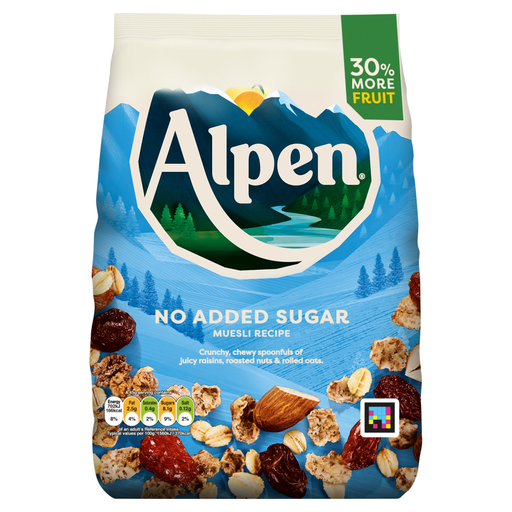
A 950g muesli option for a shared brunch where a lower declared sugar figure than Alpen Original is a priority.
Declares 18g sugars and 8.0g fibre per 100g. The recipe includes wholegrain wheat and oats, raisins, roasted almonds and hazelnuts.
Contains wheat, oats, milk, almonds and hazelnuts, and may contain other nuts. It is not a default choice for guests avoiding these allergens or requiring gluten-free food.
 No image available
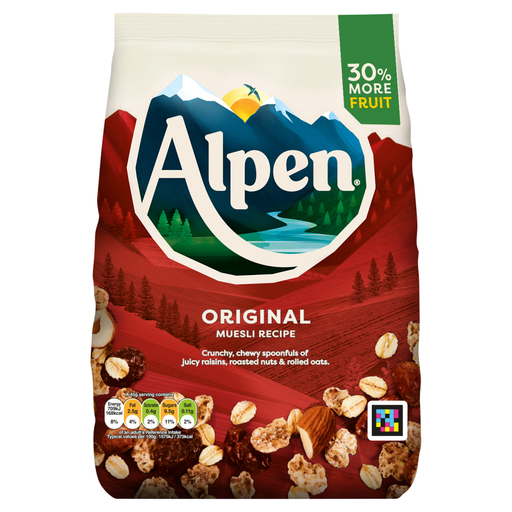
A 950g option for brunches where the standard Alpen fruit-and-nut recipe is preferred.
Declares 21g sugars per 100g and includes wholegrain wheat and oats, raisins, almonds and hazelnuts.
Contains wheat, oats, milk, almonds and hazelnuts, and may contain other nuts. Compare its declared sugars with Alpen No Added Sugar if that difference matters to your household.
No. Alpen’s official nutrition panel declares 18g sugars per 100g and lists raisins among the ingredients. Compare the per-100g panel with alternatives rather than reading the product name as a sugar-free claim.
Do not assume that you can. Alpen Original and No Added Sugar contain wheat and oats, while the Dorset examples contain oat, wheat and/or barley ingredients. The Food Standards Agency states that food labelled gluten-free must contain no more than 20mg/kg gluten, so check the exact pack’s current gluten-free claim and allergen statement before serving.
Choose Alpen No Added Sugar if the lower declared sugar figure is important: its official panel lists 18g per 100g, compared with 21g per 100g for Alpen Original. Choose Original if you prefer its standard recipe, provided its ingredient and allergen declaration suits everyone being served.
A per-100g comparison puts nutrition values on the same basis when serving sizes differ between products. It makes it easier to compare items such as sugars, fibre and salt across the exact muesli packs you are considering.