
24/7 Customer Support

Free returns

Same-day & Next-day Delivery

Quality Guaranteed

Unlock Your Welcome Offers: FREE Delivery | Up to 80% OFF | Free 30-day JoyPlus trial
Download the APP
Multi-angle mitre shears can make short work of trim, PVC strips, rubber seals and cable ducting, but choosing the wrong pair may lead to crushed edges, inaccurate joints or a tool that is uncomfortable after a few cuts. For UK DIY enthusiasts, installers, carpenters and maintenance workers, the important question is not simply whether a product is described as “multi-functional”. It is whether the cutter matches the material, angle range and cutting capacity required for the job.
A product may offer a wide adjustment range, but that does not mean it can cut every profile at every angle. Some adjustable angle shears are designed for narrow trim, while extendable models can accommodate wider sections.
Check both the stated angle range and the maximum material size. A 45 to 135 degree angle cutter may suit a broad range of mitre joints, but a large moulding or cable duct may still exceed the opening of a standard tool.
Mitre shears are generally intended for soft wood, plastic, PVC, rubber seals, vinyl, moulding and similar materials. They are not a substitute for metal snips, a saw or heavy-duty shears designed for hardwood.
Using a trim cutter on metal, hardwood or material beyond its rated capacity can damage the blade and create an uneven or unsafe cut. Product descriptions should clearly identify suitable materials rather than relying on vague phrases such as “cuts everything”.
A low purchase price can become less attractive if replacement blades are unavailable or if the handle causes hand strain. Look for replaceable SK5 blades, a secure grip and a safety lock for storage.
A non-slip coating can help maintain control, particularly when making repeated cuts during flooring, skirting-board or cable-management work. However, comfort features do not increase the tool’s material capacity, so both factors need to be considered separately.
For repeatable joints, choose shears with a clearly marked scale and a slider or stop that stays in position. Common angles include 45°, 60°, 75°, 90°, 105° and 120°, while some models extend to 135°.
A built-in stop can be useful when cutting multiple pieces of trim to the same angle. Before starting a visible installation, make a test cut on a spare piece and confirm that the resulting joint matches the required angle.
SK5 steel is commonly used for cutting blades because it is intended for sharp, durable edges. Product descriptions may specify SK5 steel or SK5 stainless steel; either way, the blade should be kept clean and dry and inspected regularly.
Replacement blades are particularly useful for tradespeople and frequent DIY users. A dull blade may require more hand pressure and can crush PVC or leave a ragged edge on rubber gasket material. Always check whether spare blades are included and whether replacements are listed for the model.
A PVC cutter or cable duct cutter should state the materials it is designed to handle. Soft wood, pine, plastic, vinyl, rubber weatherstripping and PVC are typical examples. Some products also specify a maximum cutting diameter, such as 6.8 cm.
Do not interpret this measurement as a universal guarantee for every shape. A wide, flat profile may behave differently from a round tube of the same nominal size. For professional installation, compare the tool’s opening with the actual width and thickness of the material.
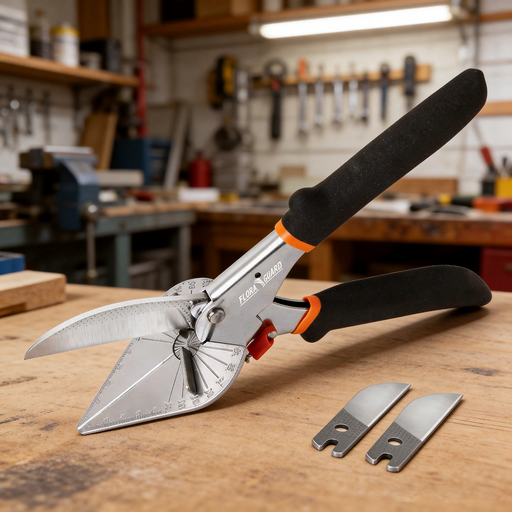
Why This Fits Their Persona: A practical option for occasional home projects such as cutting skirting trim, PVC strips, rubber seals and soft wood sections.
It specifies a 45° to 135° cutting range, an engraved scale, an adjustable slider and two replacement blades rather than relying only on general-purpose marketing language.
SK5 steel blades, an aluminium alloy handle with non-slip PPC cover, rotating safety lock and two spare blades.
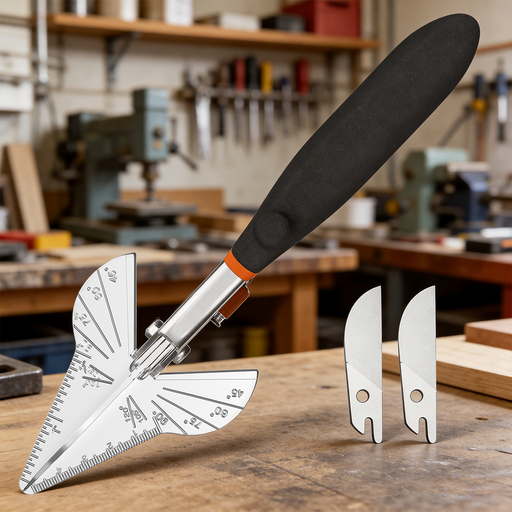
Why This Fits Their Persona: Suitable for users who value a steel-handled tool for recurring trim, vinyl, pine, PVC and cable duct projects around the home or on installations.
The product information identifies the blade and handle materials, lists marked cutting positions and states the intended soft-material applications.
Hardened SK5 stainless steel blade, steel handle with non-slip PVC coating and two replacement blades.
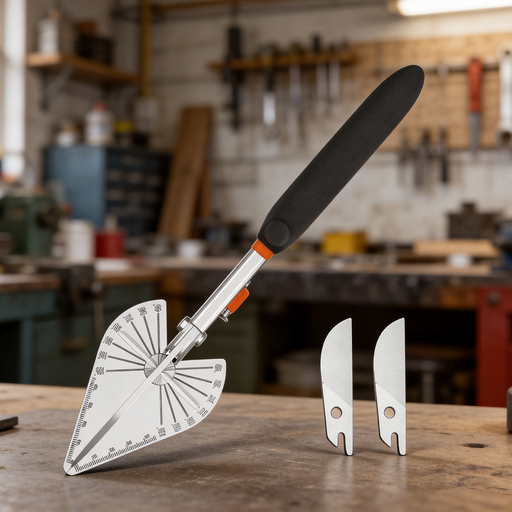
Why This Fits Their Persona: Designed for larger trim, rounded profiles, weatherstripping and cable duct work where a standard mitre shears cutter may have limited clearance.
Its stated maximum cutting diameter is 6.8 cm, helping buyers compare capacity more realistically than choosing based on the angle range alone.
Extendable design, 45° to 135° adjustment, SK5 stainless steel blade, aluminium alloy handle and rotating safety lock.
Keep fingers clear of the blade path and wear suitable gloves and eye protection when cutting. These are sharp hand tools, so the safety lock should be engaged whenever the shears are not in use. Keep them away from children and avoid using them on materials outside the stated specification.
Wipe the blade after use, store it in a dry place and inspect it for chips or damage. Replace a dull or damaged blade rather than increasing hand pressure. For models with a pivot point, occasional lubrication may help maintain smooth movement, subject to the product instructions.
We have compiled a complete, real-time list of products that fully satisfy these strict selection criteria and UK safety regulations.
They can be suitable for PVC trunking when the profile is within the tool’s stated capacity. Check the product description for PVC or cable duct compatibility, measure the trunking and make a test cut before installation.
Blade life depends on the material, thickness, cutting frequency and storage conditions. Cutting soft PVC and rubber within the stated capacity should place less strain on the blade than cutting unsuitable hard materials. Replace the blade when cuts become ragged or require excessive pressure.
No. These are manual hand tools, so they do not require batteries, charging or mains electricity. The main ongoing cost is occasional replacement blades, along with basic cleaning and maintenance.